Question: Please answer my question properly and not from internet, this book is so confusing i wanna konw ur own though:) The book Ghost Map by
Please answer my question properly and not from internet, this book is so confusing i wanna konw ur own though:)
The book Ghost Map by Steven Johnson. The questions are meant to inspire critical thinking skills while also demonstrating your knowledge of the subject and what you read. You will need to justify your answers and you may use other sources to do so. Please respond to the following prompt:
- Henry whitehead, John Snow, William Farr, and Edwin chadwick all played a pivotal role in the eventual end of this epidemic. Discuss what you believe the contribution of each were and if thier views were at odds with one another. compare and contrast their views and describe how this may have impacted the course of the epidemic.
This should be 500 words......
Here are some few page of the book.
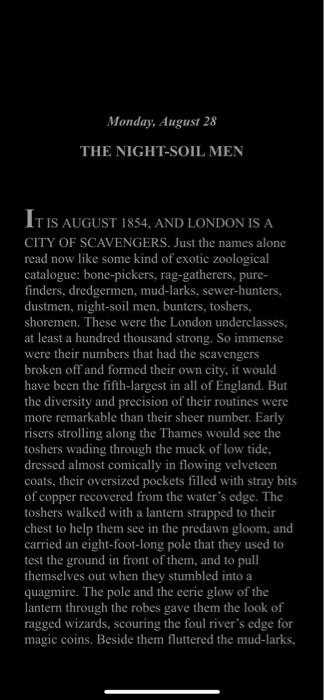
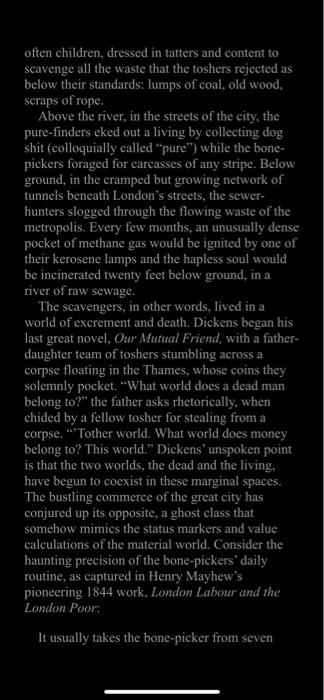
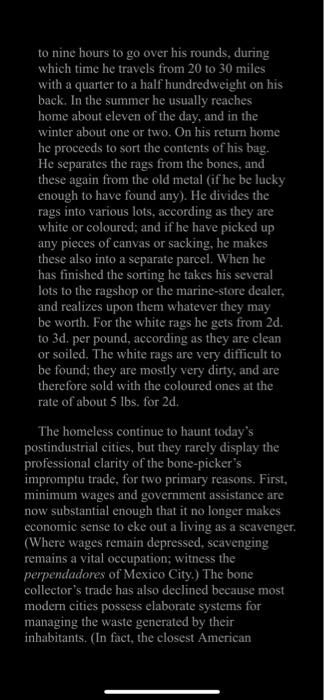
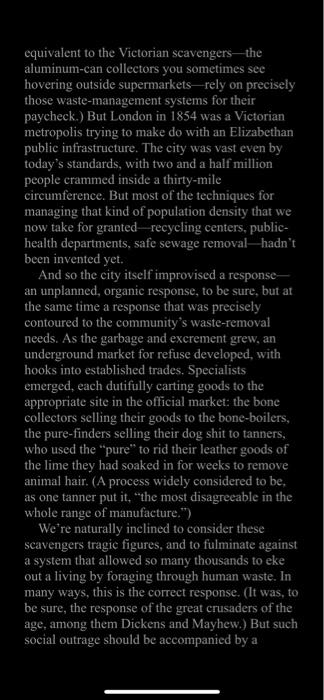
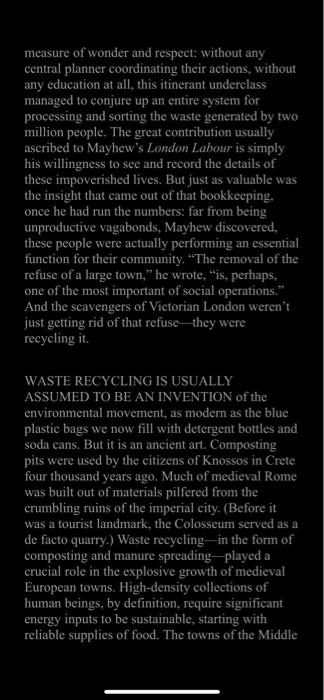
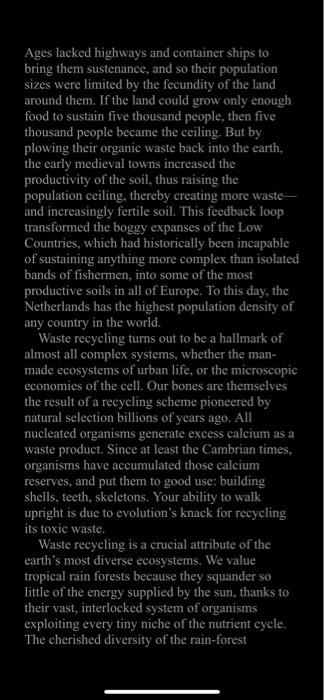
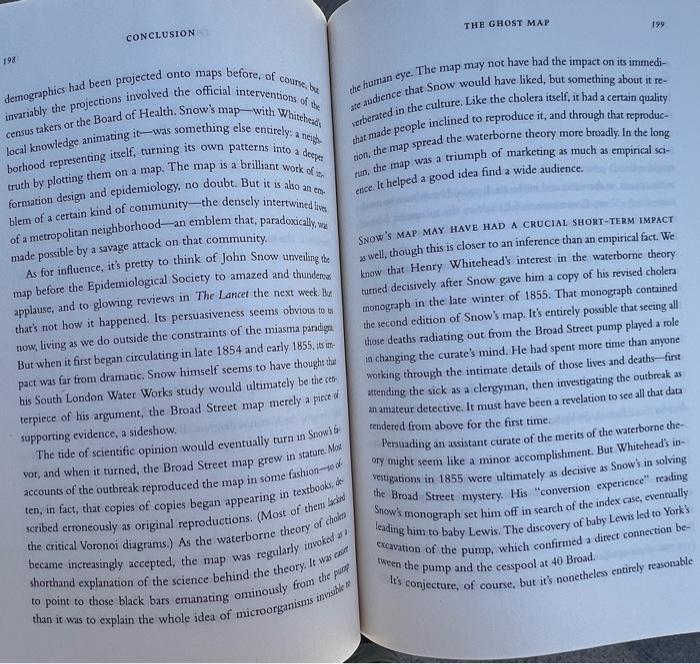
Monday, August 28 THE NIGHT-SOIL MEN IT IS AUGUST 1854, AND LONDON IS A CITY OF SCAVENGERS. Just the names alone read now like some kind of exotic zoological catalogue: bone-pickers, rag-gatherers, purefinders, dredgermen, mud-larks, sewer-hunters, dustmen, night-soil men, bunters, toshers, shoremen. These were the London underclasses, at least a hundred thousand strong. So immense were their numbers that had the scavengers broken off and formed their own city, it would have been the fifth-largest in all of England. But the diversity and precision of their routines were more remarkable than their sheer number. Early risers strolling along the Thames would see the toshers wading through the muck of low tide, dressed almost comically in flowing velveteen coats, their oversized pockets filled with stray bits of copper recovered from the water's edge. The toshers walked with a lantern strapped to their chest to help them see in the predawn gloom, and carried an eight-foot-long pole that they used to test the ground in front of them, and to pull themselves out when they stumbled into a quagmire. The pole and the eerie glow of the lantern through the robes gave them the look of ragged wizards, scouring the foul river's edge for magic coins. Beside them fluttered the mud-larks, often children, dressed in tatters and content to scavenge all the waste that the toshers rejected as below their standards: lumps of coal, old wood, scraps of rope. Above the river, in the streets of the city, the pure-finders eked out a living by collecting dog shit (colloquially called "pure") while the bonepickers foraged for carcasses of any stripe. Below ground, in the cramped but growing network of tunnels beneath London's streets, the sewerhunters slogged through the flowing waste of the metropolis. Every few months, an unusually dense pocket of methane gas would be ignited by one of their kerosene lamps and the hapless soul would be incinerated twenty feet below ground, in a river of raw sewage. The scavengers, in other words, lived in a world of excrement and death. Dickens began his last great novel, Our Mutual Friend, with a fatherdaughter team of toshers stumbling across a corpse floating in the Thames, whose coins they solemnly pocket. "What world does a dead man belong to?" the father asks rhetorically, when chided by a fellow tosher for stealing from a corpse. "'Tother world. What world does money belong to? This world." Dickens' unspoken point is that the two worlds, the dead and the living. have begun to coexist in these marginal spaces. The bustling commerce of the great city has conjured up its opposite, a ghost class that somehow mimics the status markers and value calculations of the material world. Consider the haunting precision of the bone-pickers' daily routine, as captured in Henry Mayhew's pioneering 1844 work, London Labour and the London Poor: It usually takes the bone-picker from seven to nine hours to go over his rounds, during which time he travels from 20 to 30 miles with a quarter to a half hundredweight on his back. In the summer he usually reaches home about eleven of the day, and in the winter about one or two. On his return home he proceeds to sort the contents of his bag. He separates the rags from the bones, and these again from the old metal (if he be lucky enough to have found any). He divides the rags into various lots, according as they are white or coloured; and if he have picked up any pieces of canvas or sacking, he makes these also into a separate parcel. When he has finished the sorting he takes his several lots to the ragshop or the marine-store dealer, and realizes upon them whatever they may be worth. For the white rags he gets from 2d. to 3d. per pound, according as they are clean or soiled. The white rags are very difficult to be found; they are mostly very dirty, and are therefore sold with the coloured ones at the rate of about 5lbs, for 2d. The homeless continue to haunt today's postindustrial cities, but they rarely display the professional clarity of the bone-picker's impromptu trade, for two primary reasons. First, minimum wages and government assistance are now substantial enough that it no longer makes economic sense to eke out a living as a scavenger. (Where wages remain depressed, scavenging remains a vital occupation; witness the perpendadores of Mexico City.) The bone collector's trade has also declined because most modern cities possess elaborate systems for managing the waste generated by their inhabitants. (In fact, the closest American equivalent to the Victorian scavengers - the aluminum-can collectors you sometimes see hovering outside supermarkets - rely on precisely those waste-management systems for their paycheck.) But London in 1854 was a Victorian metropolis trying to make do with an Elizabethan public infrastructure. The city was vast even by today's standards, with two and a half million people crammed inside a thirty-mile circumference. But most of the techniques for managing that kind of population density that we now take for granted-recycling centers, publichealth departments, safe sewage removal- hadn't been invented yet. And so the city itself improvised a responsean unplanned, organic response, to be sure, but at the same time a response that was precisely contoured to the community's waste-removal needs. As the garbage and excrement grew, an underground market for refuse developed, with hooks into established trades. Specialists emerged, each dutifully carting goods to the appropriate site in the official market: the bone collectors selling their goods to the bone-boilers, the pure-finders selling their dog shit to tanners, who used the "pure" to rid their leather goods of the lime they had soaked in for weeks to remove animal hair. (A process widely considered to be, as one tanner put it, "the most disagreeable in the whole range of manufacture.") We're naturally inclined to consider these scavengers tragic figures, and to fulminate against a system that allowed so many thousands to eke out a living by foraging through human waste. In many ways, this is the correct response. (It was, to be sure, the response of the great crusaders of the age, among them Dickens and Mayhew.) But such social outrage should be accompanied by a measure of wonder and respect: without any central planner coordinating their actions, without any education at all, this itinerant underclass managed to conjure up an entire system for processing and sorting the waste generated by two million people. The great contribution usually ascribed to Mayhew's London Labour is simply his willingness to see and record the details of these impoverished lives. But just as valuable was the insight that came out of that bookkeeping, once he had run the numbers: far from being unproductive vagabonds, Mayhew discovered, these people were actually performing an essential function for their community. "The removal of the refuse of a large town," he wrote, "is, perhaps, one of the most important of social operations." And the scavengers of Victorian London weren't just getting rid of that refuse-they were recycling it. WASTE RECYCLING IS USUALLY ASSUMED TO BE AN INVENTION of the environmental movement, as modern as the blue plastic bags we now fill with detergent bottles and soda cans. But it is an ancient art. Composting pits were used by the citizens of Knossos in Crete four thousand years ago. Much of medieval Rome was built out of materials pilfered from the crumbling ruins of the imperial city. (Before it was a tourist landmark, the Colosseum served as a de facto quarry.) Waste recycling - in the form of composting and manure spreading-played a crucial role in the explosive growth of medieval European towns. High-density collections of human beings, by definition, require significant energy inputs to be sustainable, starting with reliable supplies of food. The towns of the Middle Ages lacked highways and container ships to bring them sustenance, and so their population sizes were limited by the fecundity of the land around them. If the land could grow only enough food to sustain five thousand people, then five thousand people became the ceiling. But by plowing their organic waste back into the earth, the early medieval towns increased the productivity of the soil, thus raising the population ceiling, thereby creating more wasteand increasingly fertile soil. This feedback loop transformed the boggy expanses of the Low Countries, which had historically been incapable of sustaining anything more complex than isolated bands of fishermen, into some of the most productive soils in all of Europe. To this day, the Netherlands has the highest population density of any country in the world. Waste recycling turns out to be a hallmark of almost all complex systems, whether the manmade ecosystems of urban life, or the microscopic economies of the cell. Our bones are themselves the result of a recycling scheme pioneered by natural selection billions of years ago. All nucleated organisms generate excess calcium as a waste product. Since at least the Cambrian times, organisms have accumulated those calcium reserves, and put them to good use; building shells, teeth, skeletons. Your ability to walk upright is due to evolution's knack for recycling its toxic waste. Waste recycling is a crucial attribute of the earth's most diverse ecosystems. We value tropical rain forests because they squander so little of the energy supplied by the sun, thanks to their vast, interlocked system of organisms exploiting every tiny niche of the nutrient cycle. The cherished diversity of the rain-forest demographics had been projected onto maps before, of courge, bu the thuman eye. The map may not have had the impact on its immediof a metropolitan neighborhood-an emblem that, paradoxically, We _ SNOW'S MAP MAY HAVE HAD A CRUCIAL SHORT-TERM IMPACT made possible by a savage attack on that community. . As for influence, it's pretty to think of John Snow unveling tit map before the Epidemiological Society to amazed and thunderoo _know that Henry Whitehead's interest in the waterborne theory applause, and to glowing reviews in The Lancet the next week. Ble turned decisively after Snow gave him a copy of his revised cholera that's not how it happened. Its persuasiveness seems obvious to is the second edition of Snow's map. It's entirely possible that secing all now, living as we do outside the constraints of the miasma panadign- those deaths radiating out from the Broad Street pump played a role But when it first began circulating in late 1854 and early is changing the curate's mind. He had spent more time than anyone his South London Water Works study would ultimately be the cto- mending the sick as a clergyman, then investigating the outbreak as The tide of scientific opinion would eventually turn in Snowit. readered from above for the first time: Persuading an assistant curate of the merits of the waterborne thevor, and when it turned, the Broad Street map grew in stature Mos - ory might seem like a minor accomplishment. But Whitehead's inten, in fact, that copies of copies began appearing in textbookst . had the Broad Street mystery. His "converrion experience" reading the critical Voronoi diagrams.) As the waterborne theory of choks . leading him to baby Lewis. The discovery of baby Lewis led to York's became increasingly aceepted, the map was regalarly involed y1. excavation of the pump, which confirmed a direct connection beshorthand explanation of the science behind the theory. It was eper the the pump and the cesspool at 40 Broad. to point to those black bars emanating ominously from the fight in the conjecture, of course, but it's nonetheless entirely reasonable









 Study Help