







Question: Please answer No 7. Green energy field trip 1) Set-up the cart for turbine and equipment field trip 2) Mount turbine on a ring stand
Please answer No 7.
Green energy field trip
1) Set-up the cart for turbine and equipment field trip
2) Mount turbine on a ring stand
3) Run fan on turbine and use the multimeter to check voltage, note what voltage the LED light is activated. (think about what potential uses the LED line might have in terms of a complete charging (overcharge prevention) circuit).
4) Use a labquest 2 that is working well (responding to touch commands), hook a current meter up to the wind turbine.
5) Use jumper cables to wire wind turbines in series, measure the voltage and current, explain any changes.
6) Maximize current output with walking towards the lake. When maximized (note what configuration maximizes your data) set the graph acquisition for hours as the x-axis (set the data acquisition to 0.5 hr), current should be on the y-axis.
7) Collect data, take a picture of the raw data, then integrate (I'll demonstrate) and take another picture. Since your y-axis is current, if you assume a constant voltage, then P=VI (which is in Watts). So, the integral should be multiplied by the Voltage observed, and since your axis is currently in Watts, divide by 1000 to get kW. Since the area under the curve is equal to the product if the x (hrs) and y axes (P): You have kWh, which is what you are charged for. The answer from your integration is now in kWhs. Calculate the kWh expected for one good windy day from your data.
Reference:
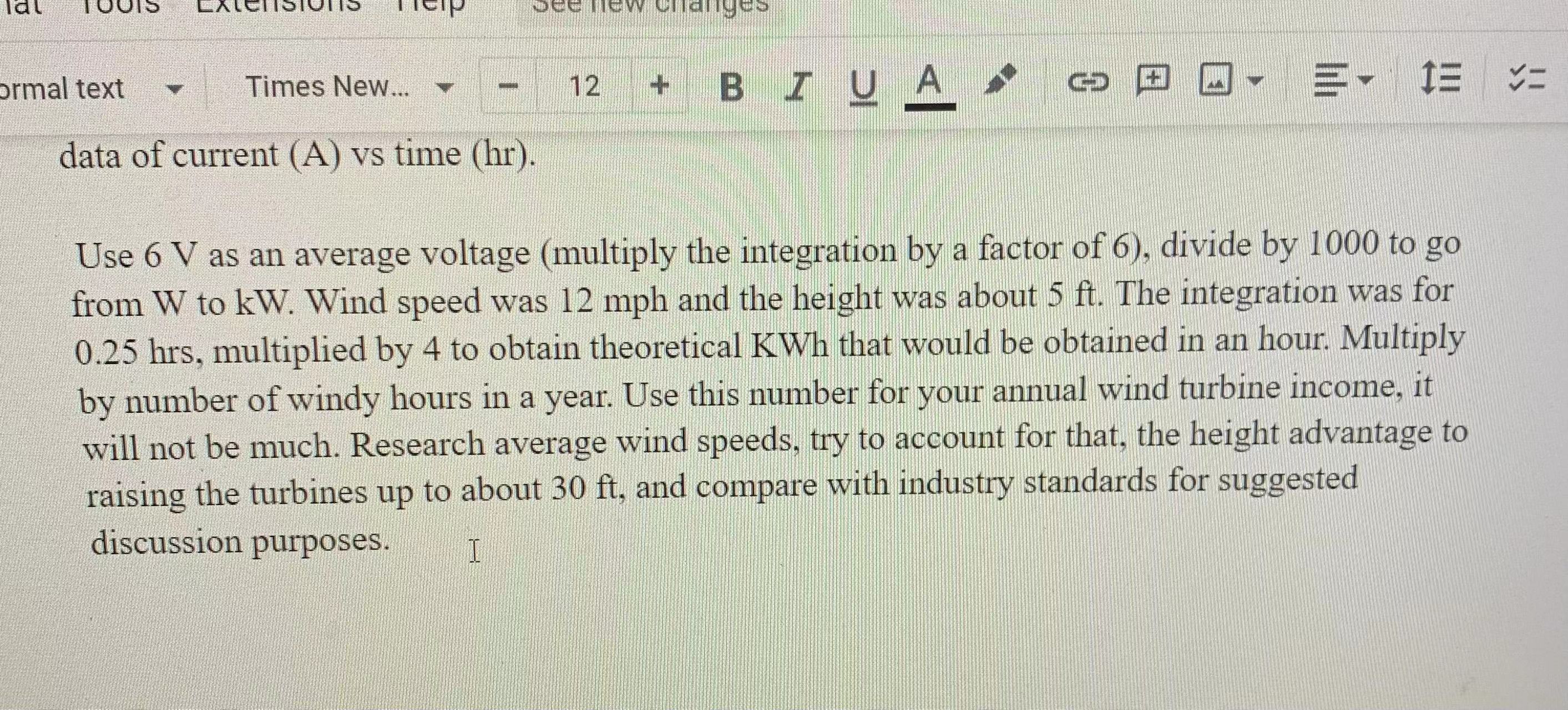
lal occ new Changes ormal text Times New.. 12 + B JUA data of current (A) vs time (hr). Use 6 V as an average voltage (multiply the integration by a factor of 6), divide by 1000 to go from W to kW. Wind speed was 12 mph and the height was about 5 ft. The integration was for 0.25 hrs, multiplied by 4 to obtain theoretical KWh that would be obtained in an hour. Multiply by number of windy hours in a year. Use this number for your annual wind turbine income, it will not be much. Research average wind speeds, try to account for that, the height advantage to raising the turbines up to about 30 ft, and compare with industry standards for suggested discussion purposes
Step by Step Solution
There are 3 Steps involved in it

Get step-by-step solutions from verified subject matter experts
 Study Help