







Question: PLEASE ANSWER NUMBER 6 Does Cheating in Golf Predict Cheating in Business? D avid Callahan published an influential juxtaposes one's personal ethics in specific spheres
PLEASE ANSWER NUMBER 6
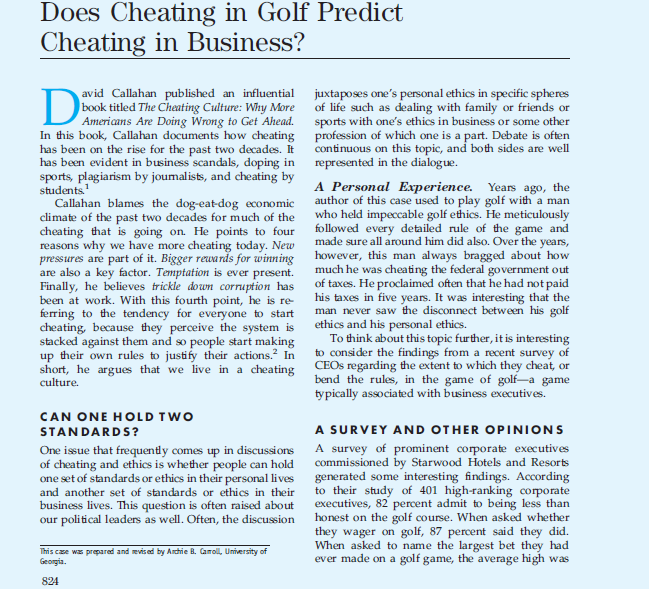
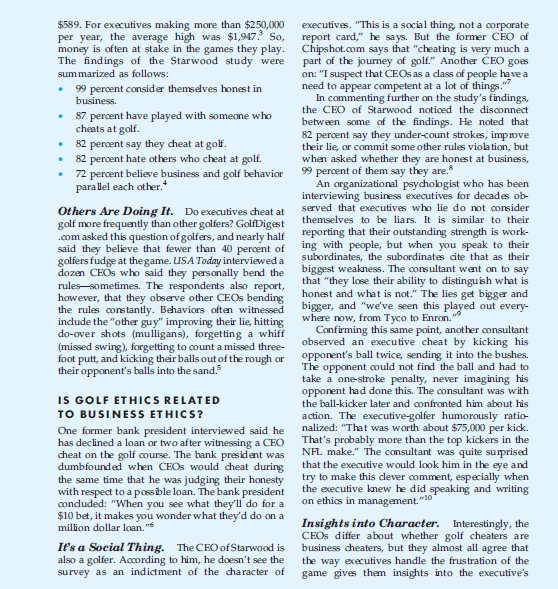
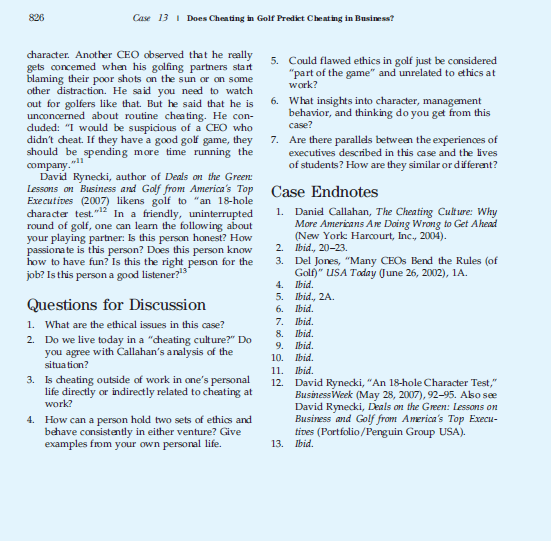
Does Cheating in Golf Predict Cheating in Business? D avid Callahan published an influential juxtaposes one's personal ethics in specific spheres book titled The Cheating Culture: Why More of life such as dealing with family or friends or Americans Are Doing Wrong to Get Ahead. sports with one's ethics in business or some other In this book, Callahan documents how cheating profession of which one is a part. Debate is often a has been on the rise for the past two decades. It continuous on this topic, and both sides are well has been evident in business scandals, doping in represented in the dialogue. sports, plagiarism by joumalists, and cheating by students? A Personal Experience. Years ago, the Callahan blames the dog-eat-dog economic author of this case used to play golf with a man climate of the past two decades for much of the who held impeccable golf ethics. He meticulously cheating that is going on. He points to four followed every detailed rule of the game and reasons why we have more cheating today. New made sure all around him did also. Over the years, pressures are part of it. Bigger rewards for winning however, this man always bragged about how are also a key factor. Temptation is ever present. much he was cheating the federal government out Finally, he believes trickle down corruption has of taxes. He proclaimed often that he had not paid been at work. With this fourth point, he is re- his taxes in five years. It was interesting that the ferring to the tendency for everyone to start man never saw the disconnect between his golf cheating, because they perceive the system is ethics and his personal ethics. stacked against them and so people start making To think about this topic further, it is interesting up their own rules to justify their actions. In to consider the findings from a recent survey of short, he argues that we live in a cheating CEOs regarding the extent to which they cheat, or culture. bend the rules, in the game of golfa game typically associated with business executives. CAN ONE HOLD TWO STANDARDS? A SURVEY AND OTHER OPINIONS One issue that frequently comes up in discussions A survey of prominent corporate executives of cheating and ethics is whether people can hold commissioned by Starwood Hotels and Resorts one set of standards or ethics in their personal lives generated some interesting findings. According and another set of standards or ethics in their to their study of 401 high-ranking corporate business lives. This question is often raised about executives, 82 percent admit to being less than our political leaders as well. Often, the discussion honest on the golf course. When asked whether they wager on golf, 87 percent said they did. This cze w prepared and revised by Archie B. Gamol, University of When asked to name the largest bet they had Georgia. ever made on a golf game, the average high was 824 $589. For executives making more than $250,000 executives. "This is a social thing, not a corporate per year, the average high was $1,947. So, report card," he says. But the former CEO of money is often at stake in the games they play. Chipshot.com says that "cheating is very much a The findings of the Starwood study were part of the journey of golt." Another CEO goes summarized as follows: on: "I suspect that CEOs as a class of people have a 99 percent consider themselves honest in need to appear competent at a lot of things." business. In commenting further on the study's findings, the CEO of Starwood noticed the disconnect 87 percent have played with someone who cheats at golf. between some of the findings. He noted that 82 percent say they under-count strokes, improve 82 percent say they cheat at golf their lie, or commit some other rules violation, but 82 percent hate others who cheat at golf. when asked whether they are honest at business, 72 percent believe business and golf behavior 99 percent of them say they are paralel each other. An organizational psychologist who has been interviewing business executives for decades ob- Others Are Doing It. Do executives cheat at served that executives who lie do not consider golf more frequently than other golfers? GolfDigest themselves to be liars. It is similar to their .com asked this question of golfers, and nearly half reporting that their outstanding strength is work- said they believe that fewer than 40 percent of ing with people, but when you speak to their golfers fudge at the game. USA Today interviewed a subordinates, the subordinates cite that as their dozen CEOs who said they personally bend the biggest weakness. The consultant went on to say rulessometimes. The respondents also report, that "they lose their ability to distinguish what is however, that they observe other CEOs bending honest and what is not." The lies get bigger and the rules constantly. Behaviors often witnessed bigger, and "we've seen this played out every include the "other guy" improving their lie hitting where now, from Tyco to Enron." do-over shots (mulligans), forgetting a whiff Confirming this same point, another consultant (missed swing), forgetting to count a missed three- observed an executive cheat by kicking his foot putt, and kicking their balls out of the rough or opponent's ball twice, sending it into the bushes. their opponent's balls into the sand The opponent could not find the ball and had to take a one stroke penalty, never imagining his opponent had done this. The consultant was with IS GOLF ETHICS RELATED the ball-kicker later and confronted him about his TO BUSINESS ETHICS? action. The executive-golfer humorously ratio- One former bank president interviewed said he nalized: "That was worth about $75,000 per kick. has declined a loan or two after witnessing a CEO That's probably more than the top kickers in the cheat on the golf course. The bank president was NFL make." The consultant was quite surprised dumbfounded when CEOs would cheat during that the executive would look him in the eye and the same time that he was judging their honesty try to make this dever comment, especially when with respect to a possible loan. The bank president the executive lanew he did speaking and writing conduded: "When you see what they'll do for a on ethics in management."10 $10 bet, it makes you wonder what they'd do on a million dollar loan." Insights into Character. Interestingly, the CEOs differ about whether golf cheaters are It's a Social Thing. The CEO of Starwood is business cheaters, but they almost all agree that also a golfer. According to him, he doesn't see the the way executives handle the frustration of the survey as an indictment of the character of game gives them insights into the executive's 826 Case 13 I Does Cheating in Golf Predict Cheating in Business? company. 11 character. Another CEO observed that he really gets concemed when his golfing partners start blaming their poor shots on the sun or on some other distraction. He said you need to watch out for golfers like that. But he said that he is unconcerned about routine cheating. He con- cluded: "I would be suspicious of a CEO who didn't cheat. If they have a good golf game, they should be spending more time running the David Rynecki, author of Deals on the Green: Lessons on Business and Golf from America's Top Executives (2007) likens golf to "an 18-hole character test."12 In a friendly, uninterrupted round of golf, one can learn the following about your playing partner: Is this person honest? How passionate is this person? Does this person know how to have fun? Is this the right person for the job? Is this person a good listener?13 Questions for Discussion 1. What are the ethical issues in this case? 2. Do we live today in a "cheating culture?" Do you agree with Callahan's analysis of the situation? 3. Is cheating outside of work in one's personal life directly or indirectly related to cheating at work? 4. How can a person hold two sets of ethics and behave consistently in either venture? Give examples from your own personal life. 5. Could flawed ethics in golf just be considered "part of the game" and unrelated to ethics at work? 6. What insights into character, management behavior, and thinking do you get from this case? 7. Are there parallels between the experiences of executives described in this case and the lives of students? How are they similar or different? Case Endnotes 1. Daniel Callahan, The Cheating Culture: Why More Americans Are Doing wrong to Get Ahead (New York Harcourt, Inc., 2004). 2. Ibid., 20-23 3. Del Jones, "Many CEOs Bend the Rules (of Golf)" USA Today (June 26, 2002), 1A. 4. ibid. 5. Ibid., 2A. 6. ibid. 7. Ibid. 8. ibid. Ibid. 10. Ibid. 11. lbid. 12. David Rynecki, "An 18-hole Character Test," Business Week (May 28, 2007), 9295. Ako se David Rynecki, Deals on the Green: Lessons on Business and Golf from America's Top Execu- tives (Portfolio/Penguin Group USA). 13. IbidStep by Step Solution
There are 3 Steps involved in it
1 Expert Approved Answer
Step: 1 Unlock

Question Has Been Solved by an Expert!
Get step-by-step solutions from verified subject matter experts
Step: 2 Unlock
Step: 3 Unlock
 Study Help