







Question: please answer only question D1 through D6. 14-15 OPTIMAL CAPITAL STRUCTURE Assume that you have just been hired as business manager of Campus Deli (CD),

please answer only question D1 through D6.
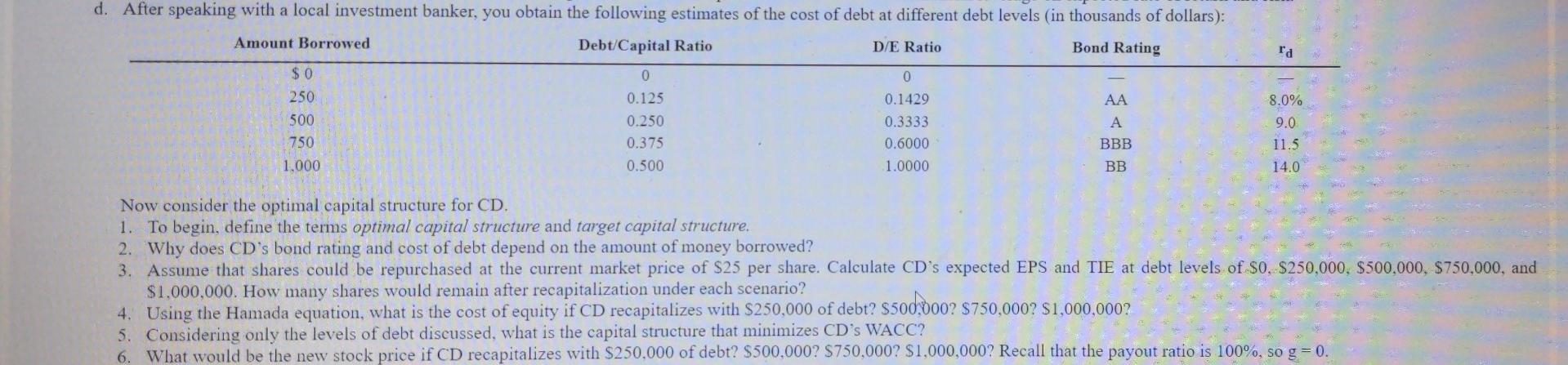
14-15 OPTIMAL CAPITAL STRUCTURE Assume that you have just been hired as business manager of Campus Deli (CD), which is located adjacent to the campus. Sales were $1,100,000 last year, variable costs were 60% of sales, and fixed costs were $40,000. Therefore, EBIT totaled $400,000. Because the university's enrollment is capped, EBIT is expected to be constant over time. Because no expansion capital is required, CD distributes all earnings as dividends. Invested capital is $2 million, and 80,000 shares are outstanding. The management group owns about 50% of the stock, which is traded in the over-the-counter market. CD currently has no debtit is an all-equity firmand its 80,000 shares outstanding sell at a price of $25 per share, which is also the book value. The firm's federal-plus-state tax rate is 25%. On the basis of statements made in your finance text, you believe that CD's shareholders would be better off if some debt financing were used. When you suggested this to your new boss, she encouraged you to pursue the idea but to provide support for the suggestion. Note that CD is a small firm, so it is exempt from the interest deduction limitation. In today's market, the risk-free rate, FRF, is 7.5%, and the market risk premium, RPM, is 6%. CD's unlevered beta, bu, is 1.25. CD currently has no debt, so its cost of equity (and WACC) is 15%. If the firm was recapitalized, debt would be issued, and the borrowed funds would be used to repurchase stock. Stockholders, in turn, would use funds provided by the repurchase to buy equities in other fast-food companies similar to CD. You plan to complete your report by asking and then answering the following questions. d. After speaking with a local investment banker, you obtain the following estimates of the cost of debt at different debt levels in thousands of dollars): Amount Borrowed Debt/Capital Ratio D/E Ratio Bond Rating I'd 0 0 $0 250 AA 500 750 0.125 0.250 0.375 0.500 0.1429 0.3333 0.6000 1.0000 A BBB BB 8.0% 9.0 11.5 14.0 1.000 Now consider the optimal capital structure for CD. 1. To begin, define the terms optimal capital structure and target capital structure. 2. Why does CD's bond rating and cost of debt depend on the amount of money borrowed? 3. Assume that shares could be repurchased at the current market price of $25 per share. Calculate CD's expected EPS and TIE at debt levels of $0, $250,000, $500,000, $750,000, and $1,000,000. How many shares would remain after recapitalization under each scenario? 4. Using the Hamada equation, what is the cost of equity if CD recapitalizes with $250,000 of debt? $500,000 $750,000? S1,000,000? 5. Considering only the levels of debt discussed, what is the capital structure that minimizes CD's WACC? 6. What would be the new stock price if CD recapitalizes with $250,000 of debt? $500,000? $750,000 $1,000,000? Recall that the payout ratio is 100%, so g = 0. 14-15 OPTIMAL CAPITAL STRUCTURE Assume that you have just been hired as business manager of Campus Deli (CD), which is located adjacent to the campus. Sales were $1,100,000 last year, variable costs were 60% of sales, and fixed costs were $40,000. Therefore, EBIT totaled $400,000. Because the university's enrollment is capped, EBIT is expected to be constant over time. Because no expansion capital is required, CD distributes all earnings as dividends. Invested capital is $2 million, and 80,000 shares are outstanding. The management group owns about 50% of the stock, which is traded in the over-the-counter market. CD currently has no debtit is an all-equity firmand its 80,000 shares outstanding sell at a price of $25 per share, which is also the book value. The firm's federal-plus-state tax rate is 25%. On the basis of statements made in your finance text, you believe that CD's shareholders would be better off if some debt financing were used. When you suggested this to your new boss, she encouraged you to pursue the idea but to provide support for the suggestion. Note that CD is a small firm, so it is exempt from the interest deduction limitation. In today's market, the risk-free rate, FRF, is 7.5%, and the market risk premium, RPM, is 6%. CD's unlevered beta, bu, is 1.25. CD currently has no debt, so its cost of equity (and WACC) is 15%. If the firm was recapitalized, debt would be issued, and the borrowed funds would be used to repurchase stock. Stockholders, in turn, would use funds provided by the repurchase to buy equities in other fast-food companies similar to CD. You plan to complete your report by asking and then answering the following questions. d. After speaking with a local investment banker, you obtain the following estimates of the cost of debt at different debt levels in thousands of dollars): Amount Borrowed Debt/Capital Ratio D/E Ratio Bond Rating I'd 0 0 $0 250 AA 500 750 0.125 0.250 0.375 0.500 0.1429 0.3333 0.6000 1.0000 A BBB BB 8.0% 9.0 11.5 14.0 1.000 Now consider the optimal capital structure for CD. 1. To begin, define the terms optimal capital structure and target capital structure. 2. Why does CD's bond rating and cost of debt depend on the amount of money borrowed? 3. Assume that shares could be repurchased at the current market price of $25 per share. Calculate CD's expected EPS and TIE at debt levels of $0, $250,000, $500,000, $750,000, and $1,000,000. How many shares would remain after recapitalization under each scenario? 4. Using the Hamada equation, what is the cost of equity if CD recapitalizes with $250,000 of debt? $500,000 $750,000? S1,000,000? 5. Considering only the levels of debt discussed, what is the capital structure that minimizes CD's WACC? 6. What would be the new stock price if CD recapitalizes with $250,000 of debt? $500,000? $750,000 $1,000,000? Recall that the payout ratio is 100%, so g = 0
Step by Step Solution
There are 3 Steps involved in it

Get step-by-step solutions from verified subject matter experts
 Study Help