







Question: please answer only #'s 2-5 since you can only answer 4 on chegg and incase you are wondering yes this has been answered before but
please answer only #'s 2-5 since you can only answer 4 on chegg and incase you are wondering yes this has been answered before but i want explanations for questions 2-6 more specific to this question, i wanted more explanation.
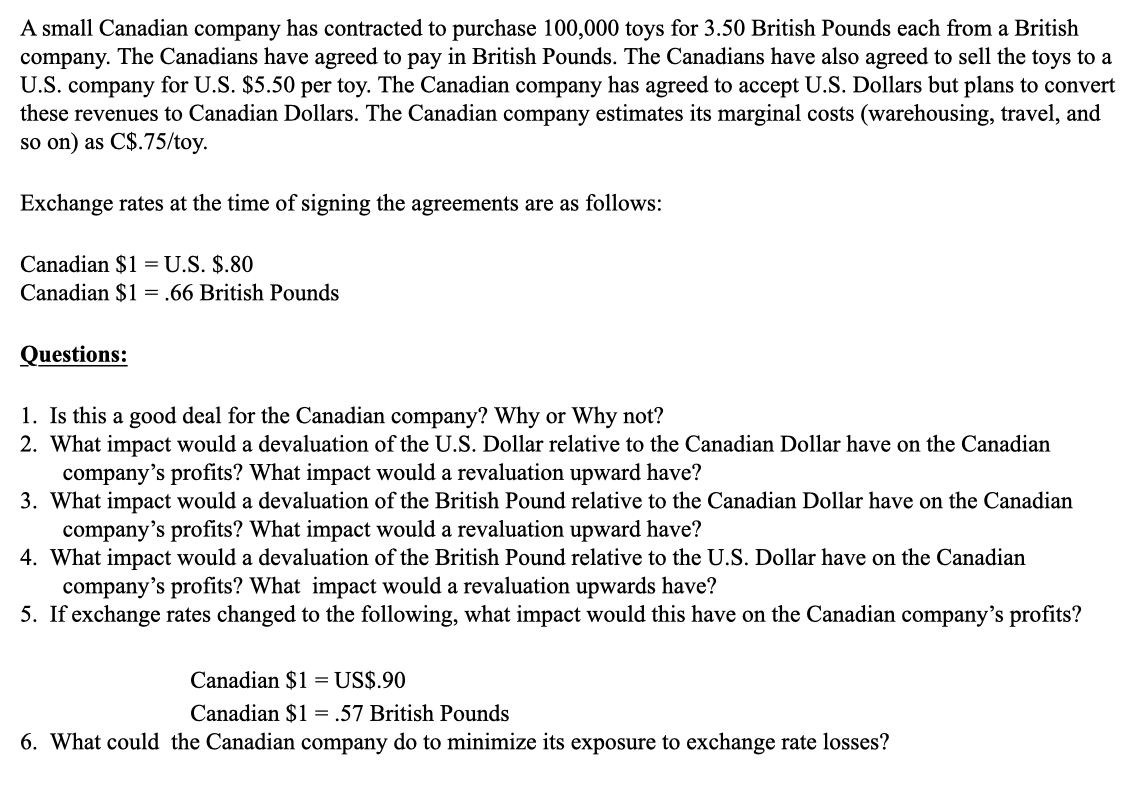
A small Canadian company has contracted to purchase 100,000 toys for 3.50 British Pounds each from a British company. The Canadians have agreed to pay in British Pounds. The Canadians have also agreed to sell the toys to a U.S. company for U.S. $5.50 per toy. The Canadian company has agreed to accept U.S. Dollars but plans to convert these revenues to Canadian Dollars. The Canadian company estimates its marginal costs (warehousing, travel, and so on) as C$.75/toy. Exchange rates at the time of signing the agreements are as follows: Canadian $1 = U.S. $.80 Canadian $1 = .66 British Pounds Questions: 1. Is this a good deal for the Canadian company? Why or Why not? 2. What impact would a devaluation of the U.S. Dollar relative to the Canadian Dollar have on the Canadian company's profits? What impact would a revaluation upward have? 3. What impact would a devaluation of the British Pound relative to the Canadian Dollar have on the Canadian company's profits? What impact would a revaluation upward have? 4. What impact would a devaluation of the British Pound relative to the U.S. Dollar have on the Canadian company's profits? What impact would a revaluation upwards have? 5. If exchange rates changed to the following, what impact would this have on the Canadian company's profits? Canadian $1 = US$.90 Canadian $1 = .57 British Pounds 6. What could the Canadian company do to minimize its exposure to exchange rate losses? A small Canadian company has contracted to purchase 100,000 toys for 3.50 British Pounds each from a British company. The Canadians have agreed to pay in British Pounds. The Canadians have also agreed to sell the toys to a U.S. company for U.S. $5.50 per toy. The Canadian company has agreed to accept U.S. Dollars but plans to convert these revenues to Canadian Dollars. The Canadian company estimates its marginal costs (warehousing, travel, and so on) as C$.75/toy. Exchange rates at the time of signing the agreements are as follows: Canadian $1 = U.S. $.80 Canadian $1 = .66 British Pounds Questions: 1. Is this a good deal for the Canadian company? Why or Why not? 2. What impact would a devaluation of the U.S. Dollar relative to the Canadian Dollar have on the Canadian company's profits? What impact would a revaluation upward have? 3. What impact would a devaluation of the British Pound relative to the Canadian Dollar have on the Canadian company's profits? What impact would a revaluation upward have? 4. What impact would a devaluation of the British Pound relative to the U.S. Dollar have on the Canadian company's profits? What impact would a revaluation upwards have? 5. If exchange rates changed to the following, what impact would this have on the Canadian company's profits? Canadian $1 = US$.90 Canadian $1 = .57 British Pounds 6. What could the Canadian company do to minimize its exposure to exchange rate losses
Step by Step Solution
There are 3 Steps involved in it

Get step-by-step solutions from verified subject matter experts
 Study Help