







Question: Please answer part b Question 2 (50% - Past Exam Question). When a part arrives at a manufacturing system, it is first processed by a
Please answer part b
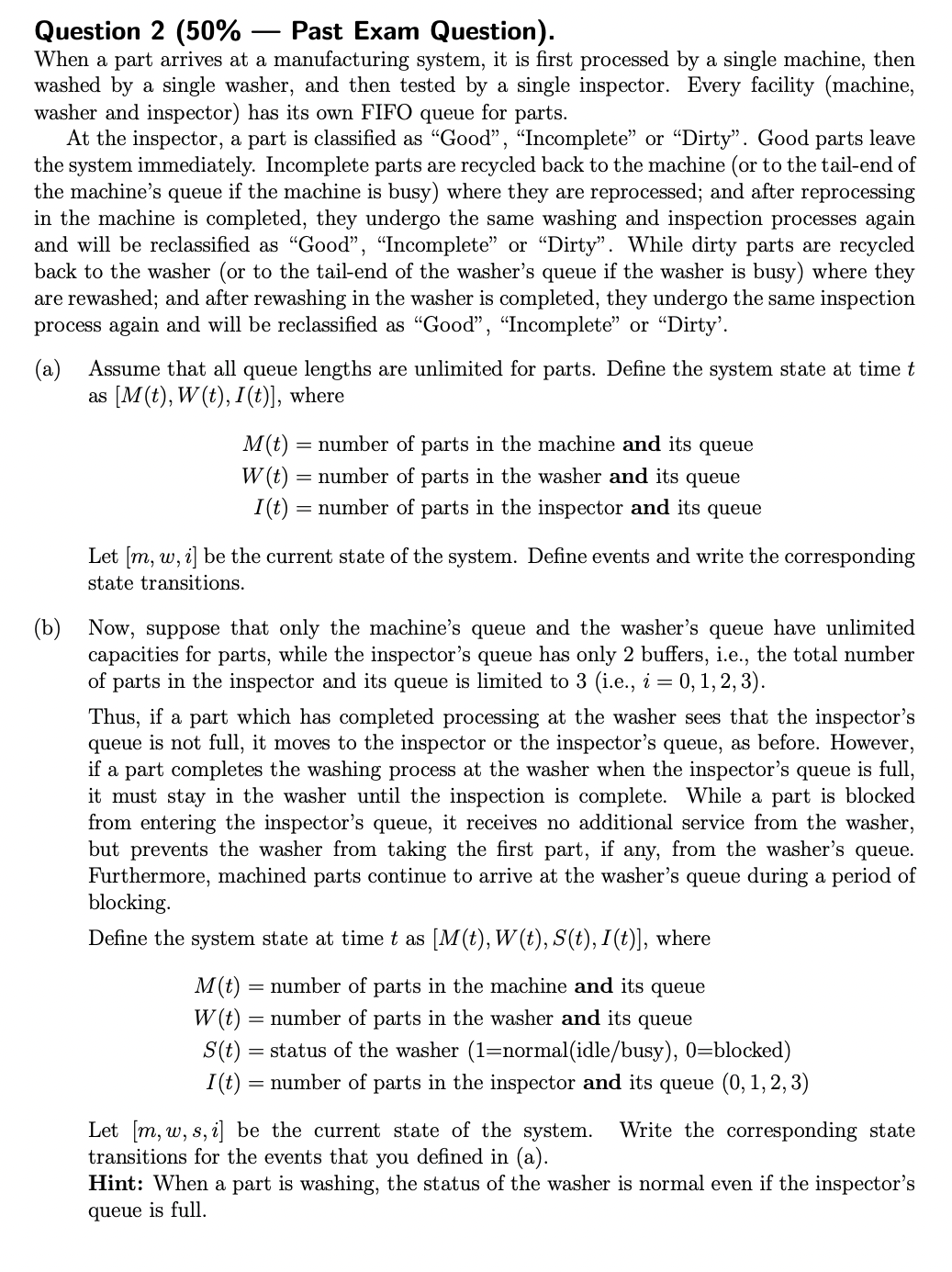
Question 2 (50\% - Past Exam Question). When a part arrives at a manufacturing system, it is first processed by a single machine, then washed by a single washer, and then tested by a single inspector. Every facility (machine, washer and inspector) has its own FIFO queue for parts. At the inspector, a part is classified as "Good", "Incomplete" or "Dirty". Good parts leave the system immediately. Incomplete parts are recycled back to the machine (or to the tail-end of the machine's queue if the machine is busy) where they are reprocessed; and after reprocessing in the machine is completed, they undergo the same washing and inspection processes again and will be reclassified as "Good", "Incomplete" or "Dirty". While dirty parts are recycled back to the washer (or to the tail-end of the washer's queue if the washer is busy) where they are rewashed; and after rewashing in the washer is completed, they undergo the same inspection process again and will be reclassified as "Good", "Incomplete" or "Dirty'. (a) Assume that all queue lengths are unlimited for parts. Define the system state at time t as [M(t),W(t),I(t)], where M(t)W(t)I(t)=numberofpartsinthemachineanditsqueue=numberofpartsinthewasheranditsqueue=numberofpartsintheinspectoranditsqueue Let [m,w,i] be the current state of the system. Define events and write the corresponding state transitions. (b) Now, suppose that only the machine's queue and the washer's queue have unlimited capacities for parts, while the inspector's queue has only 2 buffers, i.e., the total number of parts in the inspector and its queue is limited to 3 (i.e., i=0,1,2,3 ). Thus, if a part which has completed processing at the washer sees that the inspector's queue is not full, it moves to the inspector or the inspector's queue, as before. However, if a part completes the washing process at the washer when the inspector's queue is full, it must stay in the washer until the inspection is complete. While a part is blocked from entering the inspector's queue, it receives no additional service from the washer, but prevents the washer from taking the first part, if any, from the washer's queue. Furthermore, machined parts continue to arrive at the washer's queue during a period of blocking. Define the system state at time t as [M(t),W(t),S(t),I(t)], where M(t)W(t)S(t)I(t)=numberofpartsinthemachineanditsqueue=numberofpartsinthewasheranditsqueue=statusofthewasher(1=normal(idle/busy),0=blocked)=numberofpartsintheinspectoranditsqueue(0,1,2,3) Let [m,w,s,i] be the current state of the system. Write the corresponding state transitions for the events that you defined in (a). Hint: When a part is washing, the status of the washer is normal even if the inspector's queue is full
Step by Step Solution
There are 3 Steps involved in it

Get step-by-step solutions from verified subject matter experts
 Study Help