







Question: please answer parts 7-11 as they are all the same question and show work. thank you! This is very similar to the first assignment (with
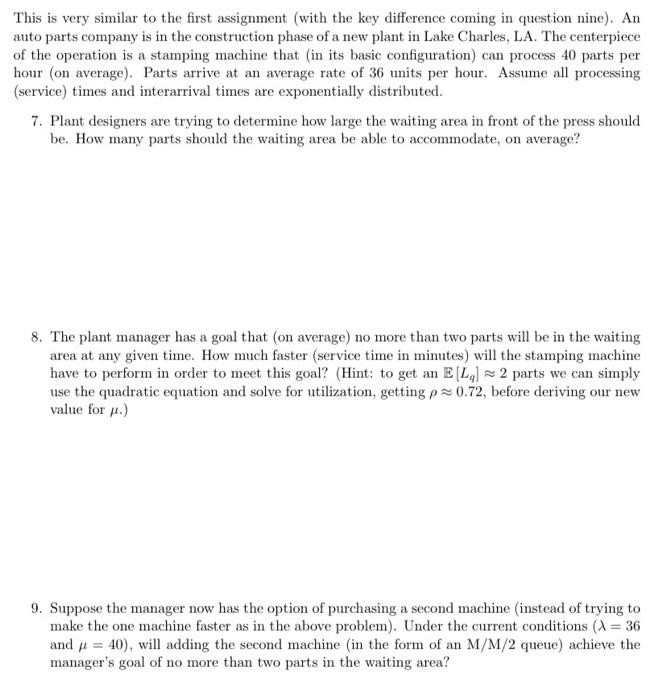
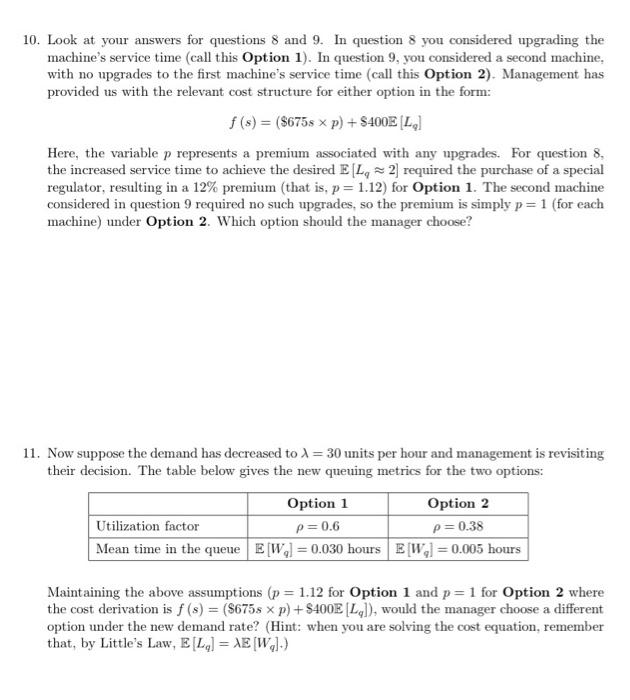
This is very similar to the first assignment (with the key difference coming in question nine). An auto parts company is in the construction phase of a new plant in Lake Charles, LA. The centerpiece of the operation is a stamping machine that (in its basic configuration) can process 40 parts per hour (on average). Parts arrive at an average rate of 36 units per hour. Assume all processing (service) times and interarrival times are exponentially distributed. 7. Plant designers are trying to determine how large the waiting area in front of the press should be. How many parts should the waiting area be able to accommodate, on average? 8. The plant manager has a goal that (on average) no more than two parts will be in the waiting area at any given time. How much faster (service time in minutes) will the stamping machine have to perform in order to meet this goal? (Hint: to get an EL,) ~ 2 parts we can simply use the quadratic equation and solve for utilization, getting p0.72, before deriving our new value for .) 9. Suppose the manager now has the option of purchasing a second machine (instead of trying to make the one machine faster as in the above problem). Under the current conditions (^ = 36 and y = 40), will adding the second machine in the form of an M/M/2 queue) achieve the manager's goal of no more than two parts in the waiting area? 10. Look at your answers for questions 8 and 9. In question 8 you considered upgrading the machine's service time (call this Option 1). In question 9, you considered a second machine, with no upgrades to the first machine's service time (call this Option 2). Management has provided us with the relevant cost structure for either option in the form: f (s) = ($6758 x P) +S400E (L) Here, the variable p represents a premium associated with any upgrades. For question 8. the increased service time to achieve the desired E [L, 2) required the purchase of a special regulator, resulting in a 12% premium (that is, p= 1.12) for Option 1. The second machine considered in question 9 required no such upgrades, so the premium is simply p= 1 (for each machine) under Option 2. Which option should the manager choose? 11. Now suppose the demand has decreased to 1 = 30 units per hour and management is revisiting their decision. The table below gives the new queuing metrics for the two options: Option 1 Option 2 Utilization factor p=0.6 p=0.38 Mean time in the queue E[W] = 0.030 hours E[W,1 = 0.005 hours Maintaining the above assumptions (p = 1.12 for Option 1 and p = 1 for Option 2 where the cost derivation is f(s) = ($6758 x P) +S400E [L]), would the manager choose a different option under the new demand rate? (Hint: when you are solving the cost equation, remember that, by Little's Law, EL = AE [W.].)
Step by Step Solution
There are 3 Steps involved in it

Get step-by-step solutions from verified subject matter experts
 Study Help