







Question: please answer parts A, B and C. part A is to find the interfacial concentration and molar flux for three different sceneraios and part B
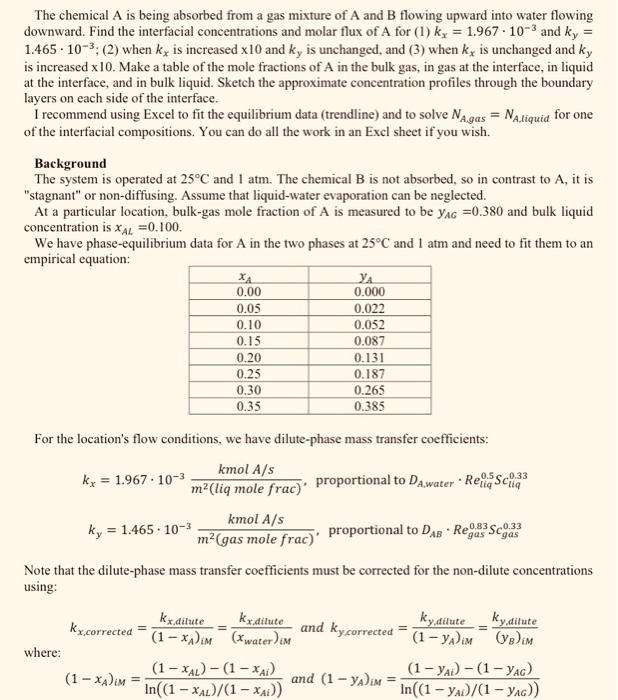
The chemical A is being absorbed from a gas mixture of A and B flowing upward into water flowing downward. Find the interfacial concentrations and molar flux of A for (1) kx=1.967103 and ky= 1.465103;(2) when kx is increased x10 and ky is unchanged, and (3) when kx is unchanged and ky is increased 10. Make a table of the mole fractions of A in the bulk gas, in gas at the interface, in liquid at the interface, and in bulk liquid. Sketch the approximate concentration profiles through the boundary layers on each side of the interface. I recommend using Excel to fit the equilibrium data (trendline) and to solve NA,gas=NA,liquid for one of the interfacial compositions. You can do all the work in an Excl sheet if you wish. Background The system is operated at 25C and 1atm. The chemical B is not absorbed, so in contrast to A, it is "stagnant" or non-diffusing. Assume that liquid-water evaporation can be neglected. At a particular location, bulk-gas mole fraction of A is measured to be yAG=0.380 and bulk liquid concentration is xAL=0.100. We have phase-equilibrium data for A in the two phases at 25C and 1atm and need to fit them to an empirical equation: For the location's flow conditions, we have dilute-phase mass transfer coefficients: kx=1.967103m2(liqmolefrac)kmolA/s,proportionaltoDA,waterReliq0.5Scliq0.33ky=1.465103m2(gasmolefrac)kmolA/s,proportionaltoDABRegas0.83Scgas0.33 Note that the dilute-phase mass transfer coefficients must be corrected for the non-dilute concentrations using: kx,corrected=(1xA)iMkx,dilute=(xwater)iMkx,diluteandky,corrected=(1yA)iMky,dilute=(yB)iMky,dilute where: (1xA)iM=ln((1xAL)/(1xAi))(1xAL)(1xAi)and(1yA)iM=ln((1yAi)/(1yAG))(1yAi)(1yAC)
Step by Step Solution
There are 3 Steps involved in it

Get step-by-step solutions from verified subject matter experts
 Study Help