



Question: Please answer Q1 and Q2 with around 80 words per each. Do not copy and paste the existing answers from Chegg!! In 2004, the University
Please answer Q1 and Q2 with around 80 words per each.
Do not copy and paste the existing answers from Chegg!!
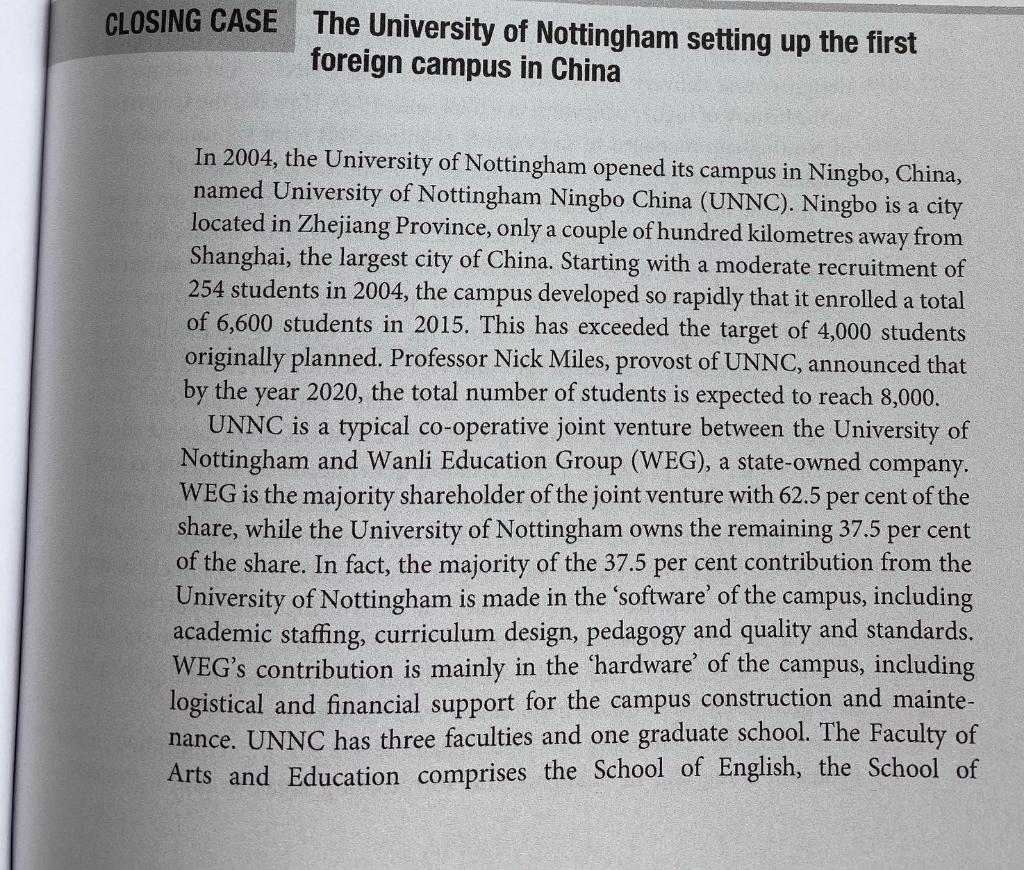
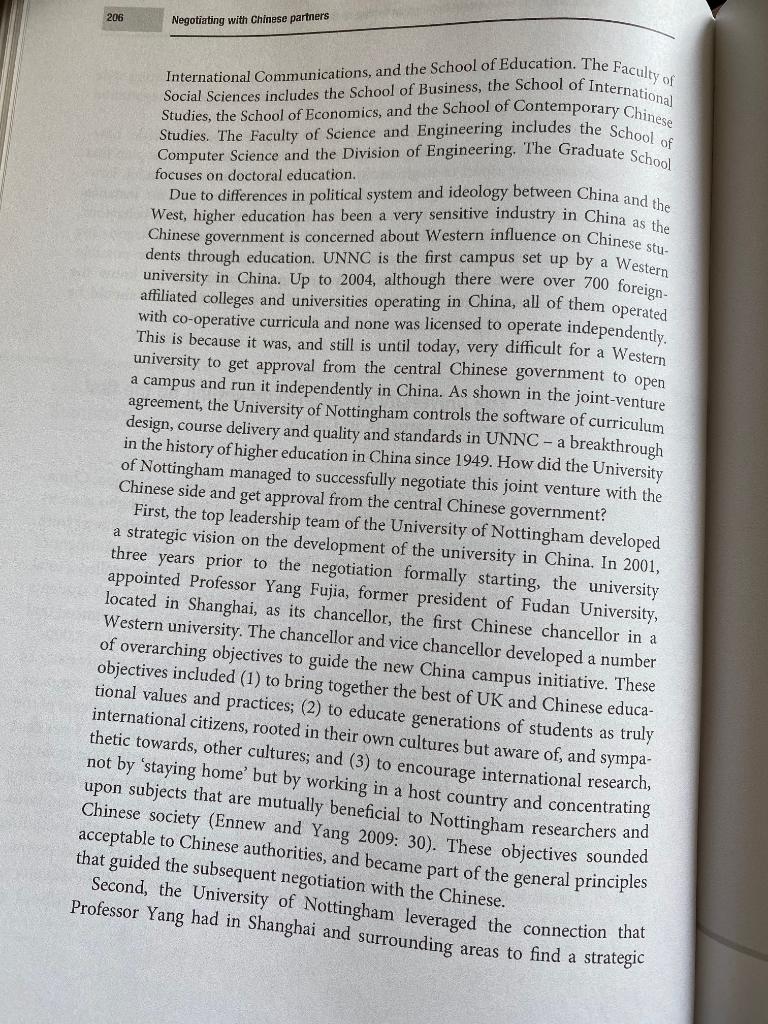
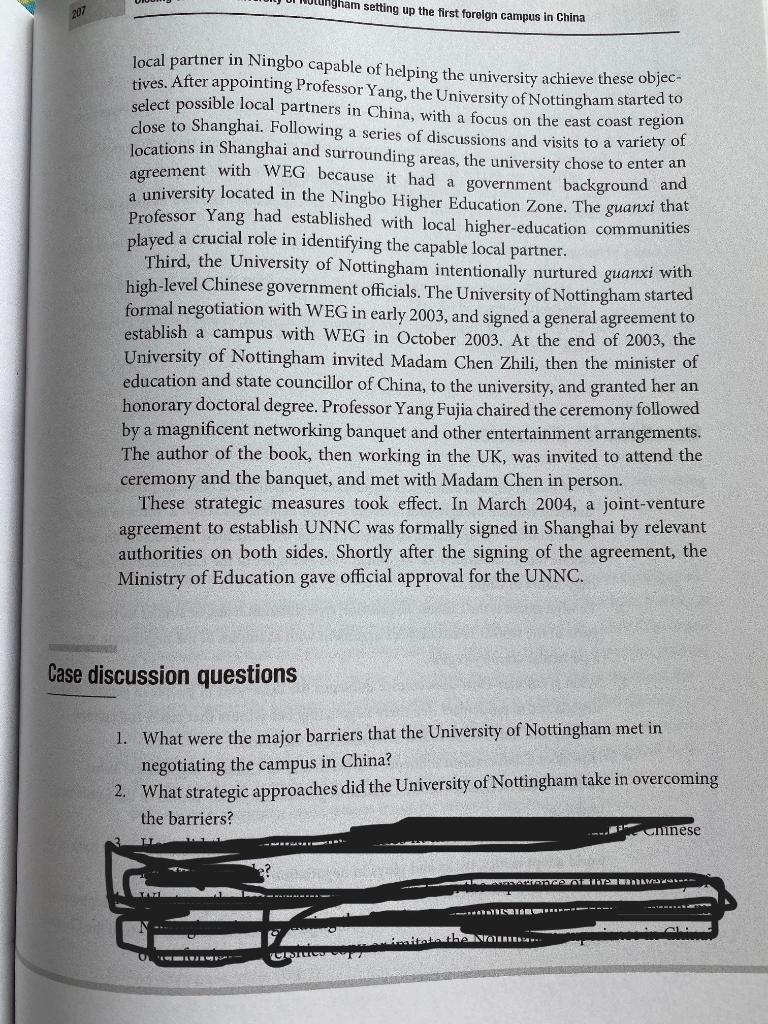
In 2004, the University of Nottingham opened its campus in Ningbo, China, named University of Nottingham Ningbo China (UNNC). Ningbo is a city located in Zhejiang Province, only a couple of hundred kilometres away from Shanghai, the largest city of China. Starting with a moderate recruitment of 254 students in 2004 , the campus developed so rapidly that it enrolled a total of 6,600 students in 2015 . This has exceeded the target of 4,000 students originally planned. Professor Nick Miles, provost of UNNC, announced that by the year 2020 , the total number of students is expected to reach 8,000 . UNNC is a typical co-operative joint venture between the University of Nottingham and Wanli Education Group (WEG), a state-owned company. WEG is the majority shareholder of the joint venture with 62.5 per cent of the share, while the University of Nottingham owns the remaining 37.5 per cent of the share. In fact, the majority of the 37.5 per cent contribution from the University of Nottingham is made in the 'software' of the campus, including academic staffing, curriculum design, pedagogy and quality and standards. WEG's contribution is mainly in the 'hardware' of the campus, including logistical and financial support for the campus construction and maintenance. UNNC has three faculties and one graduate school. The Faculty of Arts and Education comprises the School of English, the School of International Communications, and the School of Education. The Faculty of Social Sciences includes the School of Business, the School of Internationa] Studies, the School of Economics, and the School of Contemporary Chinese Studies. The Faculty of Science and Engineering includes the School of Computer Science and the Division of Engineering. The Graduate Sch of focuses on doctoral education. Due to differences in political system and ideology between China and the West, higher education has been a very sensitive industry in China as the Chinese government is concerned about Western influence on Chinese students through education. UNNC is the first campus set up by a Western university in China. Up to 2004 , although there were over 700 foreignaffiliated colleges and universities operating in China, all of them operated with co-operative curricula and none was licensed to operate independently. This is because it was, and still is until today, very difficult for a Western university to get approval from the central Chinese government to open a campus and run it independently in China. As shown in the joint-venture agreement, the University of Nottingham controls the software of curriculum design, course delivery and quality and standards in UNNC - a breakthrough in the history of higher education in China since 1949. How did the University of Nottingham managed to successfully negotiate this joint venture with the Chinese side and get approval from the central Chinese government? First, the top leadership team of the University of Nottingham developed a strategic vision on the development of the university in China. In 2001, three years prior to the negotiation formally starting, the university appointed Professor Yang Fujia, former president of Fudan University, located in Shanghai, as its chancellor, the first Chinese chancellor in a Western university. The chancellor and vice chancellor developed a number of overarching objectives to guide the new China campus initiative. These objectives included (1) to bring together the best of UK and Chinese educational values and practices; (2) to educate generations of students as truly international citizens, rooted in their own cultures but aware of, and sympathetic towards, other cultures; and (3) to encourage international research, not by 'staying home' but by working in a host country and concentrating upon subjects that are mutually beneficial to Nottingham researchers and Chinese society (Ennew and Yang 2009: 30). These objectives sounded icceptable to Chinese authorities, and became part of the general principles hat guided the subsequent negotiation with the Chinese. Second, the University of Nottingham leveraged the connection that rofessor Yang had in Shanghai and surrounding areas to find a strategic local partner in Ningbo capable of helping the university achieve these objectives. After appointing Professor Yang, the University of Nottingham started to select possible local partners in China, with a focus on the east coast region close to Shanghai. Following a series of discussions and visits to a variety of locations in Shanghai and surrounding areas, the university chose to enter an agreement with WEG because it had a government background and a university located in the Ningbo Higher Education Zone. The guanxi that Professor Yang had established with local higher-education communities played a crucial role in identifying the capable local partner. Third, the University of Nottingham intentionally nurtured guanxi with high-level Chinese government officials. The University of Nottingham started formal negotiation with WEG in early 2003, and signed a general agreement to establish a campus with WEG in October 2003. At the end of 2003, the University of Nottingham invited Madam Chen Zhili, then the minister of education and state councillor of China, to the university, and granted her an honorary doctoral degree. Professor Yang Fujia chaired the ceremony followed by a magnificent networking banquet and other entertainment arrangements. The author of the book, then working in the UK, was invited to attend the ceremony and the banquet, and met with Madam Chen in person. These strategic measures took effect. In March 2004, a joint-venture agreement to establish UNNC was formally signed in Shanghai by relevant authorities on both sides. Shortly after the signing of the agreement, the Ministry of Education gave official approval for the UNNC. Case discussion questions 1. What were the major barriers that the University of Nottingham met in negotiating the campus in China? 2. What strategic approaches did the University of Nottingham take in overcomingStep by Step Solution
There are 3 Steps involved in it
1 Expert Approved Answer
Step: 1 Unlock

Question Has Been Solved by an Expert!
Get step-by-step solutions from verified subject matter experts
Step: 2 Unlock
Step: 3 Unlock