







Question: please answer question 1 and 3 and show all work b. Assume that John and Mary in part a. (If the amount you determined is
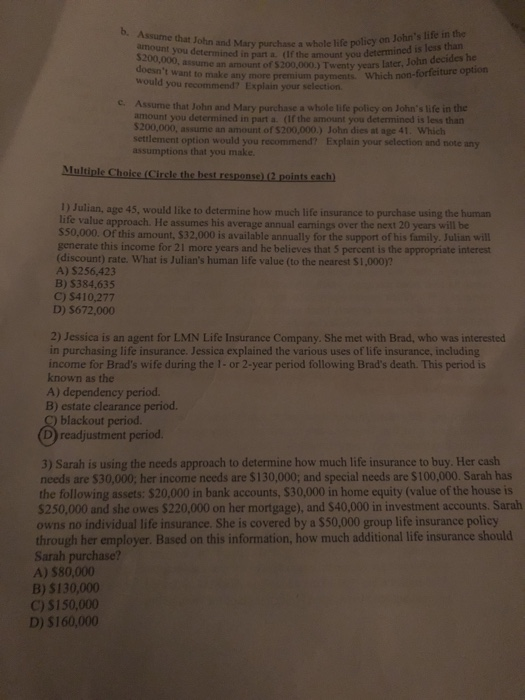
b. Assume that John and Mary in part a. (If the amount you determined is less than assume an armount of $200,000.) Twenty years later, John decades S20000 a determined in parr echae a whole life policy on John's life in the doesn't want to make any more premium payments. Which non-forfeiture option you recommend? Explain your selection. C Assume that John and Mary purchase a whole life policy on John's life in the amount you determined in part a. (If the amount you determined is less than $200,000, assume an amount of $200,000.) John dies at age 41. Which setlement option would you recommend? Explain your selection and note any assumptions that you make Multiple Choice (Circle the best res 1) Julian, age 45, would like to determine how much life insurance to purchase using the human life value approach. He assumes his average annual earnings over the next 20 years will be S50,000. Of this amount, $32,000 is available annually for the support of his family. Julian will generate this income for 21 more years and he believes that 5 percent is the appropriate interest (discount) rate. What is Julian's human life value (to the nearest $1,000)2 A) S256,423 B) $384,635 C) S410,277 D) $672,000 2) Jessica is an agent for LMN Life Insurance Company. She met with Brad, who was interested in purchasing life insurance. Jessica explained the various uses of life insurance, including income for Brad's wife during the 1- or 2-year period following Brad's death. This period is known as the A) dependency period. B) estate clearance period. blackout period. D) readjustment period 3) Sarah is using the needs approach to determine how much life insurance to buy. Her cash needs are $30,000; her income needs are $130,000; and special needs are $100,000. Sarah has the following assets: $20,000 in bank accounts, $30,000 in home equity (value of the house is $250,000 and she owes $220,000 on her mortgage), and $40,000 in investment accounts. Sarah owns no individual life insurance. She is covered by a $50,000 group life insurance policy through her employer. Based on this information, how much additional life insurance should Sarah purchase? A) $80,000 B) $130,000 C) 5150,000 D) 5160,000
Step by Step Solution
There are 3 Steps involved in it

Get step-by-step solutions from verified subject matter experts
 Study Help