







Question: Please answer question 1 based on the case study. Long paragraphs please, based on marks Occupational Risks Associated with Solid Waste Management in the Informal
Please answer question 1 based on the case study. Long paragraphs please, based on marks
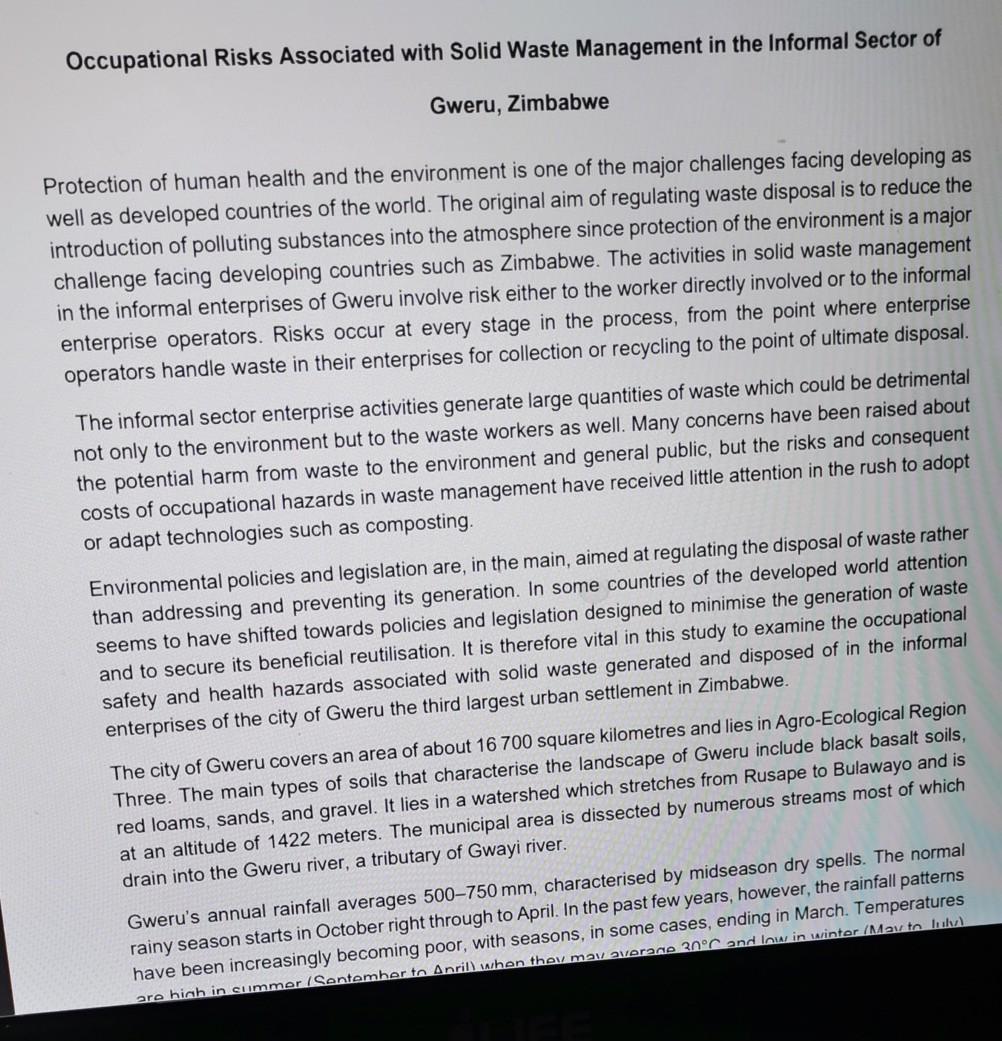
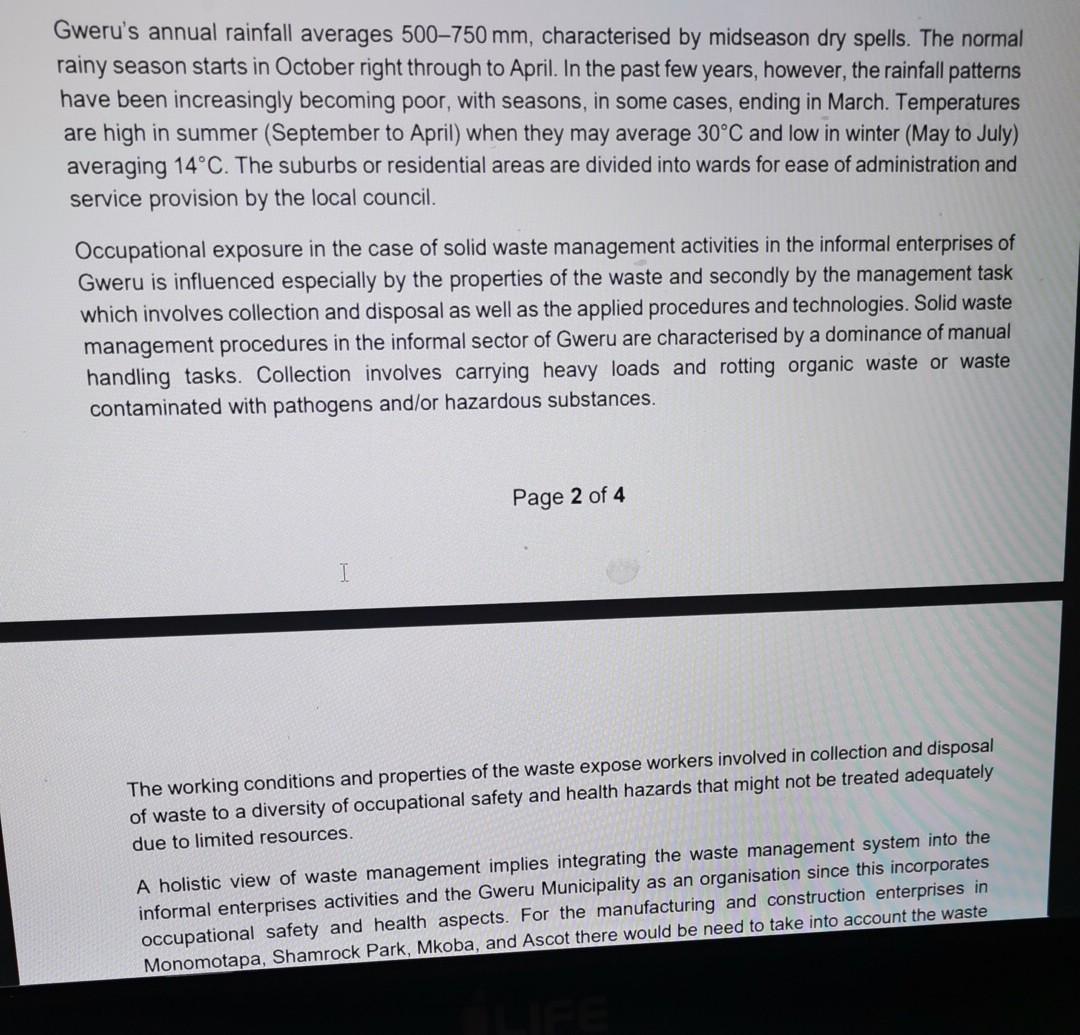
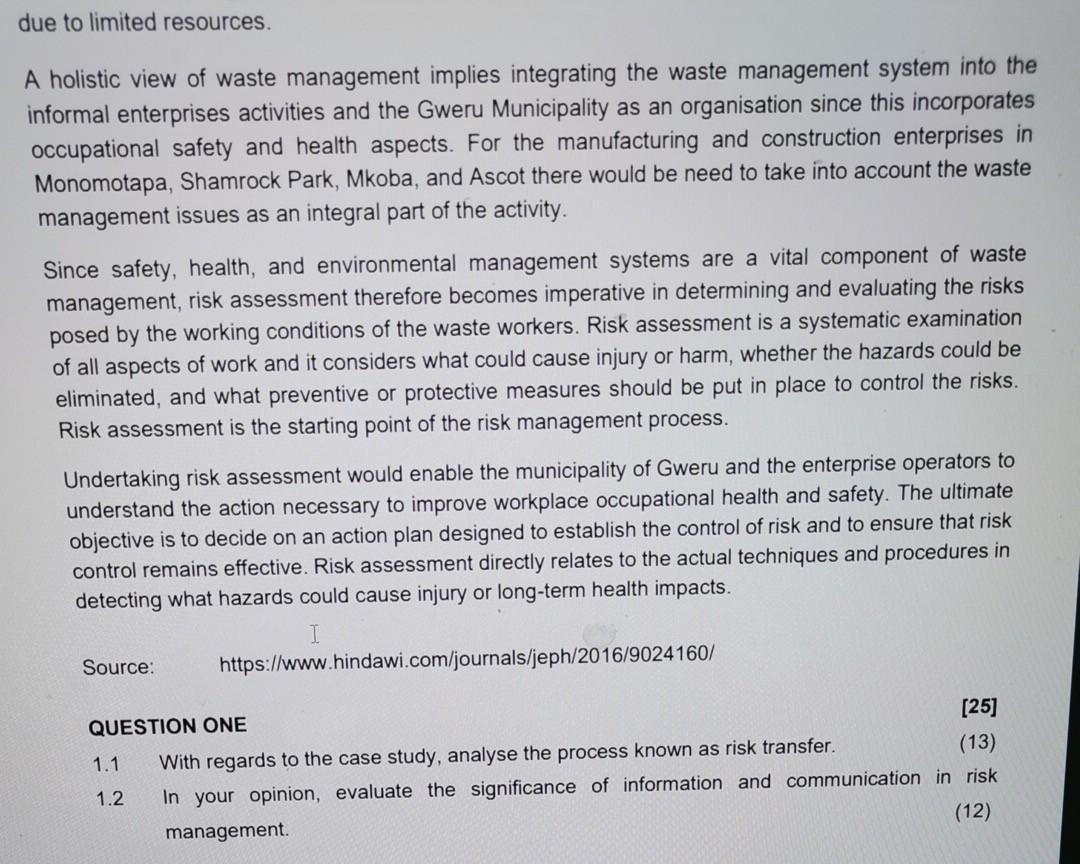
Occupational Risks Associated with Solid Waste Management in the Informal Sector of Gweru, Zimbabwe Protection of human health and the environment is one of the major challenges facing developing as well as developed countries of the world. The original aim of regulating waste disposal is to reduce the introduction of polluting substances into the atmosphere since protection of the environment is a major challenge facing developing countries such as Zimbabwe. The activities in solid waste management in the informal enterprises of Gweru involve risk either to the worker directly involved or to the informal enterprise operators. Risks occur at every stage in the process, from the point where enterprise operators handle waste in their enterprises for collection or recycling to the point of ultimate disposal. The informal sector enterprise activities generate large quantities of waste which could be detrimental not only to the environment but to the waste workers as well. Many concerns have been raised about the potential harm from waste to the environment and general public, but the risks and consequent costs of occupational hazards in waste management have received little attention in the rush to adopt or adapt technologies such as composting. Environmental policies and legislation are, in the main, aimed at regulating the disposal of waste rather than addressing and preventing its generation. In some countries of the developed world attention seems to have shifted towards policies and legislation designed to minimise the generation of waste and to secure its beneficial reutilisation. It is therefore vital in this study to examine the occupational safety and health hazards associated with solid waste generated and disposed of in the informal enterprises of the city of Gweru the third largest urban settlement in Zimbabwe. The city of Gweru covers an area of about 16 700 square kilometres and lies in Agro-Ecological Region Three. The main types of soils that characterise the landscape of Gweru include black basalt soils, red loams, sands, and gravel. It lies in a watershed which stretches from Rusape to Bulawayo and is at an altitude of 1422 meters. The municipal area is dissected by numerous streams most of which drain into the Gweru river, a tributary of Gwayi river. Gweru's annual rainfall averages 500750 mm, characterised by midseason dry spells. The normal rainy season starts in October right through to April. In the past few years, however, the rainfall patterns have been increasingly becoming poor, with seasons, in some cases, ending in March. Temperatures are high in summer (Sentemher to Anril) when they may averane 30 and low in winter (Mave to buy Gweru's annual rainfall averages 500750 mm, characterised by midseason dry spells. The normal rainy season starts in October right through to April. In the past few years, however, the rainfall patterns have been increasingly becoming poor, with seasons, in some cases, ending in March. Temperatures are high in summer (September to April) when they may average 30C and low in winter (May to July) averaging 14C. The suburbs or residential areas are divided into wards for ease of administration and service provision by the local council. Occupational exposure in the case of solid waste management activities in the informal enterprises of Gweru is influenced especially by the properties of the waste and secondly by the management task which involves collection and disposal as well as the applied procedures and technologies. Solid waste management procedures in the informal sector of Gweru are characterised by a dominance of manual handling tasks. Collection involves carrying heavy loads and rotting organic waste or waste contaminated with pathogens and/or hazardous substances. Page 2 of 4 The working conditions and properties of the waste expose workers involved in collection and disposal of waste to a diversity of occupational safety and health hazards that might not be treated adequately due to limited resources A holistic view of waste management implies integrating the waste management system into the informal enterprises activities and the Gweru Municipality as an organisation since this incorporates occupational safety and health aspects. For the manufacturing and construction enterprises in Monomotapa, Shamrock Park, Mkoba, and Ascot there would be need to take into account the waste due to limited resources. A holistic view of waste management implies integrating the waste management system into the informal enterprises activities and the Gweru Municipality as an organisation since this incorporates occupational safety and health aspects. For the manufacturing and construction enterprises in Monomotapa, Shamrock Park, Mkoba, and Ascot there would be need to take into account the waste management issues as an integral part of the activity. Since safety, health, and environmental management systems are a vital component of waste management, risk assessment therefore becomes imperative in determining and evaluating the risks posed by the working conditions of the waste workers. Risk assessment is a systematic examination of all aspects of work and it considers what could cause injury or harm, whether the hazards could be eliminated, and what preventive or protective measures should be put in place to control the risks. Risk assessment is the starting point of the risk management process. Undertaking risk assessment would enable the municipality of Gweru and the enterprise operators to understand the action necessary to improve workplace occupational health and safety. The ultimate objective is to decide on an action plan designed to establish the control of risk and to ensure that risk control remains effective. Risk assessment directly relates to the actual techniques and procedures in detecting what hazards could cause injury or long-term health impacts. Source: https://www.hindawi.com/journals/jeph/2016/9024160/ 1.1 QUESTION ONE [25] With regards to the case study, analyse the process known as risk transfer. (13) 1.2 In your opinion, evaluate the significance of information and communication in risk management (12)Step by Step Solution
There are 3 Steps involved in it
1 Expert Approved Answer
Step: 1 Unlock

Question Has Been Solved by an Expert!
Get step-by-step solutions from verified subject matter experts
Step: 2 Unlock
Step: 3 Unlock
 Study Help