







Question: Please answer question 2 not question 1 I have attached question 1 for reference In detail and explain andshow all steps of question 2 not
Please answer question 2 not question 1 I have attached question 1 for reference

In detail and explain andshow all steps of question 2 not question 1
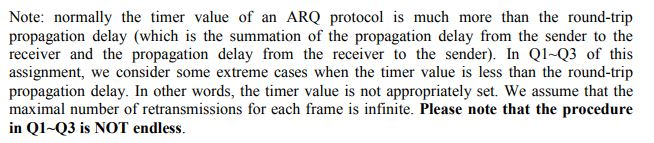
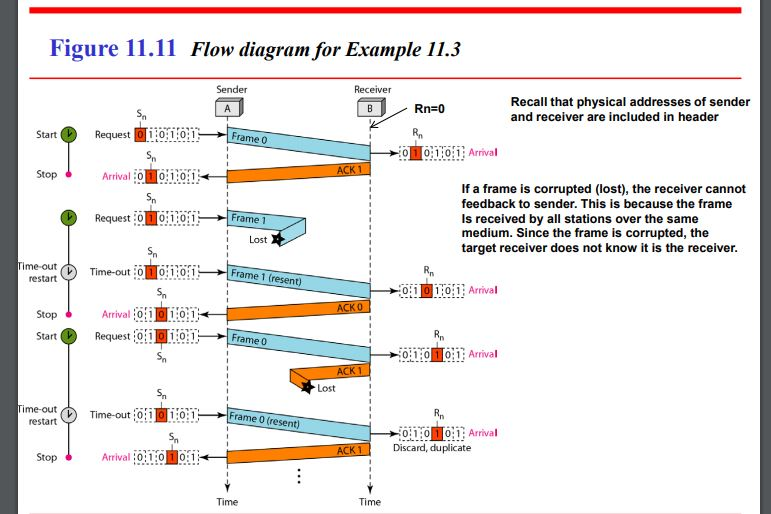
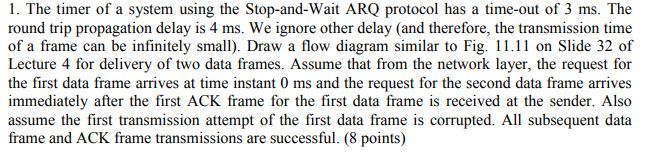
Note: normally the timer value of an ARQ protocol is much more than the round-trip propagation delay (which is the summation of the propagation delay from the sender to the receiver and the propagation delay from the receiver to the sender). In Q1-Q3 of this assignment, we consider some extreme cases when the timer value is less than the round-trip propagation delay. In other words, the timer value is not appropriately set. We assume that the maximal number of retransmissions for each frame is infinite. Please note that the procedure in Q1-Q3 is NOT endless Figure 11.11 Flow diagram for Example 11.3 Receiver Recall that physical addresses of sender and receiver are included in header Rn=0 Request iloi:0;i; Stop Arival :ojiio:i Requestoi:o1 Start Frame 0 Oi Arrival If a frame is corrupted (lost), the receiver cannot feedback to sender. This is because the frame Is received by all stations over the same medium. Since the frame is corrupted, the target receiver does not know it is the receiver Sn I Lost Time-out o010i Frame 1 (resent) restart 0:1: Arrival Arrival0 1010 Start Request olio i:0:1 Frame 0 0110011] Arrival Lost Time-out0;10:1 Frame 0 (resent) restart 011-iO011] Arrival Discard, duplicate Stop2 Arrival :01.1,00(. Time Time 1. The timer of a system using the Stop-and-Wait ARQ protocol has a time-out of 3 ms. The round trip propagation delay is 4 ms. We ignore other delay (and therefore, the transmission time of a frame can be infinitely small). Draw a flow diagram similar to Fig. 1.11 on Slide 32 of Lecture 4 for delivery of two data frames. Assume that from the network layer, the request for the first data frame arrives at time instant 0 ms and the request for the second data frame arrives immediately after the first ACK frame for the first data frame is received at the sender. Also assume the first transmission attempt of the first data frame is corrupted. All subsequent data frame and ACK frame transmissions are successful. (8 points)
Step by Step Solution
There are 3 Steps involved in it

Get step-by-step solutions from verified subject matter experts
 Study Help