Question: please help me to answer this question: case study ( Tim Horton inc ) : Based on your analysis of the company's 5 year strategic
please help me to answer this question:
case study ( Tim Horton inc ) :
Based on your analysis of the company's 5 year strategic plan, are there any flaws in the company's direction? Assess its current performance. What recommendations could you make to strengthen its strategy?
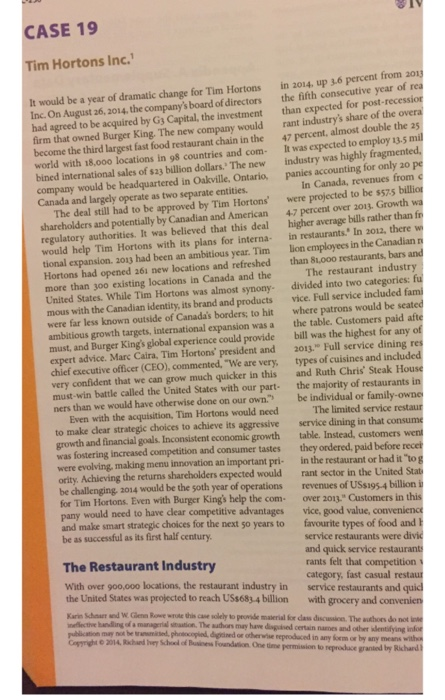
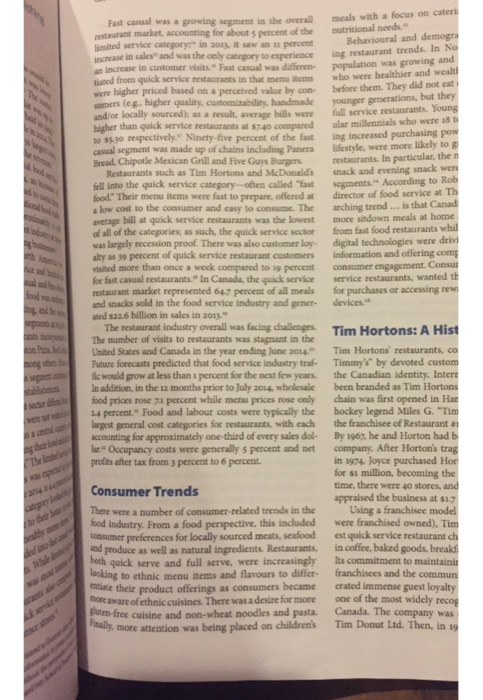
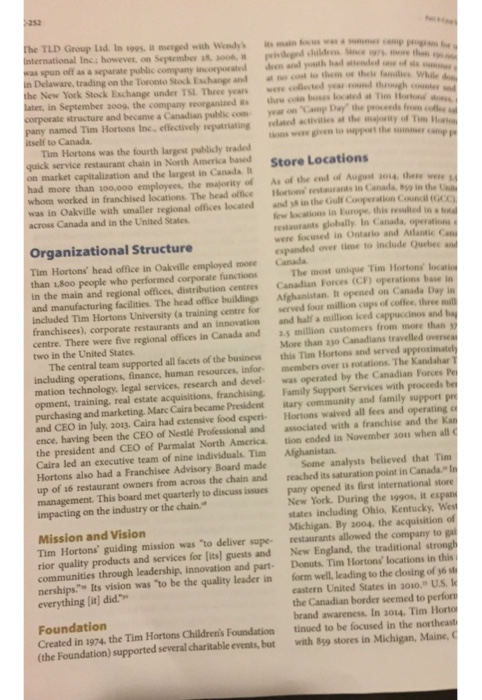
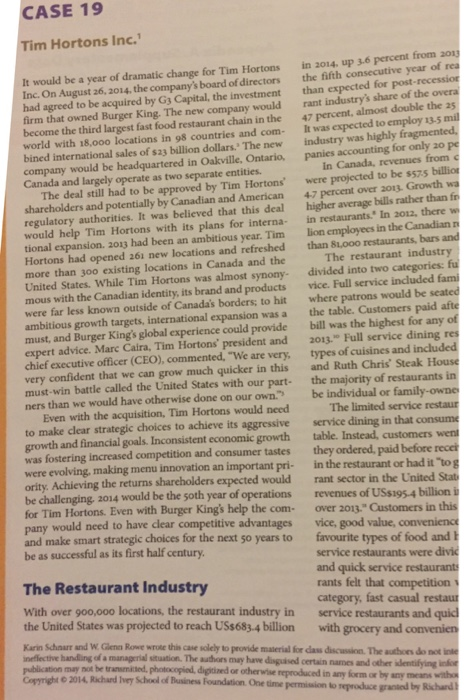
CASE 19 Tim Hortons Inc.) It would be a year of dramatic change for Tim Hortons in 2014, up 2.6 percent from 2013 the fifth consecutive year of rea Inc. On August 26, 2014, the company's board of directors had agreed to be acquired by G Capital, the investment than expected for post-recessior firm that owned Burger King. The new company would rant industry's share of the overa become the third largest fast food restaurant chain in the 47 percent, almost double the 25 world with 18.000 locations in 98 countries and com It was expected to employ 13.5 mil bined international sales of $23 billion dollars. The new industry was highly fragmented, company would be headquartered in Oakville, Ontario, panies accounting for only 20 pe In Canada, revenues from Canada and largely operate as two separate entities. The deal still had to be approved by Tim Hortons' were projected to be 5575 billion shareholders and potentially by Canadian and American 4.7 percent over 2013. Growth wa regulatory authorities. It was believed that this deal higher average bills rather than fo in restaurants. In 2012, there wa would help Tim Hortons with its plans for interna- tional expansion 2013 had been an ambitious year. Tim lion employees in the Canadian Hortons had opened 261 new locations and refreshed than 81.000 restaurants, bars and more than 3oo existing locations in Canada and the The restaurant industry United States. While Tim Hortons was almost synony. divided into two categories: fu mous with the Canadian identity, its brand and products vice. Full service included fami were far less known outside of Canada's borders; to hit where patrons would be seated ambitious growth targets, international expansion was a the table. Customers paid afte must, and Burger King's global experience could provide bill was the highest for any of expert advice. Marc Caira, Tim Hortons' president and 2013. Full service dining res chief executive officer (CEO), commented, "We are very, types of cuisines and included very confident that we can grow much quicker in this and Ruth Chris' Steak House must-win battle called the United States with our part the majority of restaurants in ners than we would have otherwise done on our own." be individual or family-owne Even with the acquisition, Tim Hortons would need The limited service restaur to make clear strategic choices to achieve its aggressive service dining in that consume growth and financial goals. Inconsistent economic growth table. Instead, customers weni was fostering increased competition and consumer tastes they ordered, paid before recet were evolving, making menu innovation an important pri in the restaurant or had it tog ority. Achieving the returns shareholders expected would rant sector in the United Stat be challenging 2014 would be the oth year of operations for Tim Hortons. Even with Burger King's help the com revenues of US$195-4 billion i pany would need to have clear competitive advantages over 2013. Customers in this and make smart strategic choices for the next so years to vice, good value, convenience be as successful as its first half century. favourite types of food and ! service restaurants were divic The Restaurant Industry and quick service restaurants rants felt that competition With over 900,000 locations, the restaurant industry in category, fast casual restaur the United States was projected to reach US$6834 billion service restaurants and quid with Karin hund W. Glen Rowe wrote this case solely to provide material for de discussie. The withoes do not be grocery and convenien waelective handling of managion. The stars may have died certain names and other dentifying info publication may be red photocopied died or otherwise reproduced in any form or by any means with Copyright 2014. They School of Business Foundation. One time permission to reproduce granted by Richard Fast Casual was a growing segment in the overall meals with a focus on cateri restaurant market, accounting for about 5 percent of the nutritional needs limited service category in 2013, it saw an 1 percent Behavioural and demogra increase in sales and was the only category to experience ing restaurant trends. In No an increase in customer visits. Fast Casual was differen population was growing and Listed from quick service restaurants in that menu items who were healthier and wealth were higher priced based on a perceived value by con before them. They did not cat sumers (eg, higher quality customizability, handmade younger generations, but they and/or locally sourced); as a result, average bills were full service restaurants. Young higher than quick service restaurants at 57.40 compared ular millennials who were 18 to $5.30 respectively." Ninety-five percent of the fast ing increased purchasing pow casual segment was made up of chains including Panera lifestyle, were more likely to g Bread. Chipotle Mexican Grill and Five Guys Burgers restaurants. In particular, then Restaurants such as Tim Hortons and McDonald's snack and evening snack were fell into the quick service category-often called "fast segments. According to Rob food." Their menu items were fast to prepare offered at director of food service at Th a low cost to the consumer and easy to consume. The arching trend ... is that Canad average bill at quick service restaurants was the lowest more sit down meals at home of all of the categories as such, the quick service sector from fast food restaurants whil was largely recession proof. There was also customer loy digital technologies were drivi alty as 39 percent of quick service restaurant customers information and offering com visited more than once a week compared to 19 percent consumer engagement Consui for fast casual restaurants in Canada, the quick service service restaurants, wanted th restaurant market represented 64.7 percent of all meals for purchases or accessing rew and snacks sold in the food service industry and gener devices ated $22.6 billion in sales in 2013." The restaurant industry overall was facing challenges. Tim Hortons: A Hist The number of visits to restaurants was stagnant in the United States and Canada in the year ending June 2014 Tim Hortons restaurants, co Future forecasts predicted that food service industry traf Timmy's by devoted custom fic would grow at less than 1 percent for the next few years. the Canadian identity. Interr In addition, in the 12 months prior to July 2014, wholesale been branded as Tim Hortons food prices rose z percent while menu prices rose only chain was first opened in Har 2.4 percent." Food and labour costs were typically the hockey legend Miles G. "Tim largest general cost categories for restaurants, with each the franchisee of Restaurant accounting for approximately one-third of every sales dol By 1967. he and Horton had b lar. Occupancy costs were generally 5 percent and net company. After Horton's trag profits after tax from 3 percent to 6 percent. in 1974. Joyce purchased Hor for si million, becoming the Consumer Trends time, there were 40 stores, and appraised the business at $1.7 There were a number of consumer-related trends in the Using a franchisee model food industry. From a food perspective, this included were franchised owned). Tim consumer preferences for locally sourced meats, seafood est quick service restaurant ch and produce as well as natural ingredients. Restaurants, in coffee, baked goods, breakf both quick serve and full serve, were increasingly Its commitment to maintaini looking to ethnic menu items and flavours to differ- franchisees and the commun entiate their product offerings as consumers became crated immense guest loyalty more aware of ethnic cuisines. There was a desire for more one of the most widely recog gluten-free cuisine and non-wheat noodles and pasta. Canada. The company was more attention was being placed on children's Tim Donut Ltd. Then, in 19 mong Pinally The TLD Group Lid. In 1995. It merged with Wendy International Inc., however, on September 10, was spun off as a separate public company incorporated in Delaware, trading on the Toronto Stock Exchange and the New York Stock Exchange under TSL Three years later, in September 2009, the company reorganised corporate structure and became a Canadian public com pany named Tim Hortons Ine, effectively repatriating itself to Canada Tim Hortons was the fourth largest publicly traded quick service restaurant chain in North America based on market capitalisation and the largest in Canada. It had more than 100.000 employees, the majority of whom worked in franchised locations. The head office was in Oakville with smaller regional offices located across Canada and in the United States at no cost to them or hele families. While were collected year round through coste three bones located at Tim Horton yw on Camp Day the proceeds from code related activities at the majority of Tim Horta thes were given to wpport the summer camp Organizational Structure Tim Hortons' head office in Oakville employed more than 1.800 people who performed corporate functions in the main and regional offices, distribution centres and manufacturing facilities. The head office buildings included Tim Hortons University (a training centre for franchisees), corporate restaurants and an innovation centre. There were five regional offices in Canada and two in the United States. The central team supported all facets of the business including operations, finance, human resources, infor mation technology, legal services, research and devel opment, training, real estate acquisitions, franchising purchasing and marketing, Marc Caira became President and CEO in July, 2013. Caira had extensive food experi ence, having been the CEO of Nestl Professional and the president and CEO of Parmalat North America. Caira led an executive team of nine individuals. Tim Hortons also had a Franchisee Advisory Board made up of 16 restaurant owners from across the chain and management. This board met quarterly to discuss issues impacting on the industry or the chain. Mission and Vision Tim Hortons' guiding mission was to deliver supe- rior quality products and services for its guests and communities through leadership, innovation and part- nerships." Its vision was to be the quality leader in everything (a) did. Foundation Created in 1974, the Tim Hortons Children's Foundation (the Foundation) supported several charitable events, but Store Locations As of the end of August 2014, there were Blood restaurants in Canada, in the Uni and in the Gulf Cooperation Council few locations in Purope this resulted in to restaurants globally. In Canada, operations were focused in Ontario and Atlantic Can expanded over time to include ubes The most unique Tim Hortons locatio Canadian Forces (CF) operations basein Afghanistan. It opened on Canada Day in served four million cup of coffee, there will and half a million led cappuccinos and by 2.5 million customers from more than More than o Canadians travelled oversea this Tim Hortons and served approximately members over s rotations. The Kandahar was operated by the Canadian Forces De Family Support Services with proceeds be itary community and family support pr Hortons waived all fees and operating a associated with a franchise and the Kan tion ended in November on when all Afghanistan Some analysts believed that Tim reached its saturation point in Canada pany opened its first international store New York. During the 1990s, it expany states including Ohio, Kentucky, West Michigan. By 2004, the acquisition of restaurants allowed the company to gal New England, the traditional strong Donuts, Tim Hortons locations in this form well, leading to the closing of 36 st castern United States in 2010. U.S. the Canadian border seemed to perfor brand awareness. In 2014, Tim Horto tinued to be focused in the northeast with 859 stores in Michigan, Maine, CASE 19 Tim Hortons Inc.' It would be a year of dramatic change for Tim Hortons Inc. On August 26, 2014, the company's board of directors had agreed to be acquired by G3 Capital, the investment firm that owned Burger King. The new company would become the third largest fast food restaurant chain in the world with 18.000 locations in 98 countries and com- bined international sales of s23 billion dollars. The new company would be headquartered in Oakville, Ontario, Canada and largely operate as two separate entities. The deal still had to be approved by Tim Hortons shareholders and potentially by Canadian and American regulatory authorities. It was believed that this deal would help Tim Hortons with its plans for interna- tional expansion 2013 had been an ambitious year. Tim Hortons had opened 261 new locations and refreshed more than 300 existing locations in Canada and the United States. While Tim Hortons was almost synony- mous with the Canadian identity, its brand and products were far less known outside of Canada's borders; to hit ambitious growth targets, international expansion was a must, and Burger King's global experience could provide expert advice. Marc Caira, Tim Hortons' president and chief executive officer (CEO), commented, "We are very, very confident that we can grow much quicker in this must-win battle called the United States with our part- ners than we would have otherwise done on our own." Even with the acquisition, Tim Hortons would need to make clear strategic choices to achieve its aggressive growth and financial goals. Inconsistent economic growth was fostering increased competition and consumer tastes were evolving, making menu innovation an important pri- ority. Achieving the returns shareholders expected would be challenging. 2014 would be the oth year of operations for Tim Hortons. Even with Burger King's help the com- pany would need to have clear competitive advantages and make smart strategic choices for the next 50 years to be as successful as its first half century. in 2014, up 3.6 percent from 2013 the fifth consecutive year of rea than expected for post-recessior rant industry's share of the overa 47 percent, almost double the 25 It was expected to employ 13.5 mil industry was highly fragmented, panies accounting for only 20 pe In Canada, revenues from were projected to be 5575 billior 4.7 percent over 2013. Growth wa higher average bills rather than fn in restaurants.In 2012, there we lion employees in the Canadian than 81.000 restaurants, bars and The restaurant industry divided into two categories: fu vice. Full service included fami where patrons would be seated the table. Customers paid afte bill was the highest for any of 2013. Full service dining res types of cuisines and included and Ruth Chris' Steak House the majority of restaurants in be individual or family-owne The limited service restaur service dining in that consume table. Instead, customers went they ordered, paid before recet in the restaurant or had it tog rant sector in the United Stat revenues of US$195.4 billion is over 2013." Customers in this vice, good value, convenience favourite types of food and ! service restaurants were divi and quick service restaurants The Restaurant Industry rants felt that competition category, fast casual restaur With over 900,000 locations, the restaurant industry in service restaurants and quid the United States was projected to reach US$683.4 billion with grocery and convenien Kari Schna and W. Glenn Rowe wrote this case solely to provide material for das discussion. The authors do not inte ineffective handling of a managerial situation. The authors may have disguised certain names and other identifying info publication may not be transmitted, photocopied, digitized or otherwise reproduced in any form or by any means with Copyright 2014. Richard Iwery School of Business Foundation. One time permission to reproduce granted by Richard meals with a focus on cateri Fast casual was a growing segment in the overall nutritional needs restaurant market, accounting for about 5 percent of the Behavioural and demogra limited service category:* in 2013, it saw an u percent increase in sales and was the only category to experience ing restaurant trends. In No an increase in customer visits. Fast casual was differen- population was growing and tiated from quick service restaurants in that menu items who were healthier and wealth were higher priced based on a perceived value by con before them. They did not cat sumers (e.g., higher quality, customizability, handmade younger generations, but they and/or locally sourced); as a result, average bills were full service restaurants. Young higher than quick service restaurants at 7.40 compared ular millennials who were 18 to $5.30 respectively." Ninety-five percent of the fast ing increased purchasing pow casual segment was made up of chains including Panera lifestyle, were more likely to g Bread. Chipotle Mexican Grill and Five Guys Burgers. restaurants. In particular, then Restaurants such as Tim Hortons and McDonald's snack and evening snack wers fell into the quick service category-often called "fast segments. According to Rob food." Their menu items were fast to prepare offered at director of food service at Th a low cost to the consumer and easy to consume. The arching trend ... is that Canad average bill at quick service restaurants was the lowest more sitdown meals at home of all of the categories as such, the quick service sector from fast food restaurants whil was largely recession proof. There was also customer loy digital technologies were drivi alty as 39 percent of quick service restaurant customers information and offering com visited more than once a week compared to 19 percent consumer engagement. Consue for fast casual restaurants." In Canada, the quick service service restaurants, wanted th restaurant market represented 64.7 percent of all meals for purchases or accessing rew and snacks sold in the food service industry and gener devices ated 22.6 billion in sales in 2013." The restaurant industry overall was facing challenges. Tim Hortons: A Hist The number of visits to restaurants was stagnant in the United States and Canada in the year ending June 2014. Tim Hortons restaurants, co Future forecasts predicted that food service industry traf Timmy's" by devoted custom fic would grow at less than 1 percent for the next few years. the Canadian identity. Inter In addition, in the 12 months prior to July 2014, wholesale been branded as Tim Hortons food prices rose za percent while menu prices rose only chain was first opened in Har 2-4 percent." Food and labour costs were typically the hockey legend Miles G. "Tim largest general cost categories for restaurants, with each the franchise of Restaurant accounting for approximately one-third of every sales dol By 1967, he and Horton had b lar." Occupancy costs were generally 5 percent and net company. After Horton's trag profits after tax from 3 percent to 6 percent. in 1974. Joyce purchased Hor for si million, becoming the Consumer Trends time, there were 40 stores, and appraised the business at $1.7 There were a number of consumer-related trends in the food industry. From a food perspective, this included Using a franchisee model were franchised owned). Tim numer preferences for locally sourced meats, seafood est quick service restaurant ch and produce as well as natural ingredients. Restaurants, both quick serve and full serve, were increasingly in coffee, baked goods, breakt Its commitment to maintainit looking to ethnic menu items and flavours to differ- franchisees and the commun entiate their product offerings as consumers became crated immense guest loyalty more aware of ethnic cuisines. There was a desire for more uten-free cuisine and non-wheat noodles and pasta one of the most widely recog more attention was being placed on children's Tim Donut Lid. Then, in 19 he Pinally, Canada. The company was privileged children in the at no cost to them on the families White were collected year round through com the coin boses located Tim Horton year on Camp Day' the proceeds from code related activities at the majority of Time The TLD Group Lid. In 1995, it merged with Wendy International Inc, however, on September 2006 a spun off as a separate public company incorporated in Delaware trading on the Toronto Stock Exchange and the New York Stock Exchange under TSI. Three years Later, in September 2009, the company reorganised is corporate structure and became a Canadian public.com pany named Tim Hortons Inc, effectively repatriating itself to Canada Tim Hortons was the fourth largest publicly traded quick service restaurant chain in North America based on market capitalisation and the largest in Canada. It had more than 100.000 employees, the majority of whom worked in franchised locations. The head office was in Oakville with smaller regional offices located across Canada and in the United States Store Locations As of the end of August 2014 the Horten restaurants in Canada in the and in the Gulf Cooperation Council few locations in rope this rested in restaurants globally in Canada operations were focused in Ontario and Atlantic expanded over time to include ube Organizational Structure Tim Hortons' head office in Oakville employed more than soo people who performed corporate functions in the main and regional offices, distribution centres and manufacturing facilities. The head office buildings included Tim Hortons University (a training centre for franchisees), corporate restaurants and an innovation centre. There were five regional offices in Canada and two in the United States The central team supported all facets of the business including operations, finance, human resources, infor mation technology, legal services, research and devel opment, training, real estate acquisitions, franchising, purchasing and marketing Marc Caira became President and CEO in July, 2013. Calra had extensive food experi ence, having been the CEO of Nestle Professional and the president and CEO of Parmalat North America Caira led an executive team of nine individuals. Tim Hortons also had a Franchisee Advisory Board made up of 16 restaurant owners from across the chain and management. This board met quarterly to discuss issues impacting on the industry or the chain. The most unique Tim Hortond locatie Canadian Forces (CF) operations basein Afghanistan. It opened on Canada Day served four million cup of coffee, three mil and half a million iced cappuccinos and by 2.5 million customers from more than More than Canadians travelled over this Tim Hortons and served approximately members over s rotations. The Kandahari was operated by the Canadian Forces a Family Support Services with proceeds be tary community and family support pr Hortons waived all fees and operating a associated with a franchise and the Kas tion ended in November sou when all Afghanistan Some analysts believed that Tim reached its saturation point in Canada pany opened its first international store New York. During the 1990s, it expand states including Ohio, Kentucky, West Michigan. By 2004, the acquisition of restaurants allowed the company to ga New England, the traditional strongh Donuts. Tim Hortons' locations in this form well, leading to the closing of 36 castern United States in 2010. US. the Canadian border seemed to perfor brand awareness. In 2014. Tim Horto tinued to be focused in the northeast with 859 stores in Michigan, Maine, Mission and Vision Tim Hortons' guiding mission was to deliver supe. rior quality products and services for its guests and communities through leadership, innovation and part nerships."* Its vision was to be the quality leader in everything lit) did. Foundation Created in 1974, the Tim Hortons Children's Foundation (the Foundation) supported several charitable events, but meals with a focus on cateri Fast casual was a growing segment in the overall nutritional needs restaurant market, accounting for about 5 percent of the Behavioural and demogra limited service category:" in 2013, it saw an 13 percent increase in sales and was the only category to experience ing restaurant trends. In No population was growing and an increase in customer visits. Fast Casual was differen who were healthier and wealth tiated from quick service restaurants in that menu items were higher priced based on a perceived value by con before them. They did not cat sumers (eg, higher quality, customizability, handmade younger generations, but they and/or locally sourced); as a result, average bills were full service restaurants. Young higher than quick service restaurants at 87.40 compared ular millennials who were 18 to 55.30 respectively." Ninety-five percent of the fast ing increased purchasing pow casual segment was made up of chains including Panera lifestyle, were more likely to g Bread, Chipotle Mexican Grill and Five Guys Burgers restaurants. In particular, then Restaurants such as Tim Hortons and McDonald's snack and evening snack wens fell into the quick service category-often called "fast segments. According to Rob food." Their menu items were fast to prepare offered at director of food service at Th a low cost to the consumer and easy to consume. The arching trend ... is that Canad average bill at quick service restaurants was the lowest more sitdown meals at home of all of the categories as such, the quick service sector from fast food restaurants whil was largely recession proof. There was also customer loy digital technologies were drivi alty as 39 percent of quick service restaurant customers information and offering com visited more than once a week compared to 19 percent consumer engagement Consul for fast casual restaurants." In Canada, the quick service service restaurants, wanted th restaurant market represented 64.7 percent of all meals for purchases or accessing rew and snacks sold in the food service industry and gener devices ated 22.6 billion in sales in 2013 The restaurant industry overall was facing challenges. Tim Hortons: A Hist The number of visits to restaurants was stagnant in the United States and Canada in the year ending June 2014 Tim Hortons restaurants, co Future forecasts predicted that food service industry traf Timmy's" by devoted custom fic would grow at less than 1 percent for the next few years. the Canadian identity. Intere In addition, in the 12 months prior to July 2014, wholesale been branded as Tim Hortons food prices rose za percent while menu prices rose only chain was first opened in Har 2.4 percent." Food and labour costs were typically the hockey legend Miles G. "Tim largest general cost categories for restaurants, with each the franchise of Restaurant accounting for approximately one-third of every sales dol By 1967, he and Horton had b lur. Occupancy costs were generally 5 percent and net company. After Horton's trag profits after tax from 3 percent to 6 percent in 1974. Joyce purchased Hor for si million, becoming the Consumer Trends time, there were 40 stores, and There were a number of consumer-related trends in the appraised the business at 5.7 Using a franchisee model food industry. From a food perspective, this included were franchised owned). Tim sumer preferences for locally sourced meats, seafood and produce as well as natural ingredients. Restaurants, est quick service restaurantch in coffee, baked goods, breakt both quick serve and full serve, were increasingly Its commitment to maintaini looking to ethnic menu items and flavours to differ franchisees and the commun tntiate their product offerings as consumers became crated immense guest loyalty hot aware of ethnic cuisines. There was a desire for more puten-free cuisine and non-wheat noodles and pasta. one of the most widely recog Peally , more attention was being placed on children's Tim Donut Ltd. Then, in 19 Canada. The company was The TLD Group Lid. In 1995, it merged with Wendy International Inc, however, on September 2006 was spun off as a separate public company incorporated in Delaware trading on the Toronto Stock Exchange and the New York Stock Exchange under TSL Three years later, in September 2009, the company reorganised corporate structure and became a Canadian public com. pany named Tim Hortons Inc, effectively repatriating itself to Canada Tim Hortons was the fourth largest publicly traded quick service restaurant chain in North America based on market capitalization and the largest in Canada. It had more than 100.000 employees, the majority of whom worked in franchised locations. The head office was in Oakville with smaller regional offices located across Canada and in the United States dren and youth haltended on at nec to them or the few were collected year round the thu con boss located at Time yaron Camp Day the proceed to related activities at the majority of Time ons were given to support the com Store Locations As of the end of August, there were Hortons restante in Canada, in the and in the Cooperation CCC few locations in Europe this resulted restaurants globally in Canada were focused in Ontario and Atlantic expanded over time to include Obec Organizational Structure Tim Hortons' head office in Oakville employed more than 1.800 people who performed corporate functions in the main and regional offices, distribution centres and manufacturing facilities. The head office buildings included Tim Hortons University (a training centre for franchisees), corporate restaurants and an innovation centre. There were five regional offices in Canada and two in the United States The central team supported all facets of the business including operations, finance, human resources, infor mation technology, legal services, research and devel opment, training, real estate acquisitions, franchising. purchasing and marketing, Marc Caira became President and CEO in July, 2013. Caira had extensive food experi ence, having been the CEO of Nestl Professional and the president and CEO of Parmalat North America. Caira led an executive team of nine individuals. Tim Hortons also had a Franchisee Advisory Board made up of 16 restaurant owners from across the chain and management. This board met quarterly to discuss issues impacting on the industry or the chain. Mission and Vision Tim Hortons' guiding mission was to deliver supe- rior quality products and services for (its) guests and communities through leadership, innovation and part- nerships." Its vision was to be the quality leader in everything (it) did." Foundation Created in 1974, the Tim Hortons Children's Foundation (the Foundation) supported several charitable events, but The most unique Tim Horton locatie Canadian Forces (CF) operations bases Afghanistan. It opened on Canada Day served four million cup of coffee, there will and half a million iced cappuccines and by 2.5 million customers from more than More than 33o Canadians travelled on this Tim Hortons and served pproximately members over is rotations. The Kandahari was operated by the Canadian Forces o Family Support Services with proceeds he itary community and family support per Hortons waived all fees and operating a associated with a franchise and the Kas tion ended in November son when all Afghanistan Some analysts believed that Tim reached its saturation point in Canada to pany opened its first international store New York. During the 1990s, it expan states including Ohio, Kentucky, West Michigan. By 2004, the acquisition of restaurants allowed the company to gal New England, the traditional strongh Donuts. Tim Hortons' locations in this form well, leading to the closing of 36 castern United States in 2010. US. the Canadian border seemed to perfor brand awareness. In 2014. Tim Horta tinued to be focused in the northeast with 859 stores in Michigan, Maine









 Study Help