







Question: Please answer question 3!! Question 2 (30 points) A cellphone carrier wants to increase her profits by targeting different consumer segments. The company was able
Please answer question 3!!
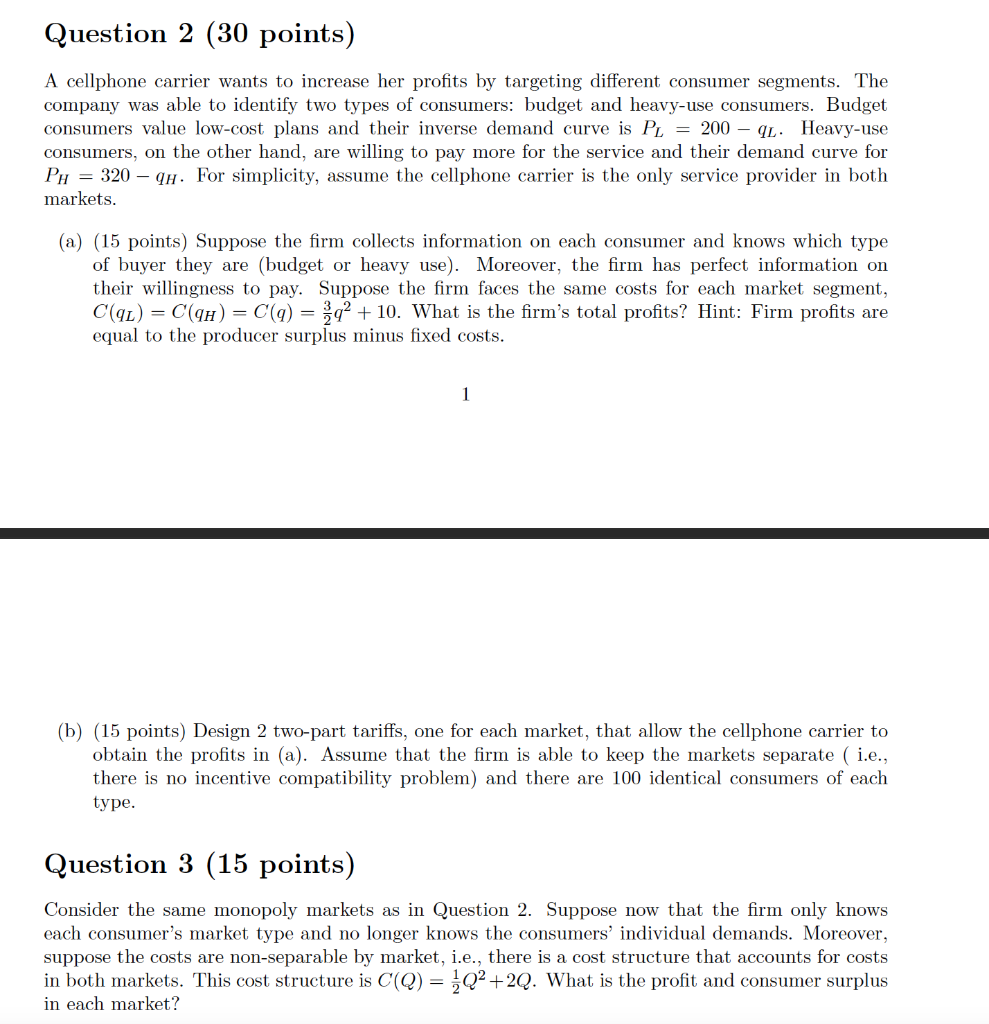
Question 2 (30 points) A cellphone carrier wants to increase her profits by targeting different consumer segments. The company was able to identify two types of consumers: budget and heavy-use consumers. Budget consumers value low-cost plans and their inverse demand curve is PL=200qL. Heavy-use consumers, on the other hand, are willing to pay more for the service and their demand curve for PH=320qH. For simplicity, assume the cellphone carrier is the only service provider in both markets. (a) (15 points) Suppose the firm collects information on each consumer and knows which type of buyer they are (budget or heavy use). Moreover, the firm has perfect information on their willingness to pay. Suppose the firm faces the same costs for each market segment, C(qL)=C(qH)=C(q)=23q2+10. What is the firm's total profits? Hint: Firm profits are equal to the producer surplus minus fixed costs. 1 (b) (15 points) Design 2 two-part tariffs, one for each market, that allow the cellphone carrier to obtain the profits in (a). Assume that the firm is able to keep the markets separate ( i.e., there is no incentive compatibility problem) and there are 100 identical consumers of each type. Question 3 ( 15 points) Consider the same monopoly markets as in Question 2. Suppose now that the firm only knows each consumer's market type and no longer knows the consumers' individual demands. Moreover, suppose the costs are non-separable by market, i.e., there is a cost structure that accounts for costs in both markets. This cost structure is C(Q)=21Q2+2Q. What is the profit and consumer surplus in each market? Question 2 (30 points) A cellphone carrier wants to increase her profits by targeting different consumer segments. The company was able to identify two types of consumers: budget and heavy-use consumers. Budget consumers value low-cost plans and their inverse demand curve is PL=200qL. Heavy-use consumers, on the other hand, are willing to pay more for the service and their demand curve for PH=320qH. For simplicity, assume the cellphone carrier is the only service provider in both markets. (a) (15 points) Suppose the firm collects information on each consumer and knows which type of buyer they are (budget or heavy use). Moreover, the firm has perfect information on their willingness to pay. Suppose the firm faces the same costs for each market segment, C(qL)=C(qH)=C(q)=23q2+10. What is the firm's total profits? Hint: Firm profits are equal to the producer surplus minus fixed costs. 1 (b) (15 points) Design 2 two-part tariffs, one for each market, that allow the cellphone carrier to obtain the profits in (a). Assume that the firm is able to keep the markets separate ( i.e., there is no incentive compatibility problem) and there are 100 identical consumers of each type. Question 3 ( 15 points) Consider the same monopoly markets as in Question 2. Suppose now that the firm only knows each consumer's market type and no longer knows the consumers' individual demands. Moreover, suppose the costs are non-separable by market, i.e., there is a cost structure that accounts for costs in both markets. This cost structure is C(Q)=21Q2+2Q. What is the profit and consumer surplus in each market
Step by Step Solution
There are 3 Steps involved in it

Get step-by-step solutions from verified subject matter experts
 Study Help