







Question: please answer question 4 3) Case 8.1 : The Vision Failed Please respond to question 4 at the end of the case using the principles
please answer question 4 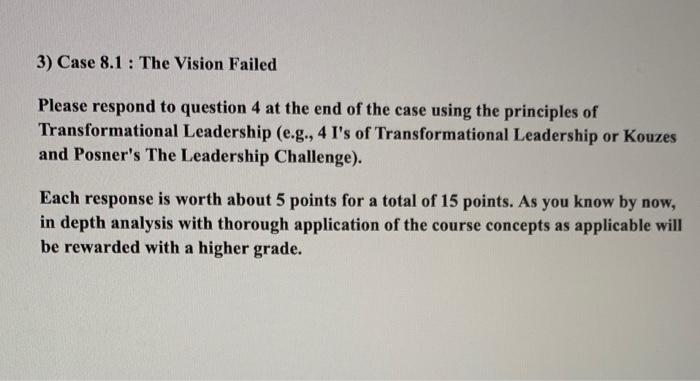
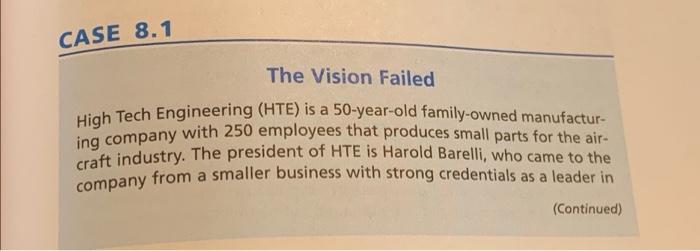
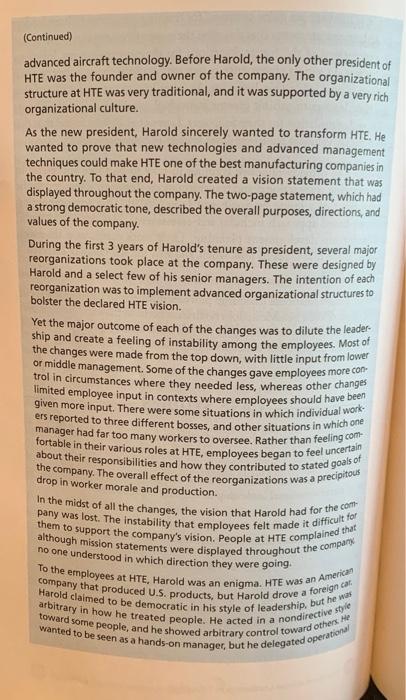
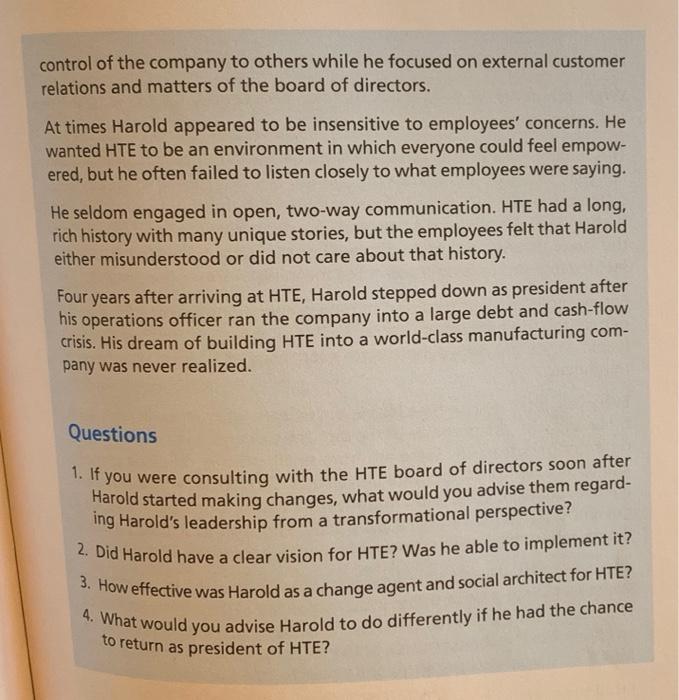
3) Case 8.1 : The Vision Failed Please respond to question 4 at the end of the case using the principles of Transformational Leadership (e.g., 4 I's of Transformational Leadership or Kouzes and Posner's The Leadership Challenge). Each response is worth about 5 points for a total of 15 points. As you know by now, in depth analysis with thorough application of the course concepts as applicable will be rewarded with a higher grade. CASE 8.1 The Vision Failed High Tech Engineering (HTE) is a 50-year-old family-owned manufactur- ing company with 250 employees that produces small parts for the air- craft industry. The president of HTE is Harold Barelli, who came to the company from a smaller business with strong credentials as a leader in (Continued) (Continued) advanced aircraft technology. Before Harold, the only other president of HTE was the founder and owner of the company. The organizational structure at HTE was very traditional, and it was supported by a very rich organizational culture. As the new president, Harold sincerely wanted to transform HTE. He wanted to prove that new technologies and advanced management techniques could make HTE one of the best manufacturing companies in the country. To that end, Harold created a vision statement that was displayed throughout the company. The two-page statement, which had a strong democratic tone, described the overall purposes, directions, and values of the company. During the first 3 years of Harold's tenure as president, several major reorganizations took place at the company. These were designed by Harold and a select few of his senior managers. The intention of each reorganization was to implement advanced organizational structures to bolster the declared HT vision. Yet the major outcome of each of the changes was to dilute the leader ship and create a feeling of instability among the employees. Most of the changes were made from the top down, with little input from lower or middle management. Some of the changes gave employees more con trol in circumstances where they needed less, whereas other changes limited employee input in contexts where employees should have been given more input. There were some situations in which individual work manager had far too many workers to oversee. Rather than feeling.com ers reported to three different bosses, and other situations in which one fortable in their various roles at HTE, employees began to feel uncertain about their responsibilities and how they contributed to stated goals of the company. The overall effect of the reorganizations was a precipitous drop in worker morale and production. In the midst of all the changes, the vision that Harold had for the com pany was lost. The instability that employees felt made it difficult for them to support the company's vision. People at HTE complained that although mission statements were displayed throughout the company To the employees at HTE, Harold was an enigma. HTE was an America company that produced U.S. products, but Harold drove a foreign cat Harold claimed to be democratic in his style of leadership, but he was arbitrary in how he treated people. He acted in a nondirective style wanted to be seen as a hands-on manager, but he delegated operation toward some people, and he showed arbitrary control toward others. He no one understood in which direction they were going. control of the company to others while he focused on external customer relations and matters of the board of directors. At times Harold appeared to be insensitive to employees' concerns. He wanted HTE to be an environment in which everyone could feel empow- ered, but he often failed to listen closely to what employees were saying. He seldom engaged in open, two-way communication. HTE had a long, rich history with many unique stories, but the employees felt that Harold either misunderstood or did not care about that history. Four years after arriving at HTE, Harold stepped down as president after his operations officer ran the company into a large debt and cash-flow crisis. His dream of building HTE into a world-class manufacturing com- pany was never realized. a a Questions 1. If you were consulting with the HTE board of directors soon after Harold started making changes, what would you advise them regard- ing Harold's leadership from a transformational perspective? 2. Did Harold have a clear vision for HTE? Was he able to implement it? 3. How effective was Harold as a change agent and social architect for HTE? 4. What would you advise Harold to do differently if he had the chance to return as president of HTE Step by Step Solution
There are 3 Steps involved in it
1 Expert Approved Answer
Step: 1 Unlock

Question Has Been Solved by an Expert!
Get step-by-step solutions from verified subject matter experts
Step: 2 Unlock
Step: 3 Unlock
 Study Help