







Question: please answer question 4,5 CASE Anti-terrorism agencies around the world have made effective use of new surveillance tech- nologies that offer unprecedented abilities to identify
please answer question 4,5 
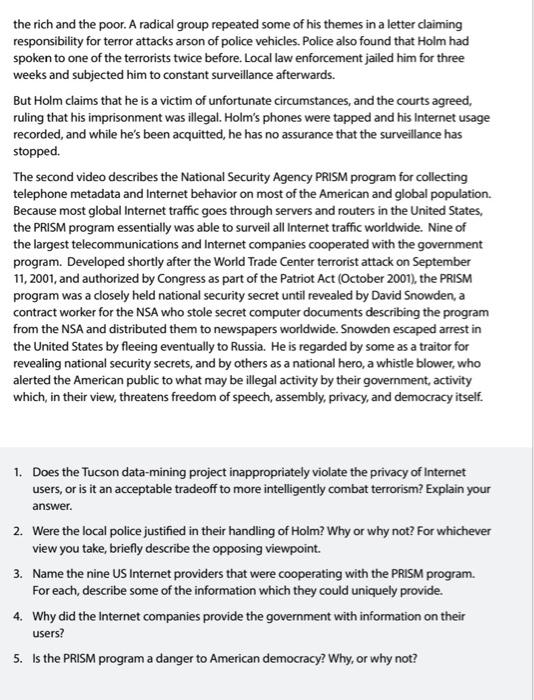
CASE Anti-terrorism agencies around the world have made effective use of new surveillance tech- nologies that offer unprecedented abilities to identify and apprehend potential terrorists. Today's terrorists are by nature difficult to track, as disconnected groups of individuals can use the Internet to communicate their plans with lower chance of detection. Anti-terrorist technology has evolved to better handle this new type of threat. But there are drawbacks to these new strategies. Often, innocent people may find their privacy compromised or completely eliminated as a result of inaccurate information. Surveillance technologies are constantly improving. While this makes it more difficult for continued terrorists and other criminals to exchange information, it also jeopardizes our privacy, on the Internet and elsewhere going forward. For instance, it may be necessary to monitor the phone calls of all American citizens, and visiting foreigners, in order to uncover a terrorist plot. Is this reason for worry? Are comparisons to Orwell's 1984 appropriate or overblown? The first video displays both the positive and negative results of new advances in tech- nology. The first segment describes a program called the Dark Web Project developed by a team at the University of Tucson that combs the Internet in search of militant leaders and their followers. The program creates profiles based on word length, punctuation, syntax, and content, and displays information about the personality type of an individual graphically. 36 D'8999 The plotting of information on a graph represents whether the user is violent or militant inexperienced and seeking advice, or an opinion leader holding sway over many more people. Programs like this have been adopted by many intelligence agencies worldwide, who incorporate it into their arsenal of terrorist surveillance technologies. It's undear if this project infringes on freedom of speech and individual privacy. On the one hand, detection of a potential terrorist is potentially an important method of deterring future terrorist attacks. On the other hand, individuals who haven't done or said anything wrong may be profiled and have their private conversations exposed. An additional concern is how to distinguish what kinds of speech are grounds for surveillance. The second segment of the video describes the plight of a German sociology professor, Andrej Holm, subjected to jail time and 24-hour surveillance thanks to his supposed associa- tion with a terror cell. Holm has written extensively on gentrification, or the gap between continued the rich and the poor. A radical group repeated some of his themes in a letter claiming responsibility for terror attacks arson of police vehicles. Police also found that Holm had spoken to one of the terrorists twice before. Local law enforcement jailed him for three weeks and subjected him to constant surveillance afterwards. But Holm claims that he is a victim of unfortunate circumstances, and the courts agreed, ruling that his imprisonment was illegal. Holm's phones were tapped and his Internet usage recorded, and while he's been acquitted, he has no assurance that the surveillance has stopped. The second video describes the National Security Agency PRISM program for collecting telephone metadata and Internet behavior on most of the American and global population. Because most global Internet traffic goes through servers and routers in the United States, the PRISM program essentially was able to surveil all Internet traffic worldwide. Nine of the largest telecommunications and Internet companies cooperated with the government program. Developed shortly after the World Trade Center terrorist attack on September 11, 2001, and authorized by Congress as part of the Patriot Act (October 2001), the PRISM program was a closely held national security secret until revealed by David Snowden, a contract worker for the NSA who stole secret computer documents describing the program from the NSA and distributed them to newspapers worldwide. Snowden escaped arrest in the United States by fleeing eventually to Russia. He is regarded by some as a traitor for revealing national security secrets, and by others as a national hero, a whistle blower, who alerted the American public to what may be illegal activity by their government, activity which, in their view, threatens freedom of speech, assembly, privacy, and democracy itself. 1. Does the Tucson data-mining project inappropriately violate the privacy of Internet users, or is it an acceptable tradeoff to more intelligently combat terrorism? Explain your answer. 2. Were the local police justified in their handling of Holm? Why or why not? For whichever view you take, briefly describe the opposing viewpoint. 3. Name the nine US Internet providers that were cooperating with the PRISM program. For each, describe some of the information which they could uniquely provide. 4. Why did the Internet companies provide the government with information on their users? 5. Is the PRISM program a danger to American democracy? Why, or why not Step by Step Solution
There are 3 Steps involved in it
1 Expert Approved Answer
Step: 1 Unlock

Question Has Been Solved by an Expert!
Get step-by-step solutions from verified subject matter experts
Step: 2 Unlock
Step: 3 Unlock
 Study Help