







Question: Please Answer Question #5. 5. Develop a single expression for the acceleration of an Atwood's machine, combining the results of the previous two steps in
Please Answer Question #5.
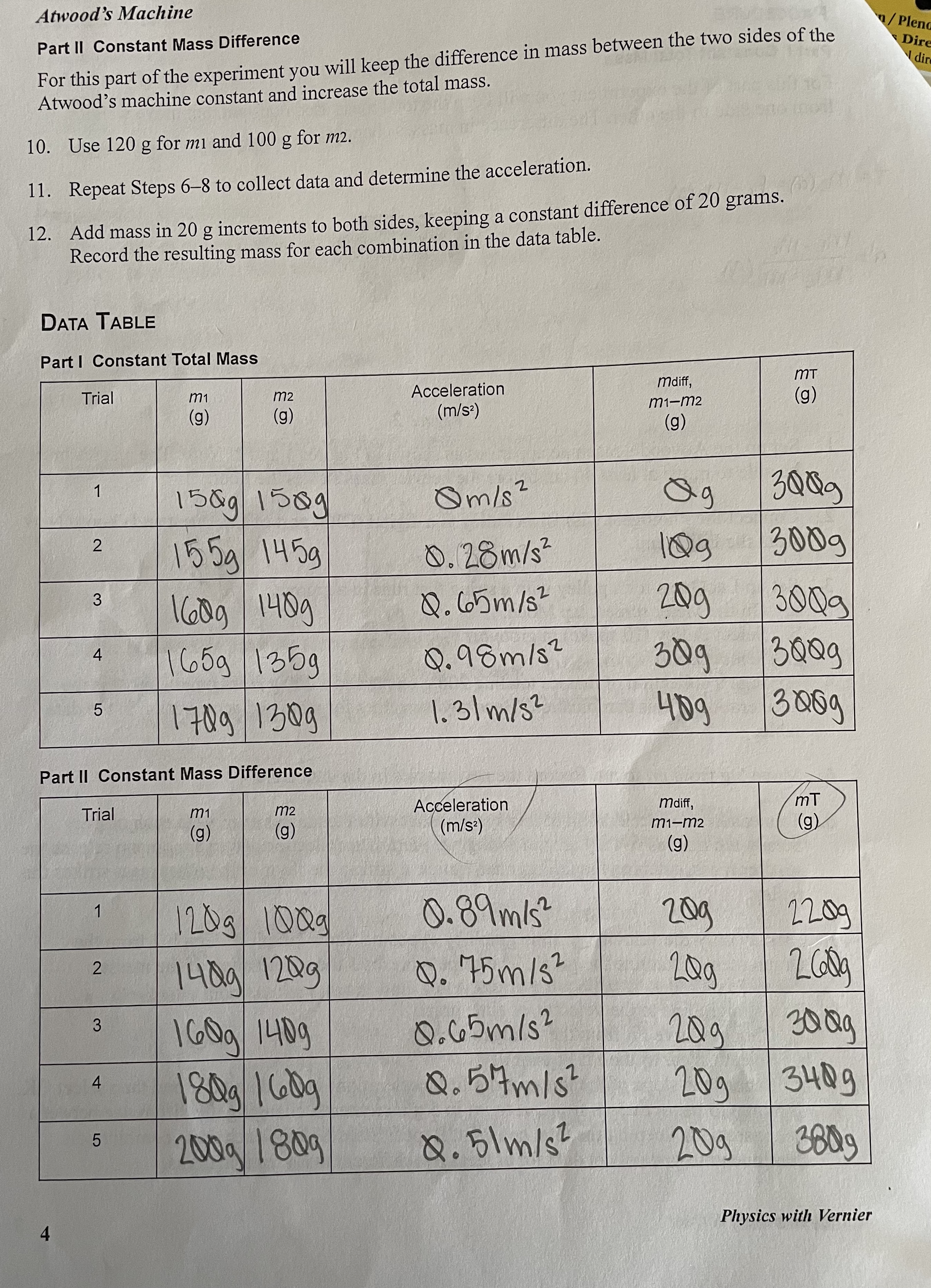
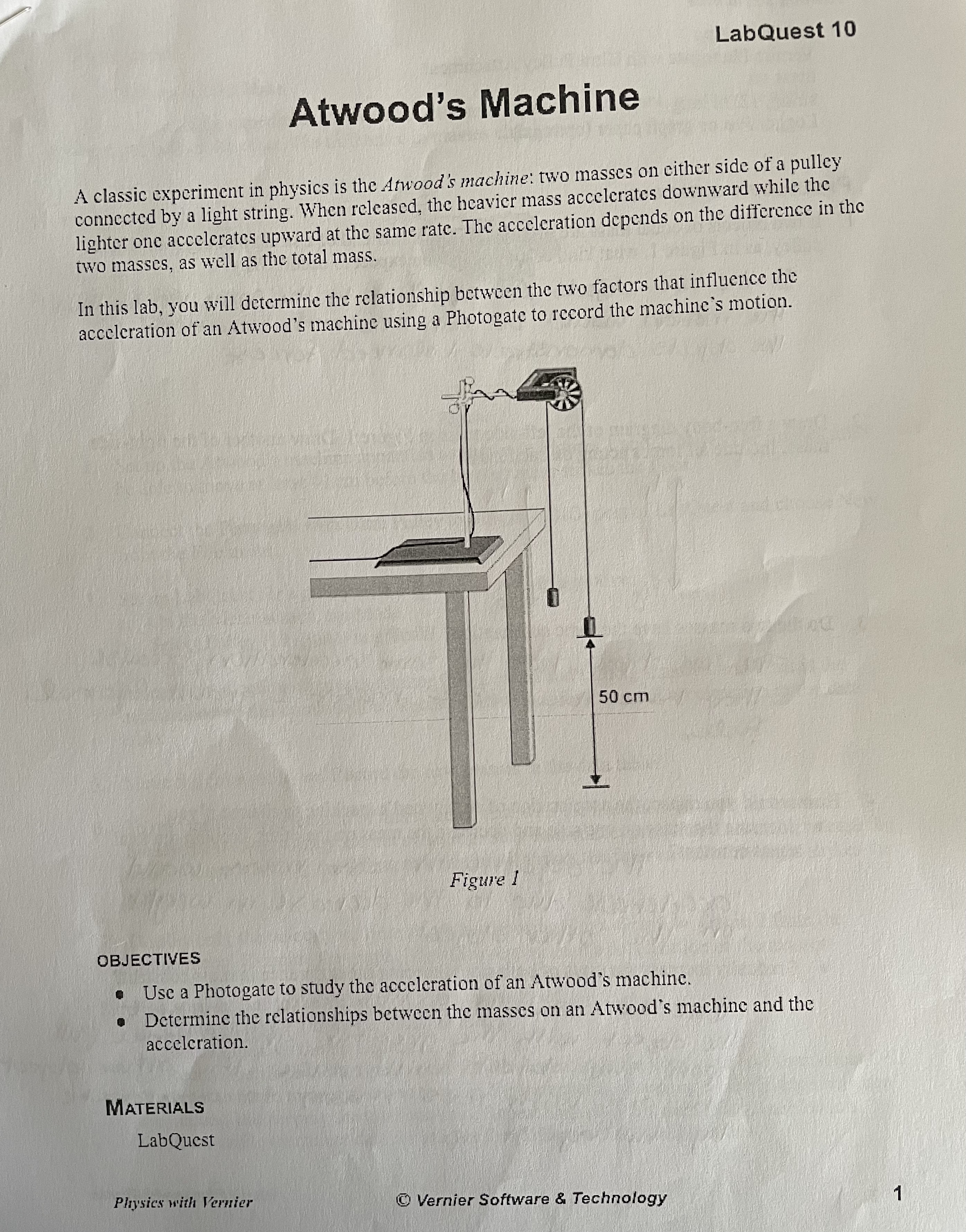
5. Develop a single expression for the acceleration of an Atwood's machine, combining the results of the previous two steps in the analysis.Atwood's Machine Part II Constant Mass Difference / Plen For this part of the experiment you will keep the difference in mass between the two sides of the Dir Atwood's machine constant and increase the total mass. 10. Use 120 g for mi and 100 g for m2. 11. Repeat Steps 6-8 to collect data and determine the acceleration. 12. Add mass in 20 g increments to both sides, keeping a constant difference of 20 grams. Record the resulting mass for each combination in the data table. DATA TABLE Part | Constant Total Mass Trial Acceleration mdiff, MT m1 M2 (9) (g) (m/s2) m1-m2 (g) (g) Om/s ? 3009 N 15 5g/145g 0. 28 m /s 2 109 300g 160g 140g Q. 65 m /s 2 209 30Qa 4 1659 135g Q. 98 m / s 2 309 3QQ9 5 1709 1309 1. 31 m/s 2 409 3Q09 Part II Constant Mass Difference Trial m1 m2 Acceleration mdiff, mT (g) (g ) (m/sz) m1-m2 (9) (g) 1209 / 10Q9 0. 89 m/s 2 209 2209 N 140g/ 120g Q. 75 m/s 2 160g 140g Q. 65m/s 2 209 30 09 4 1809/ 160g Q. 57m/s ? 20g 3409 5 2009 1809 Q. 51 m/ s 20g 380g 4 Physics with VernierLabQuest 10 Atwood's Machine A classic experiment in physics is the Atwood's machine: two masses on either side of a pulley connected by a light string. When released. the heavier mass accelerates downward while the lighter one accelerates upward at the same rate. The acceleration depends on the difference in the two masses, as well as the total mass. In this lab, you will determine the relationship between the two factors that influence the acceleration of an Atwood's machine using a Photogate to record the machine's motion. 50 cm Figure I OBJECTIVES Use a Photogate to study the acceleration of an Atwood's machine. Determine the relationships between the masses on an Atwood's machine and the acceleration. MATERIALS LabQuest Physics with Vernier @ Vernier Software & Technology 1
Step by Step Solution
There are 3 Steps involved in it

Get step-by-step solutions from verified subject matter experts
 Study Help