







Question: Please answer question number E2-6 C) Decreases assets during the period by purchasing the company's own shares 7 E2-5 (Assumptions, Principles, and Constraint) Presented below
Please answer question number E2-6
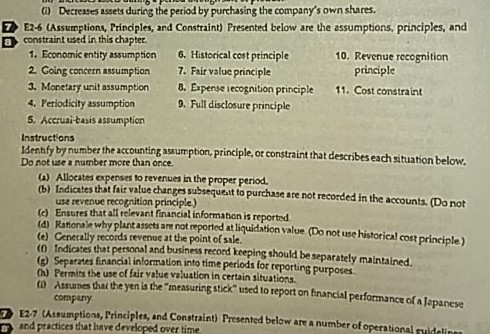
C) Decreases assets during the period by purchasing the company's own shares 7 E2-5 (Assumptions, Principles, and Constraint) Presented below are the assumptions, principles, and a constraint used in this chaptet 1. Economic entity assumption 6. Historical cost principle 2. Coing concern assumption 7. Fair value principle 3. Monetary unit assumption 8. Expense iecognition principle 4. Periodicity assumption 5. Accruai-basis assumption 10. Revenue recognition principle 11. Cost constraint . Full disclosure principle Instruct ons number the accounting assureption, principle,or constraint that describes each situation below. Do not use a number more than once (a) Allocates expenses to revenues in the proper period (b) Indicates that fair value changes subsequeat to purchase are not recorded in the accounts. (Do not use revenue recognition principle.) d Ensures that all relevant financial information is reported (d) Rationale why plant assets are not reported at liquidation value (Do not use historical cost principle) (e) Cenerally records revenuc at the point of sale. 0 Indicates that personal and business record keeping should be separately maintained (g) Separates financial information into time periods for reporting purposes (h) Permits the use of fair value valuation in certain situations Assures thai the yen is the-measuring stick" used to report on hnancial performance ofa!apanese compuny 7E2-7 Assumptions, Principles, and Constraint) Presented below are a number of operational suidelin m and practices that have developed over time
Step by Step Solution
There are 3 Steps involved in it

Get step-by-step solutions from verified subject matter experts
 Study Help