







Question: please answer questions 1 and 2 458 PART 4 Compensating Human Resources THINKING ETHICALLY employers offer health insurance to part-timers, UPS, fot example, offers benefits
please answer questions 1 and 2
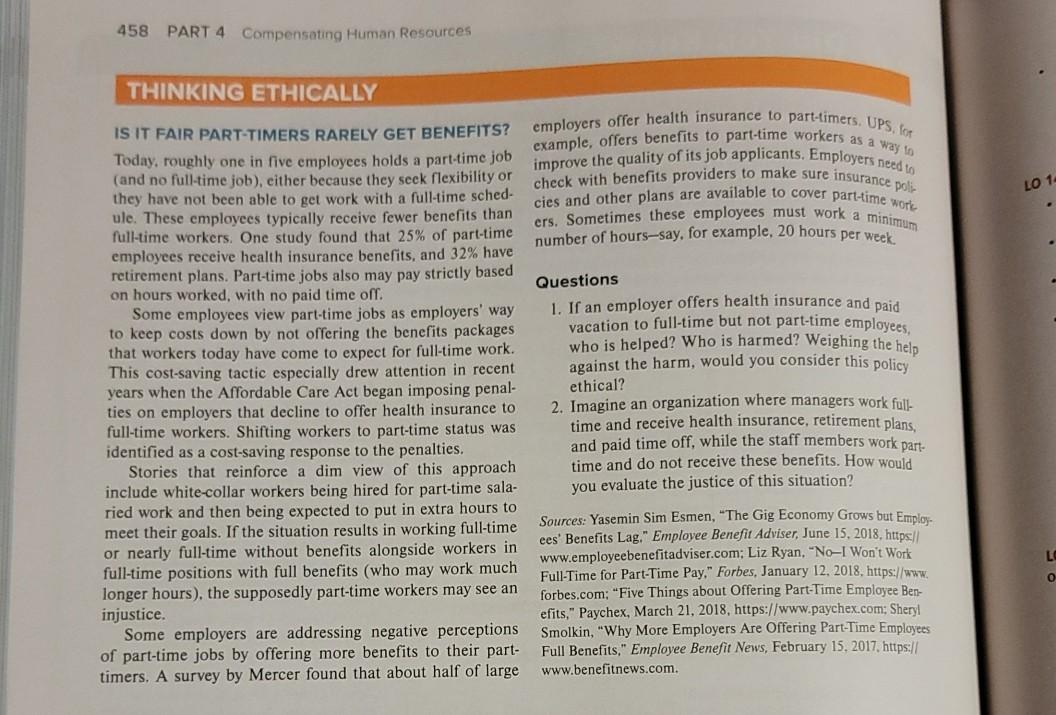
458 PART 4 Compensating Human Resources THINKING ETHICALLY employers offer health insurance to part-timers, UPS, fot example, offers benefits to part-time workers as a way to improve the quality of its job applicants. Employers need to check with benefits providers to make sure insurance poli cies and other plans are available to cover part-time work ers. Sometimes these employees must work a minimum LO 1 number of hours-say, for example, 20 hours per week IS IT FAIR PART-TIMERS RARELY GET BENEFITS? Today, roughly one in five employees holds a part-time job (and no full-time job), either because they seek flexibility or they have not been able to get work with a full-time sched- ule. These employees typically receive fewer benefits than full-time workers. One study found that 25% of part-time employees receive health insurance benefits, and 32% have retirement plans. Part-time jobs also may pay strictly based on hours worked, with no paid time off. Some employees view part-time jobs as employers' way to keep costs down by not offering the benefits packages that workers today have come to expect for full-time work. This cost-saving tactic especially drew attention in recent years when the Affordable Care Act began imposing penal- ties on employers that decline to offer health insurance to full-time workers. Shifting workers to part-time status was identified as a cost-saving response to the penalties. Stories that reinforce a dim view of this approach include white collar workers being hired for part-time sala- ried work and then being expected to put in extra hours to meet their goals. If the situation results in working full-time or nearly full-time without benefits alongside workers in full-time positions with full benefits (who may work much longer hours), the supposedly part-time workers may see an injustice. Some employers are addressing negative perceptions of part-time jobs by offering more benefits to their part- timers. A survey by Mercer found that about half of large Questions 1. If an employer offers health insurance and paid vacation to full-time but not part-time employees who is helped? Who is harmed? Weighing the help against the harm, would you consider this policy ethical? 2. Imagine an organization where managers work full- time and receive health insurance, retirement plans, and paid time off, while the staff members work part- time and do not receive these benefits. How would you evaluate the justice of this situation? Sources: Yasemin Sim Esmen, "The Gig Economy Grows but Employ- ees' Benefits Lag." Employee Benefit Adviser, June 15, 2018, https:// www.employeebenefitadviser.com; Liz Ryan. "No-I Won't Work Full-Time for Part-Time Pay." Forbes, January 12, 2018, https://www. forbes.com; "Five Things about Offering Part-Time Employee Ben- efits," Paychex, March 21, 2018, https://www.paychex.com; Sheryl Smolkin, "Why More Employers Are Offering Part-Time Employees Full Benefits," Employee Benefit News, February 15, 2017. https:// www.benefitnews.com. LE 0Step by Step Solution
There are 3 Steps involved in it
1 Expert Approved Answer
Step: 1 Unlock

Question Has Been Solved by an Expert!
Get step-by-step solutions from verified subject matter experts
Step: 2 Unlock
Step: 3 Unlock
 Study Help