Question: Please answer questions 1-3. Question 4 is not needed. Renaissance Clinic is a hospital dedicated to the health care or to Dr. Thompson. On some
Please answer questions 1-3. Question 4 is not needed.
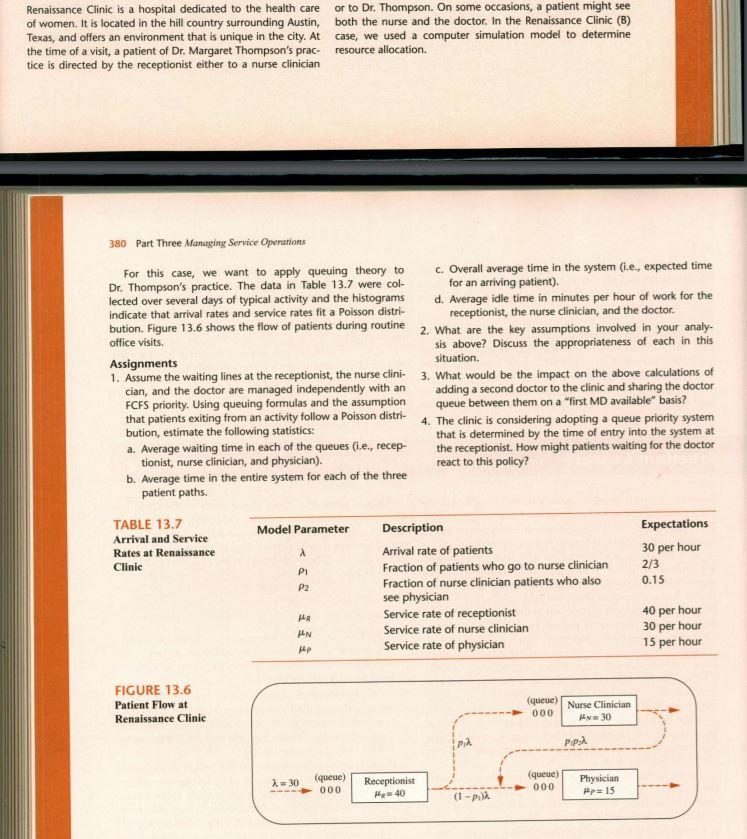
Renaissance Clinic is a hospital dedicated to the health care or to Dr. Thompson. On some occasions, a patient might see of women. It is located in the hill country surrounding Austin, both the nurse and the doctor. In the Renaissance Clinic (8) Texas, and offers an environment that is unique in the city. At case, we used a computer simulation model to determine the time of a visit, a patient of Dr. Margaret Thompson's prac resource allocation. tice is directed by the receptionist either to a nurse clinician 380 Part Three Managing Service Operations For this case, we want to apply queuing theory to c. Overall average time in the system (i.e., expected time Dr. Thompson's practice. The data in Table 13.7 were col- for an arriving patient). lected over several days of typical activity and the histograms d. Average idle time in minutes per hour of work for the indicate that arrival rates and service rates fit a Poisson distri- receptionist, the nurse clinician, and the doctor. bution. Figure 13.6 shows the flow of patients during routine 2. What are the key assumptions involved in your analy- office visits. sis above? Discuss the appropriateness of each in this Assignments situation. 1. Assume the waiting lines at the receptionist, the nurse clini- 3. What would be the impact on the above calculations of cian, and the doctor are managed independently with an adding a second doctor to the clinic and sharing the doctor FCFS priority, Using queuing formulas and the assumption queue between them on a "first MD available" basis? that patients exiting from an activity follow a Poisson distri- 4. The clinic is considering adopting a queue priority system bution, estimate the following statistics: that is determined by the time of entry into the system at a. Average waiting time in each of the queues (i.e., recep- the receptionist. How might patients waiting for the doctor tionist, nurse clinician, and physician). react to this policy? b. Average time in the entire system for each of the three patient paths. Model Parameter TABLE 13.7 Arrival and Service Rates at Renaissance Clinic Description Arrival rate of patients Fraction of patients who go to nurse clinician Fraction of nurse clinician patients who also see physician Service rate of receptionist Service rate of nurse clinician Service rate of physician Expectations 30 per hour 2/3 0.15 Pi P2 HAR IN Up 40 per hour 30 per hour 15 per hour FIGURE 13.6 Patient Flow at Renaissance Clinic (queue) 000 Nurse Clinician N30 PA .. 2 = 30 (queue 000 Receptionist (queue) 000 Physician Hp 15 He40 (1-pild Renaissance Clinic is a hospital dedicated to the health care or to Dr. Thompson. On some occasions, a patient might see of women. It is located in the hill country surrounding Austin, both the nurse and the doctor. In the Renaissance Clinic (8) Texas, and offers an environment that is unique in the city. At case, we used a computer simulation model to determine the time of a visit, a patient of Dr. Margaret Thompson's prac resource allocation. tice is directed by the receptionist either to a nurse clinician 380 Part Three Managing Service Operations For this case, we want to apply queuing theory to c. Overall average time in the system (i.e., expected time Dr. Thompson's practice. The data in Table 13.7 were col- for an arriving patient). lected over several days of typical activity and the histograms d. Average idle time in minutes per hour of work for the indicate that arrival rates and service rates fit a Poisson distri- receptionist, the nurse clinician, and the doctor. bution. Figure 13.6 shows the flow of patients during routine 2. What are the key assumptions involved in your analy- office visits. sis above? Discuss the appropriateness of each in this Assignments situation. 1. Assume the waiting lines at the receptionist, the nurse clini- 3. What would be the impact on the above calculations of cian, and the doctor are managed independently with an adding a second doctor to the clinic and sharing the doctor FCFS priority, Using queuing formulas and the assumption queue between them on a "first MD available" basis? that patients exiting from an activity follow a Poisson distri- 4. The clinic is considering adopting a queue priority system bution, estimate the following statistics: that is determined by the time of entry into the system at a. Average waiting time in each of the queues (i.e., recep- the receptionist. How might patients waiting for the doctor tionist, nurse clinician, and physician). react to this policy? b. Average time in the entire system for each of the three patient paths. Model Parameter TABLE 13.7 Arrival and Service Rates at Renaissance Clinic Description Arrival rate of patients Fraction of patients who go to nurse clinician Fraction of nurse clinician patients who also see physician Service rate of receptionist Service rate of nurse clinician Service rate of physician Expectations 30 per hour 2/3 0.15 Pi P2 HAR IN Up 40 per hour 30 per hour 15 per hour FIGURE 13.6 Patient Flow at Renaissance Clinic (queue) 000 Nurse Clinician N30 PA .. 2 = 30 (queue 000 Receptionist (queue) 000 Physician Hp 15 He40 (1-pild









 Study Help