Question: please answer questions one and two after the case thanks! nary Encouraging employee behaviors that help achieve an organization's objectives and foster- ing a sense
please answer questions one and two after the case thanks!
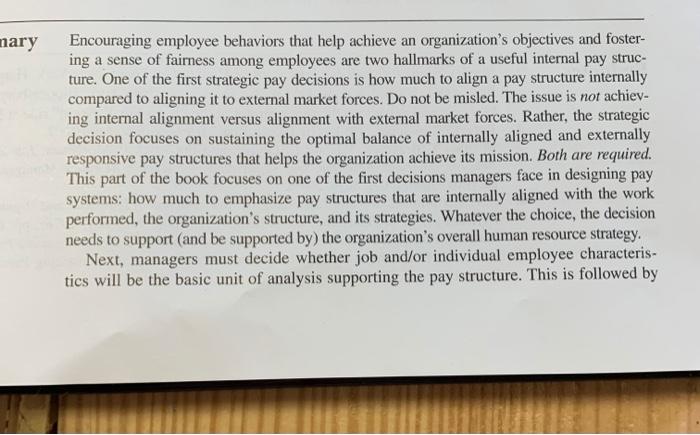
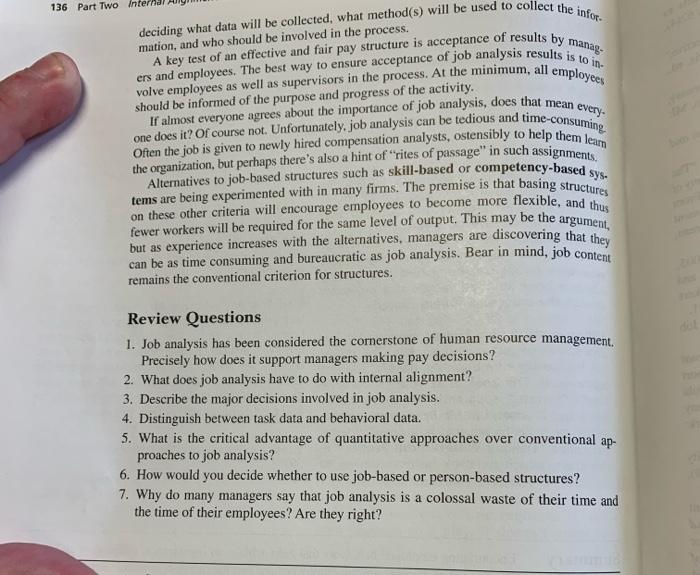
nary Encouraging employee behaviors that help achieve an organization's objectives and foster- ing a sense of fairness among employees are two hallmarks of a useful internal pay struc- ture. One of the first strategic pay decisions is how much to align a pay structure internally compared to aligning it to external market forces. Do not be misled. The issue is not achiev- ing internal alignment versus alignment with external market forces. Rather, the strategic decision focuses on sustaining the optimal balance of internally aligned and externally responsive pay structures that helps the organization achieve its mission. Both are required. This part of the book focuses on one of the first decisions managers face in designing pay systems: how much to emphasize pay structures that are internally aligned with the work performed, the organization's structure, and its strategies. Whatever the choice, the decision needs to support (and be supported by) the organization's overall human resource strategy. Next, managers must decide whether job and/or individual employee characteris- tics will be the basic unit of analysis supporting the pay structure. This is followed by 136 Part Two deciding what data will be collected, what method(s) will be used to collect the infor mation, and who should be involved in the process. ers and employees. The best way to ensure acceptance of job analysis results is to in- A key test of an effective and fair pay structure is acceptance of results by manag- volve employees as well as supervisors in the process. At the minimum, all employees should be informed of the purpose and progress of the activity. If almost everyone agrees about the importance of job analysis, does that mean every Often the job is given to newly hired compensation analysts, ostensibly to help them learn one does it? Of course not. Unfortunately, job analysis can be tedious and time-consuming the organization, but perhaps there's also a hint of rites of passage in such assignments Alternatives to job-based structures such as skill-based or competency-based sys- tems are being experimented with in many firms. The premise is that basing structures on these other criteria will encourage employees to become more flexible, and thus fewer workers will be required for the same level of output. This may be the argument, but as experience increases with the alternatives, managers are discovering that they can be as time consuming and bureaucratic as job analysis. Bear in mind, job conten remains the conventional criterion for structures. Review Questions 1. Job analysis has been considered the cornerstone of human resource management. Precisely how does it support managers making pay decisions? 2. What does job analysis have to do with internal alignment? 3. Describe the major decisions involved in job analysis. 4. Distinguish between task data and behavioral data. 5. What is the critical advantage of quantitative approaches over conventional ap- proaches to job analysis? 6. How would you decide whether to use job-based or person-based structures? 7. Why do many managers say that job analysis is a colossal waste of their time and the time of their employees? Are they right? nary Encouraging employee behaviors that help achieve an organization's objectives and foster- ing a sense of fairness among employees are two hallmarks of a useful internal pay struc- ture. One of the first strategic pay decisions is how much to align a pay structure internally compared to aligning it to external market forces. Do not be misled. The issue is not achiev- ing internal alignment versus alignment with external market forces. Rather, the strategic decision focuses on sustaining the optimal balance of internally aligned and externally responsive pay structures that helps the organization achieve its mission. Both are required. This part of the book focuses on one of the first decisions managers face in designing pay systems: how much to emphasize pay structures that are internally aligned with the work performed, the organization's structure, and its strategies. Whatever the choice, the decision needs to support (and be supported by) the organization's overall human resource strategy. Next, managers must decide whether job and/or individual employee characteris- tics will be the basic unit of analysis supporting the pay structure. This is followed by 136 Part Two deciding what data will be collected, what method(s) will be used to collect the infor mation, and who should be involved in the process. ers and employees. The best way to ensure acceptance of job analysis results is to in- A key test of an effective and fair pay structure is acceptance of results by manag- volve employees as well as supervisors in the process. At the minimum, all employees should be informed of the purpose and progress of the activity. If almost everyone agrees about the importance of job analysis, does that mean every Often the job is given to newly hired compensation analysts, ostensibly to help them learn one does it? Of course not. Unfortunately, job analysis can be tedious and time-consuming the organization, but perhaps there's also a hint of rites of passage in such assignments Alternatives to job-based structures such as skill-based or competency-based sys- tems are being experimented with in many firms. The premise is that basing structures on these other criteria will encourage employees to become more flexible, and thus fewer workers will be required for the same level of output. This may be the argument, but as experience increases with the alternatives, managers are discovering that they can be as time consuming and bureaucratic as job analysis. Bear in mind, job conten remains the conventional criterion for structures. Review Questions 1. Job analysis has been considered the cornerstone of human resource management. Precisely how does it support managers making pay decisions? 2. What does job analysis have to do with internal alignment? 3. Describe the major decisions involved in job analysis. 4. Distinguish between task data and behavioral data. 5. What is the critical advantage of quantitative approaches over conventional ap- proaches to job analysis? 6. How would you decide whether to use job-based or person-based structures? 7. Why do many managers say that job analysis is a colossal waste of their time and the time of their employees? Are they right









 Study Help