







Question: Please answer requirement a and b. Thanks More info It purchases cocoa beans and processes them into two intermediate products: chocolate-powder liquor base and milk-chocolate
Please answer requirement a and b.
Thanks
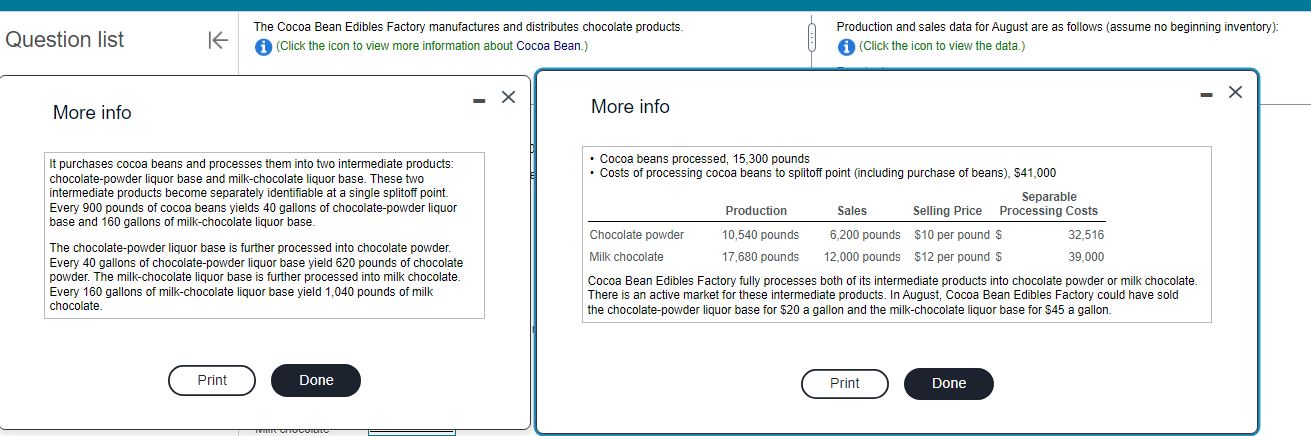
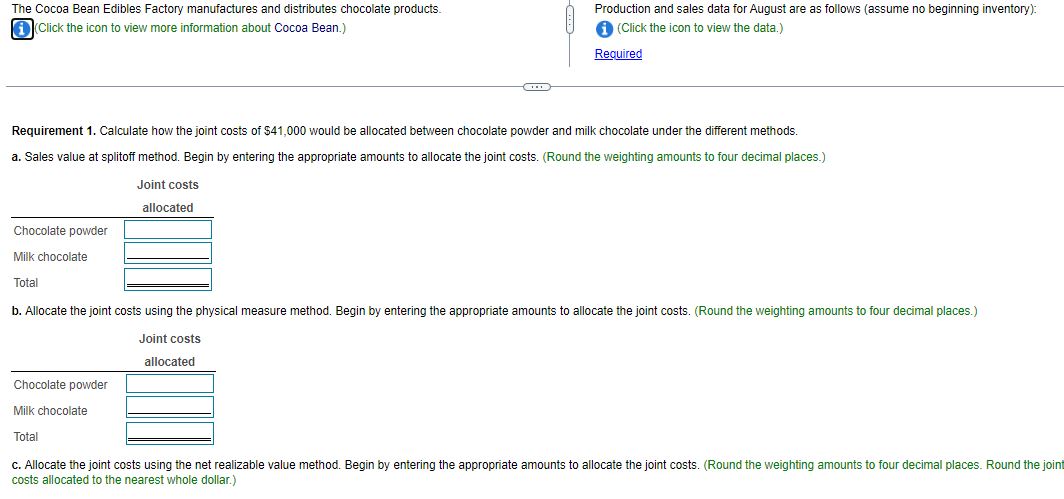
More info It purchases cocoa beans and processes them into two intermediate products: chocolate-powder liquor base and milk-chocolate liquor base. These two intermediate products become separately identifiable at a single splitoff point. Every 900 pounds of cocoa beans yields 40 gallons of chocolate-powder liquor base and 160 gallons of milk-chocolate liquor base. The chocolate-powder liquor base is further processed into chocolate powder. Every 40 gallons of chocolate-powder liquor base yield 620 pounds of chocolate powder. The milk-chocolate liquor base is further processed into milk chocolate. Every 160 gallons of milk-chocolate liquor base yield 1,040 pounds of milk chocolate. More info - Cocoa beans processed, 15,300 pounds - Costs of processing cocoa beans to splitoff point (including purchase of beans), $41,000 Cocoa Bean Edibles Factory fully processes both of its intermediate products into chocolate powder or milk chocolate. There is an active market for these intermediate products. In August, Cocoa Bean Edibles Factory could have sold the chocolate-powder liquor base for $20 a gallon and the milk-chocolate liquor base for $45 a gallon. The Cocoa Bean Edibles Factory manufactures and distributes chocolate products. 'Click the icon to view more information about Cocoa Bean.) Production and sales data for August are as follows (assume no beginning inventory): (Click the icon to view the data.) Required Requirement 1. Calculate how the joint costs of $41,000 would be allocated between chocolate powder and milk chocolate under the different methods. a. Sales value at splitoff method. Begin by entering the appropriate amounts to allocate the joint costs. (Round the weighting amounts to four decimal places.) b. Allocate the joint costs using the physical measure method. Begin by entering the appropriate amounts to allocate the joint costs. (Round the weighting amounts to four decimal places.) c. Allocate the joint costs using the net realizable value method. Begin by entering the appropriate amounts to allocate the joint costs. (Round the weighting amounts to four decimal places. Round the joi costs allocated to the nearest whole dollar.)
Step by Step Solution
There are 3 Steps involved in it

Get step-by-step solutions from verified subject matter experts
 Study Help