Question: please answer the case study, will be highly appreciated. INTERACTIVE SESSION: PEOPLE Piloting Procter and Gamble from Decision Cockpits Procter and Gamble (P&G) is the
please answer the case study, will be highly appreciated.
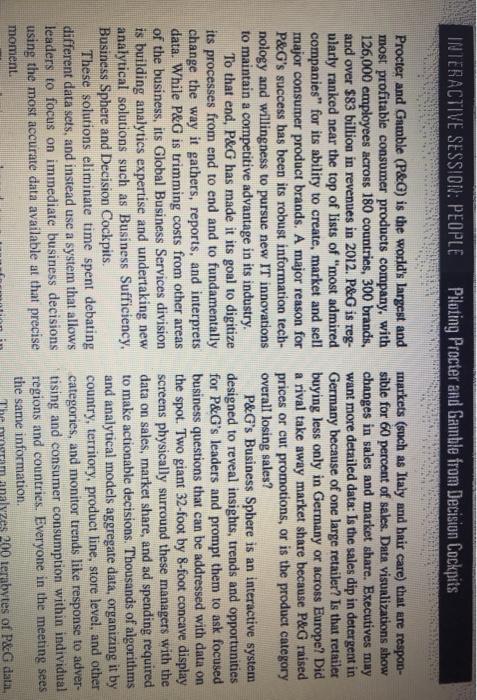
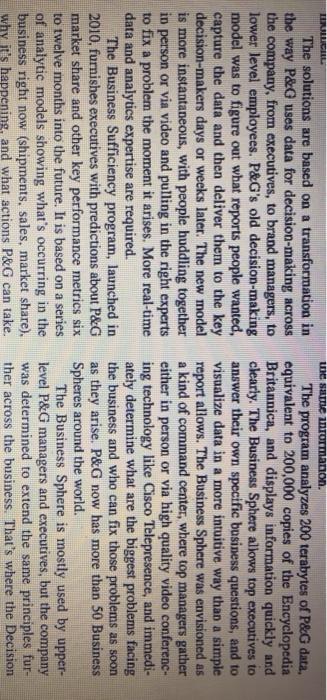
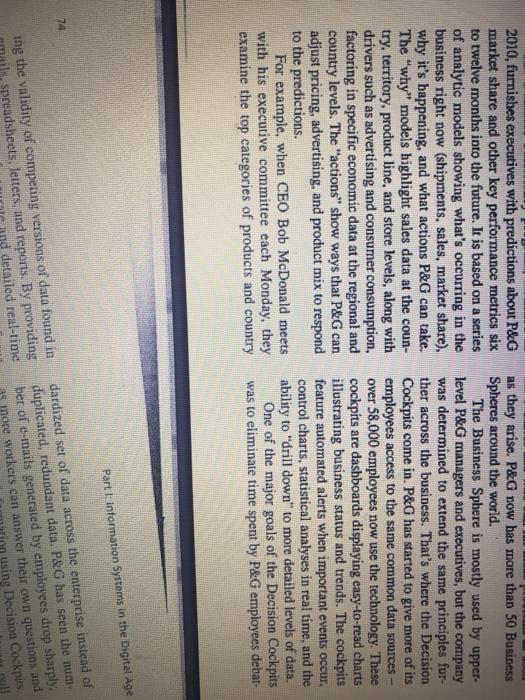
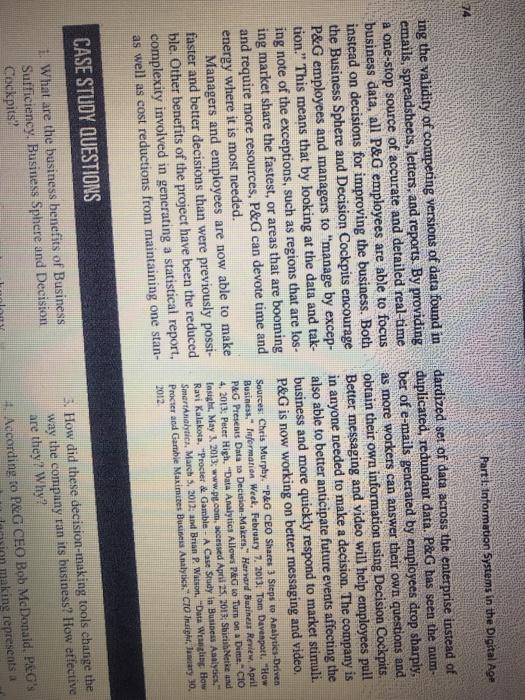
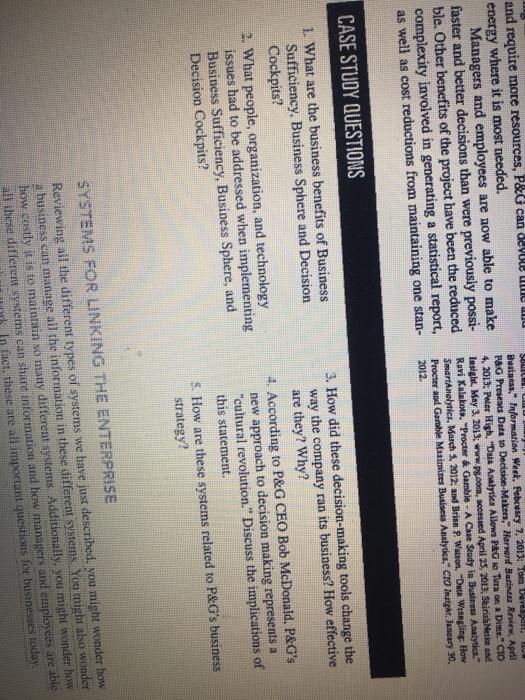
INTERACTIVE SESSION: PEOPLE Piloting Procter and Gamble from Decision Cockpits Procter and Gamble (P&G) is the world's largest and most profitable consumer products company, with 126,000 employees across 180 countries, 300 brands, and over $83 billion in revenues in 2012. P&G is reg- ularly ranked near the top of lists of "most admired companies" for its ability to create, market and sell major consumer product brands. A major reason for P&G's success has been its robust information tech- nology and willingness to pursue new IT innovations to maintain a competitive advantage in its industry. To that end, P&G has made it its goal to digitize its processes from end to end and to fundamentally change the way it gathers, reports, and interprets data. While P&G is trimming costs from other areas of the business, its Global Business Services division is building analytics expertise and undertaking new analytical solutions such as Business Sufficiency, Business Sphere and Decision Cockpits. These solutions eliminate time spent debating different data sets, and instead use a system that allows leaders to focus on immediate business decisions using the most accurate data available at that precise moment markets (such as Italy and hair care) that are respon- sible for 60 percent of sales. Data visualizations show changes in sales and market share. Executives muy want more detailed data: Is the sales dip in detergent in Germany because of one large retailer? Is that retailer buying less only in Germany or across Europe? Did a rival take away market share because P&G raised prices or cut promotions, or is the product category overall losing sales? P&G's Business Sphere is an interactive system designed to reveal insights, trends and opportunities for P&G's leaders and prompt them to ask focused business questions that can be addressed with data on the spot. Two giant 32-foot by 8-foot concave display screens physically surround these managers with the data on sales, market share, and ad spending required to make actionable decisions. Thousands of algorithms and analytical models aggregate data, organizing it by country, territory, product line, store level, and other categories, and monitor trends like response to adver- tising and consumer consumption within individual regions and countries. Everyone in the meeting sees the same information. analyzes 200 terabytes of P&G data. HNIUCH e same Umanon The solutions are based on a transformation in the way P&G uses data for decision-making across the company, from executives, to brand managers, to lower level employees. P&G's old decision-making model was to figure out what reports people wanted, capture the data and then deliver them to the key decision-makers days or weeks later. The new model is more instantaneous, with people huddling together in person or via video and pulling in the right experts to fix a problem the moment it arises. More real-time data and analytics expertise are required. The Business Sufficiency program, launched in 2010, furnishes executives with predictions about P&G market share and other key performance metrics six to twelve months into the future. It is based on a series of analytic models showing what's occurring in the business right now (shipments, sales, market share). why it's happening, and what actions P&G can take. The program analyzes 200 terabytes of P&G data. equivalent to 200,000 copies of the Encyclopedia Britannica, and displays information quickly and clearly. The Business Sphere allows top executives to answer their own specific business questions, and to visualize data in a more intuitive way than a simple report allows. The Business Sphere was envisioned as a kind of command center, where top managers gather either in person or via high quality video conferenc- ing technology like Cisco Telepresence, and immedi- ately determine what are the biggest problems facing the business and who can fix those problems as soon as they arise. P&G now has more than 50 Business Spheres around the world. The Business Sphere is mostly used by upper- level P&G managers and executives, but the company was determined to extend the same principles fur- ther across the business. That's where the Decision 2010, furnishes executives with predictions about P&G market share and other key performance metrics six to twelve months into the future. It is based on a series of analytic models showing what's occurring in the business right now (shipments, sales, market share), why it's happening, and what actions P&G can take. The "why" models highlight sales data at the coun- try, territory, product line, and store levels, along with drivers such as advertising and consumer consumption, factoring in specific economic data at the regional and country levels. The actions" show ways that P&G can adjust pricing, advertising, and product mix to respond to the predictions For example, when CEO Bob McDonald meets with his executive committee each Monday, they examine the top categories of products and country as they arise. P&G now has more than 50 Business Spheres around the world. The Business Sphere is mostly used by upper- level P&G managers and executives, but the company was determined to extend the same principles fur- ther across the business. That's where the Decision Cockpits come in. P&G has started to give more of its employees access to the same common data sources - over 58,000 employees now use the technology. These cockpits are dashboards displaying easy-to-read charts illustrating business status and trends. The cockpits feature automated alerts when important events occur. control charts, statistical analyses in real time, and the ability to "drill down" to more detailed levels of data. One of the major goals of the Decision Cockpits was to eliminate time spent by P&G employees debat- Part 1: information Systems in the Digital Age 74 ing the validity of competing versions of data found in preadsheets, letters and reports. By providing and detailed real-time dardized set of data across the enterprise instead of duplicated, redundant data. P&G has seen the num- ber of e-mails generated by employees drop sharply. more workers can answer their own questions and using Decision Cockpirs Part 1: Information Systems in the Digital Age 74 ing the validity of competing versions of data found in emails, spreadsheets, letters, and reports. By providing a one-stop source of accurate and detailed real-time business data, all P&G employees are able to focus instead on decisions for improving the business. Both the Business Sphere and Decision Cockpits encourage P&G employees and managers to "manage by excep- tion." This means that by looking at the data and tak- ing note of the exceptions, such as regions that are los- ing market share the fastest, or areas that are booming and require more resources, P&G can devote time and energy where it is most needed. Managers and employees are now able to make faster and better decisions than were previously possi- ble. Other benefits of the project have been the reduced complexity involved in generating a statistical report, as well as cost reductions from maintaining one stan- dardized set of data across the enterprise instead of duplicated, redundant data. P&G has seen the num- ber of e-mails generated by employees drop sharply, as more workers can answer their own questions and obtain their own information using Decision Cockpits. Better messaging and video will help employees pull in anyone needed to make a decision. The company is also able to better anticipate future events affecting the business and more quickly respond to market stimuli. P&G is now working on better messaging and video Sources: Chris Murphy, "P&G CEO Shares 3 Steps to Analyties Driven Business." Tifermanian Week, February 7. 2013. Tom Davenport. "How PAG Presents Data to Decision-Makers, Harvard Business Review April 4. 2013: Peter High, "Data Analytics Allows P&G to Turn on a Dime.. CIO Insight. May 3. 2013; www.pe.com, cessed April 25, 2018 Shitish Netke and Ravi Kalekota, "Procter & Gamble A Case Study in Business Analysis SmartAnalytics, March 5, 2012: and Brian P. Watson,"Data Wrangling How Procter and Gamble Maximutes Business Analytics. CIO Inigar. Juary 30. 2012 CASE STUDY QUESTIONS 1. What are the business benefits of Business Sufficiency. Business Sphere and Decision Cockpits? How did these decision-making tools change the way the company ran its business? How effective are they? Why? f. According to PRG CEO Bob McDonald, P&G'S making represents a and require more resources, P&G can deve le energy where it is most needed. Managers and employees are now able to make faster and better decisions than were previously possi- ble. Other benefits of the project have been the reduced complexity involved in generating a statistical report, as well as cost reductions from maintaining one stan- SOUILE But, information Week, February 7, 2013: Toma breve pall, P&G Presents Data to Decision-Makers, Harvard Business Review, April 4, 2013: Peter High. "Due Analytica Allow P&G to Turs on a Dime. CIO Insight. May 3, 2013 www.pg.com, Accessed April 25, 2013, Stirish Netke and Ravi Kalakota. "Procter & Gamble - A Case Study in Business Analytics." SmartAnalytics, March , 2012 and Brian Watson. "Data Wrangling: How Procter and Gamble Marimnires Business Analytics. CEO lustght, Juscary 30, 2012 CASE STUDY QUESTIONS 1. What are the business benefits of Business Sufficiency. Business Sphere and Decision Cockpits? 2. What people, organization, and technology issues had to be addressed when implementing Business Sufficiency, Business Sphere, and Decision Cockpits? 3. How did these decision-making tools change the way the company ran its business? How effective are they? Why? 4. According to P&G CEO Bob McDonald, P&G's new approach to decision making represents a "cultural revolution." Discuss the implications of this statement 5. How are these systems related to P&G's business strategy? SYSTEMS FOR LINKING THE ENTERPRISE Reviewing all the different types of systems we have just described, you might wonder how a business can manage all the information in these different systems. You might also wonder how costly it is to maintain so many different systems. Additionally, you might wonder how allthese different systems can share intonation and how managers and emplovees are able In fact, these are all important questions for businesses today









 Study Help