Question: Please answer the first 3 question from problem solving perspective. You can snawer the rest 4 question on my 2nd post. Thanks Management in Action
Please answer the first 3 question from problem solving perspective. You can snawer the rest 4 question on my 2nd post. Thanks
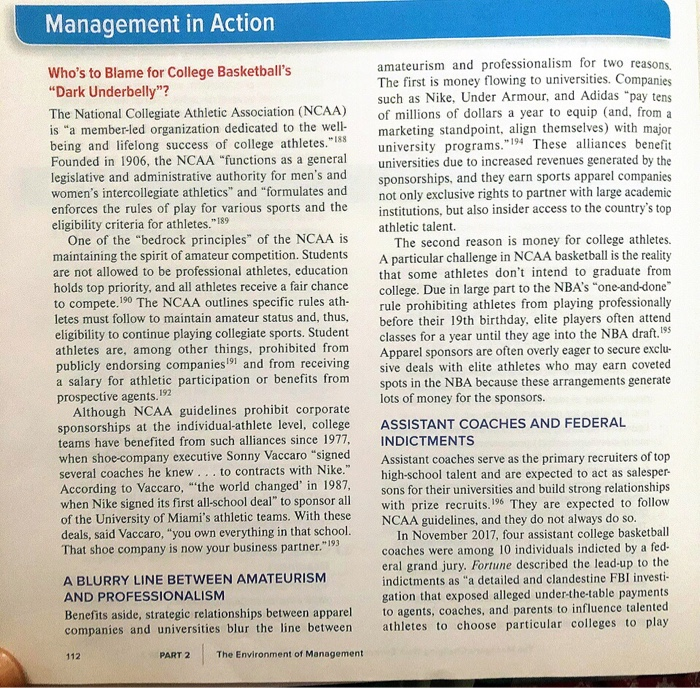
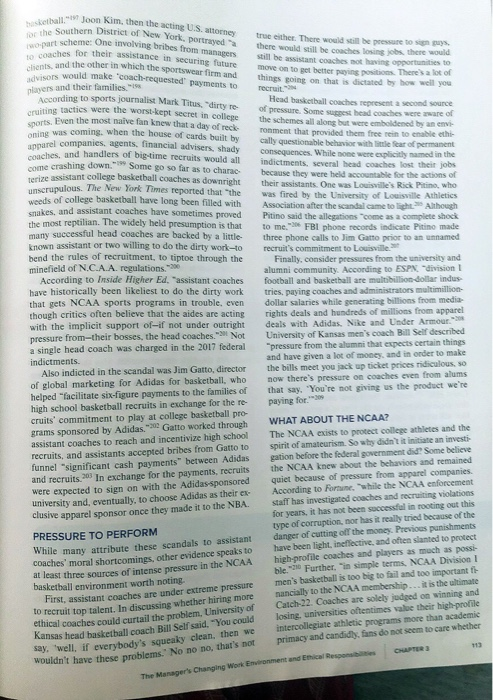
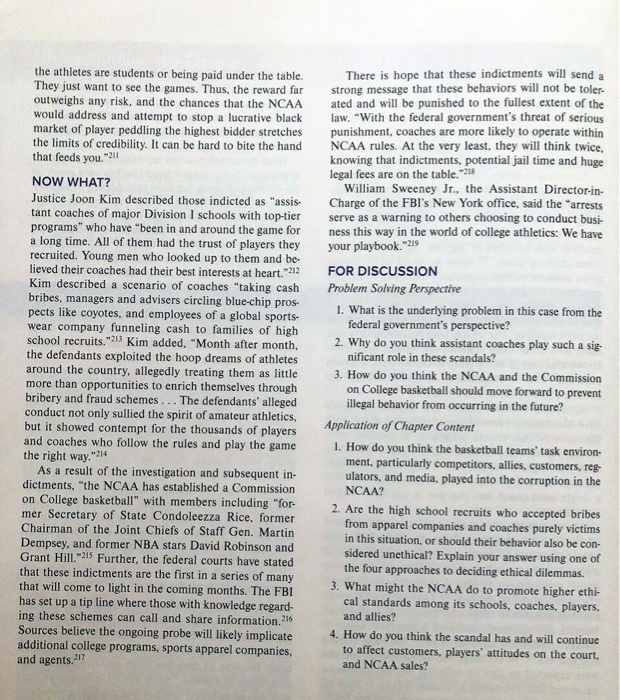
Management in Action Who's to Blame for College Basketball's "Dark Underbelly"? The National Collegiate Athletic Association (NCAA) is a member-led organization dedicated to the well- being and lifelong success of college athletes."188 Founded in 1906, the NCAA "functions as a general legislative and administrative authority for men's and women's intercollegiate athletics" and "formulates and enforces the rules of play for various sports and the eligibility criteria for athletes."189 One of the "bedrock principles of the NCAA is maintaining the spirit of amateur competition. Students are not allowed to be professional athletes, education holds top priority, and all athletes receive a fair chance to compete.190 The NCAA outlines specific rules ath- letes must follow to maintain amateur status and, thus, eligibility to continue playing collegiate sports. Student athletes are, among other things, prohibited from publicly endorsing companies and from receiving a salary for athletic participation or benefits from prospective agents.192 Although NCAA guidelines prohibit corporate sponsorships at the individual-athlete level, college teams have benefited from such alliances since 1977, when shoe-company executive Sonny Vaccaro "signed several coaches he knew ... to contracts with Nike." According to Vaccaro, "the world changed in 1987, when Nike signed its first all-school deal" to sponsor all of the University of Miami's athletic teams. With these deals, said Vaccaro, "you own everything in that school. That shoe company is now your business partner."193 amateurism and professionalism for two reasons. The first is money flowing to universities. Companies such as Nike, Under Armour, and Adidas "pay tens of millions of dollars a year to equip (and, from a marketing standpoint, align themselves) with major university programs." These alliances benefit universities due to increased revenues generated by the sponsorships, and they earn sports apparel companies not only exclusive rights to partner with large academic institutions, but also insider access to the country's top athletic talent. The second reason is money for college athletes. A particular challenge in NCAA basketball is the reality that some athletes don't intend to graduate from college. Due in large part to the NBA's "one-and-done" rule prohibiting athletes from playing professionally before their 19th birthday, elite players often attend classes for a year until they age into the NBA draft.195 Apparel sponsors are often overly eager to secure exclu. sive deals with elite athletes who may earn coveted spots in the NBA because these arrangements generate lots of money for the sponsors. ASSISTANT COACHES AND FEDERAL INDICTMENTS Assistant coaches serve as the primary recruiters of top high-school talent and are expected to act as salesper sons for their universities and build strong relationships with prize recruits. 196 They are expected to follow NCAA guidelines, and they do not always do so. In November 2017, four assistant college basketball coaches were among 10 individuals indicted by a fed- eral grand jury. Fortune described the lead-up to the indictments as "a detailed and clandestine FBI investi- gation that exposed alleged under-the-table payments to agents, coaches, and parents to influence talented athletes to choose particular colleges to play A BLURRY LINE BETWEEN AMATEURISM AND PROFESSIONALISM Benefits aside, strategic relationships between apparel companies and universities blur the line between PART 2 The Environment of Management 112 sketball." Joon for the Southern District part scheme Joon Kim, then the acting US alone Southern District of New York, portrayed cheme: One involving bribes from managers ches for their assistance in securine future and the other in which the sportswear firmand would make coach-requested payments to true either. There would still be pressure there would still be coaches losing obs, there would still be assistant coaches so having opportunities to move on to get better paying position. There's a lot of things going on that is dictated by how well you players and their families. "198 recruit cording to sports journalist Mark Titus Cintre Head basketball coaches represent a second source ne tactics were the worst-kept secret in college of pressure. Some sugeest head coaches were aware of Even the most naive fan knew that a day ofrece the schemes all along but were ning was coming. when the house of cards built by boldened by an en ronment that provided the el companies, agents, financial advisers shady free run to enable thi cally questionable behavior with t ches, and handlers of big-time recruits would all ear of permanent consequences. While some were explicitly named in the crashing down. Some go so far as to change indictments, several head coaches lost their jobs iesistant college basketball coaches as downrighi because they were held accountaNe for the actions of unscrupulous. The New York Times reported that the their assistants. One was Louisville's Rick Pitino, who its of college basketball have long been filled with was fired by the University of Louisville Athletics kes, and assistant coaches have sometimes proved Association after the scandal came tocht. Although the most reptilian. The widely held presumption is that Pitino said the allegations come as a complete shock many successful head coaches are backed by a little to me.-206 FBI phone records indicate Pitino made known assistant or two willing to do the dirty work to three phone calls to Jim Gatto prior to an unnamed bend the rules of recruitment, to tiptoe through the recruit's commitment to Louisville. Finally, consider pressures from the University and minefield of N.C.A.A. regulations.-200 alumni community. According to ESPN division According to Inside Higher Ed. assistant coaches football and basketball are mult billion dollar indus have historically been likeliest to do the dirty work tries, paying coaches and administrators multimillion that gets NCAA sports programs in trouble, even dollar salaries while generating billions from media though critics often believe that the aides are acting rights deals and hundreds of millions from apparel with the implicit support of-if not under outright deals with Adidas Nike and Under Armour pressure from their bosses, the head coaches. Not University of Kansas men's coach Bill Self described a single head coach was charged in the 2017 federal pressure from the alumni that expects certain things indictments and have given a lot of money, and in order to make Also indicted in the scandal was Jim Gatto, director the bills meet you jack up ticket prices ridiculous, so of global marketing for Adidas for basketball, who now there's pressure on coaches even from alums helped "facilitate six-figure payments to the families of that say, "You're not giving us the product we're high school basketball recruits in exchange for the re- paying for cruits' commitment to play at college basketball pro- WHAT ABOUT THE NCAA? grams sponsored by Adidas. Gatto worked through assistant coaches to reach and incentivize high school The NCAA exists to protect college athletes and the spirit of amateurism. So why didn't it initiate an investi- recruits, and assistants accepted bribes from Gatto to funnel "significant cash payments" between Adidas gation before the federal government did? Some believe the NCAA knew about the behaviors and remained and recruits.903 In exchange for the payments, recruits quiet because of pressure from apparel companies were expected to sign on with the Adidas sponsored According to Fortune. "While the NCAA enforcement university and eventually, to choose Adidas as their ex staff has investigated coaches and recruiting violations clusive apparel sponsor once they made it to the NBA. for years, it has not been successful in rooting out this type of corruption, nor has it really tried because of the PRESSURE TO PERFORM danger of cutting off the money. Previous punishments While many attribute these scandals to assistant have been light, ineffective, and often slanted to protect coaches' moral shortcomines, other evidence speaks to high-profile coaches and players as much as possi at least three sources of intense pressure in the NCAA ble. Further, in simple terms. NCAA Division 1 basketball environment worth noting men's basketball is too big to fail and too importanti First, assistant coaches are under extreme pressure nancially to the NCAA membership... it is the ultimate Catch-22. Coaches are solely judged on winning and to recruit top talent. In discussing whether hiring more losing, universities oftentimes value their high-profile ethical coaches could curtail the problem. University of Kansas head basketball cosch Bill Self said, "You could intercollegiate athletic programs more than academic primacy and candidly fans do not seem to care whether way. well, if everybody's squeaky clean, then we C TR3 wouldn't have these problems." No no no, that's not The Manager's Changing Work Environment and Erical Resome the athletes are students or being paid under the table. They just want to see the games. Thus, the reward far outweighs any risk, and the chances that the NCAA would address and attempt to stop a lucrative black market of player peddling the highest bidder stretches the limits of credibility. It can be hard to bite the hand that feeds you."211 There is hope that these indictments will send a strong message that these behaviors will not be toler- ated and will be punished to the fullest extent of the law. "With the federal government's threat of serious punishment, coaches are more likely to operate within NCAA rules. At the very least, they will think twice, knowing that indictments, potential jail time and huge legal fees are on the table. 216 William Sweeney Jr., the Assistant Director-in- Charge of the FBI's New York office, said the arrests serve as a warning to others choosing to conduct busi- ness this way in the world of college athletics: We have your playbook.219 NOW WHAT? Justice Joon Kim described those indicted as "assis- tant coaches of major Division I schools with top-tier programs" who have "been in and around the game for a long time. All of them had the trust of players they recruited. Young men who looked up to them and be lieved their coaches had their best interests at heart. 212 Kim described a scenario of coaches "taking cash bribes, managers and advisers circling blue-chip pros- pects like coyotes, and employees of a global sports- wear company funneling cash to families of high school recruits."213 Kim added, "Month after month, the defendants exploited the hoop dreams of athletes around the country, allegedly treating them as little more than opportunities to enrich themselves through bribery and fraud schemes ... The defendants' alleged conduct not only sullied the spirit of amateur athletics, but it showed contempt for the thousands of players and coaches who follow the rules and play the game the right way."214 As a result of the investigation and subsequent in dictments, "the NCAA has established a Commission on College basketball" with members including "for mer Secretary of State Condoleezza Rice, former Chairman of the Joint Chiefs of Staff Gen. Martin Dempsey, and former NBA stars David Robinson and Grant Hill.*215 Further, the federal courts have stated that these indictments are the first in a series of many that will come to light in the coming months. The FBI has set up a tip line where those with knowledge regard- ing these schemes can call and share information.216 Sources believe the ongoing probe will likely implicate additional college programs, sports apparel companies, and agents.217 FOR DISCUSSION Problem Solving Perspective 1. What is the underlying problem in this case from the federal government's perspective? 2. Why do you think assistant coaches play such a sig- nificant role in these scandals? 3. How do you think the NCAA and the Commission on College basketball should move forward to prevent illegal behavior from occurring in the future? Application of Chapter Content 1. How do you think the basketball teams' task environ- ment, particularly competitors, allies, customers, reg. ulators, and media played into the corruption in the NCAA? 2. Are the high school recruits who accepted bribes from apparel companies and coaches purely victims in this situation, or should their behavior also be con- sidered unethical? Explain your answer using one of the four approaches to deciding ethical dilemmas. 3. What might the NCAA do to promote higher ethi cal standards among its schools, coaches, players. and allies? 4. How do you think the scandal has and will continue to affect customers, players' attitudes on the court and NCAA sales









 Study Help