Question: Please answer the following questions, as they are difficult. This is the second time I am posting them as the previous time they were not
Please answer the following questions, as they are difficult. This is the second time I am posting them as the previous time they were not clear @ all, and mixed up. Please be clear for a thumbs up and a great review. Thank you in advance!!
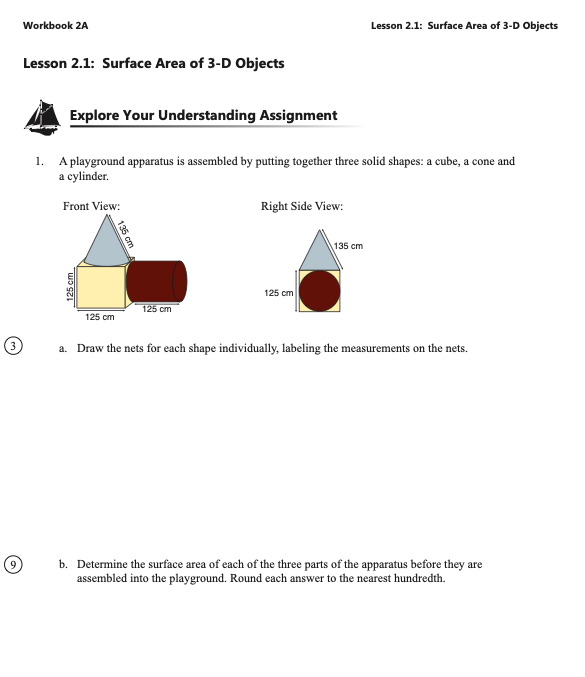
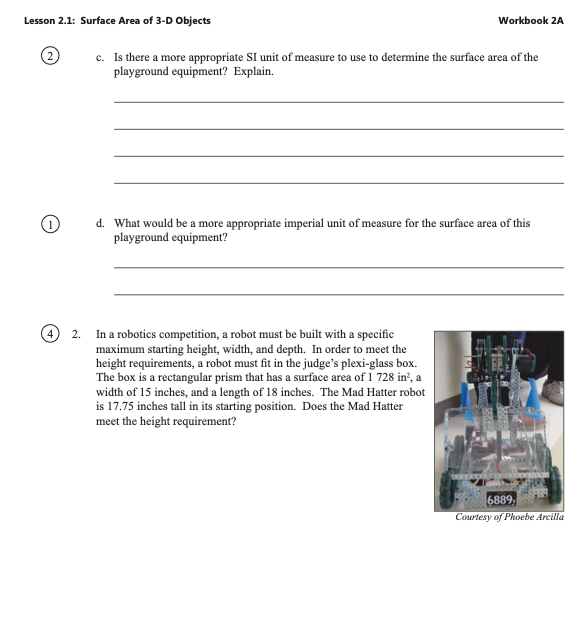
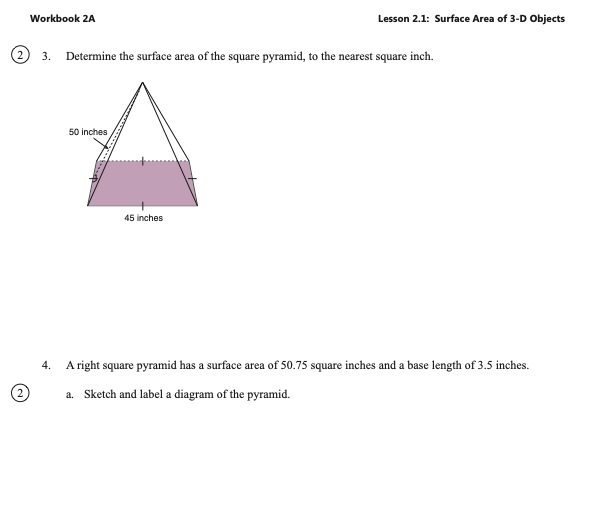
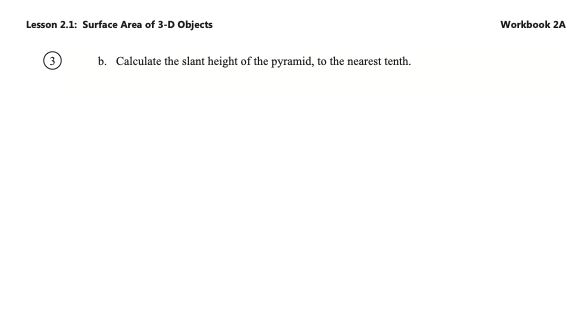
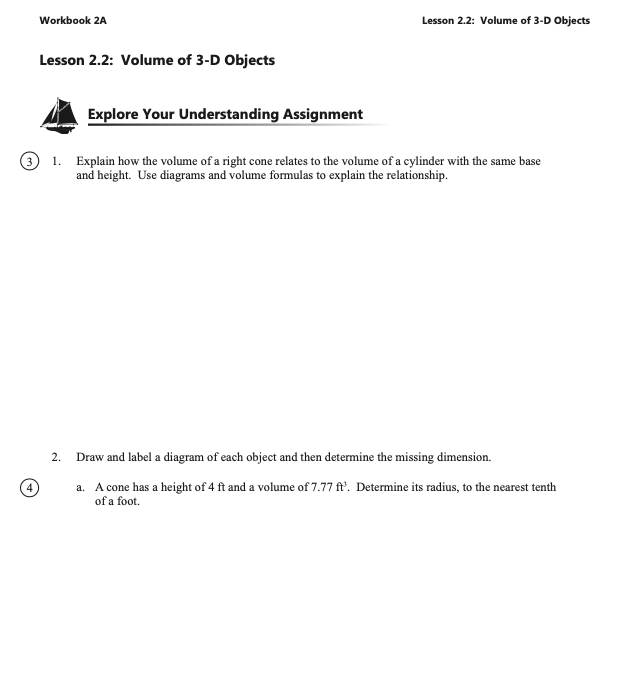
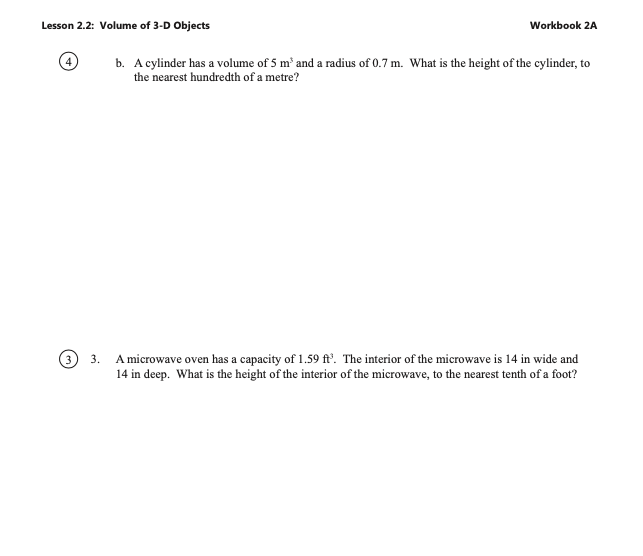
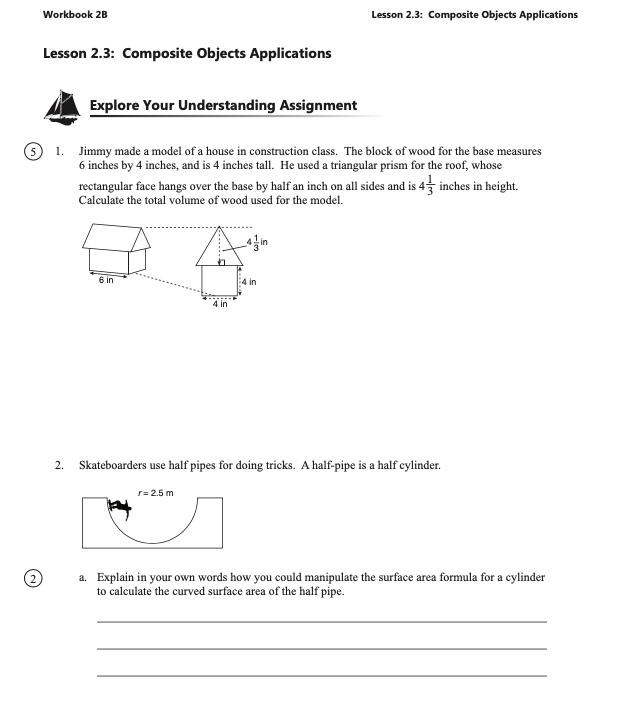
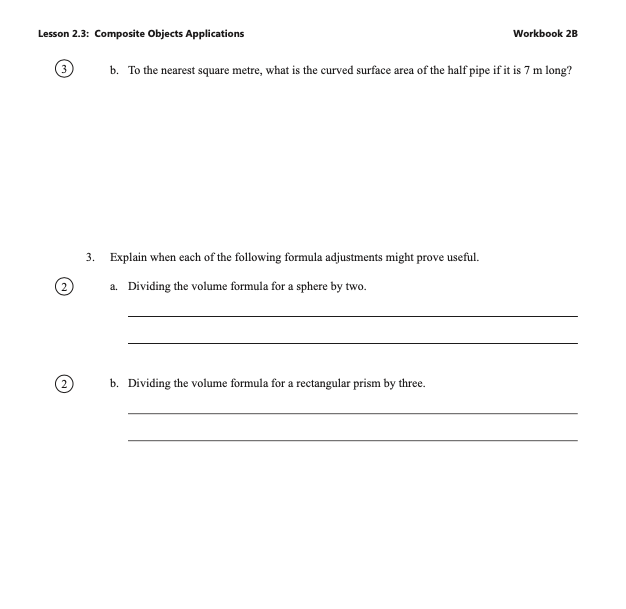
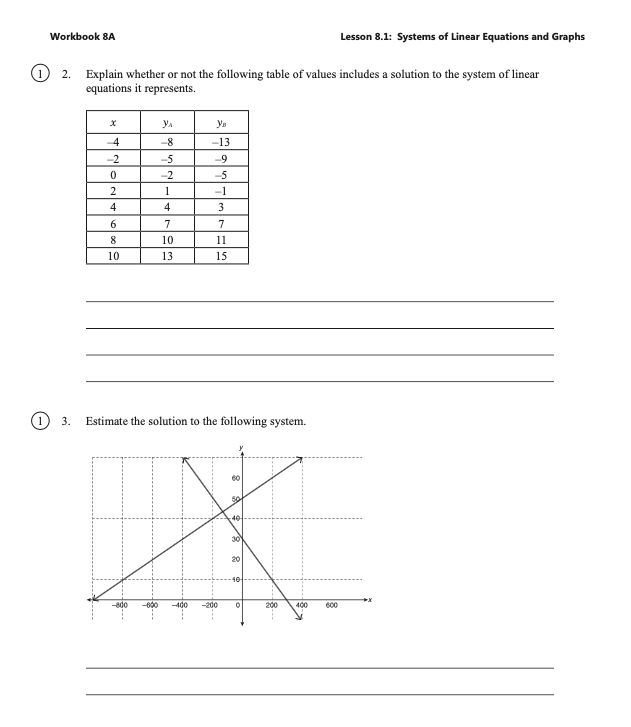
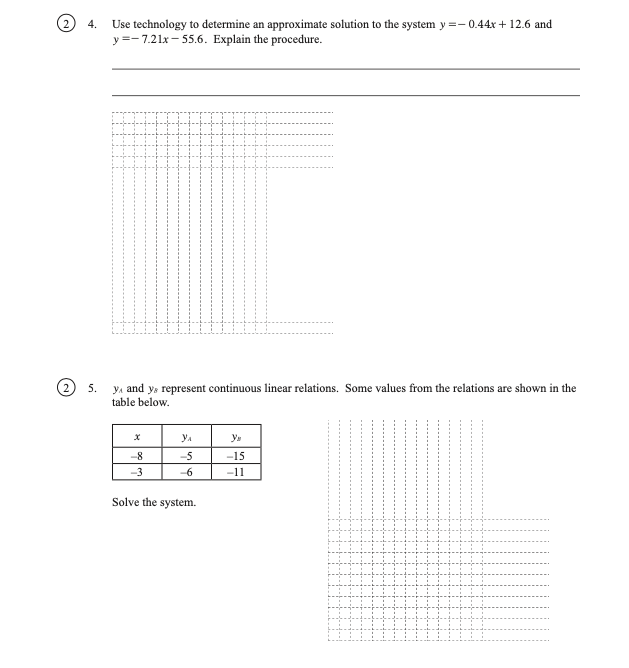
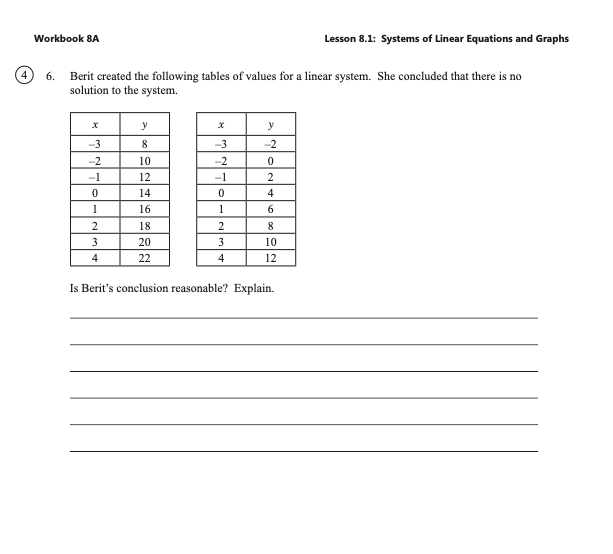
Workbook 2A Lesson 2.1: Surface Area of 3-D Objects Lesson 2.1: Surface Area of 3-D Objects Explore Your Understanding Assignment 1. A playground apparatus is assembled by putting together three solid shapes: a cube, a cone and a cylinder. Front View: Right Side View: 135 cm 125 cm 125 cm 125 cm 125 cm 3 a. Draw the nets for each shape individually, labeling the measurements on the nets. 9) b. Determine the surface area of each of the three parts of the apparatus before they are assembled into the playground. Round each answer to the nearest hundredth.Lesson 2.1: Surface Area of 3-D Objects Workbook 2A 2) c. Is there a more appropriate SI unit of measure to use to determine the surface area of the playground equipment? Explain. 1 d. What would be a more appropriate imperial unit of measure for the surface area of this playground equipment? (4) 2. In a robotics competition, a robot must be built with a specific maximum starting height, width, and depth. In order to meet the height requirements, a robot must fit in the judge's plexi-glass box. The box is a rectangular prism that has a surface area of 1 728 in', a width of 15 inches, and a length of 18 inches. The Mad Hatter robot is 17.75 inches tall in its starting position. Does the Mad Hatter meet the height requirement? 6889 Courtesy of Phoebe ArcilaLesson 2.1: Surface Area of 3-D Objects Workbook 2A (2) Determine the surface area of the square pyramid, to the nearest square inch. 50 inches 45 inches 4. A right square pyramid has a surface area of 50.75 square inches and a base length of 3.5 inches. (2 a. Sketch and label a diagram of the pyramid.Lesson 2.1: Surface Area of 3-D Objects Workbook 2A 3 b. Calculate the slant height of the pyramid, to the nearest tenth.Workbook 2A Lesson 2.2: Volume of 3-D Objects Lesson 2.2: Volume of 3-D Objects Explore Your Understanding Assignment 3 1 . Explain how the volume of a right cone relates to the volume of a cylinder with the same base and height. Use diagrams and volume formulas to explain the relationship. 2. Draw and label a diagram of each object and then determine the missing dimension. 4 a. A cone has a height of 4 ft and a volume of 7.77 ft'. Determine its radius, to the nearest tenth of a foot.Lesson 2.2: Volume of 3-D Objects Workbook 2A (4) b. A cylinder has a volume of 5 m and a radius of 0.7 m. What is the height of the cylinder, to the nearest hundredth of a metre? (3) 3. A microwave oven has a capacity of 1.59 ft'. The interior of the microwave is 14 in wide and 14 in deep. What is the height of the interior of the microwave, to the nearest tenth of a foot?Workbook 2B Lesson 2.3: Composite Objects Applications Lesson 2.3: Composite Objects Applications Explore Your Understanding Assignment 1 . Jimmy made a model of a house in construction class. The block of wood for the base measures 6 inches by 4 inches, and is 4 inches tall. He used a triangular prism for the roof, whose rectangular face hangs over the base by half an inch on all sides and is 45 inches in height. Calculate the total volume of wood used for the model. 6 in 4 In 2. Skateboarders use half pipes for doing tricks. A half-pipe is a half cylinder. F= 2.5 m 2 a. Explain in your own words how you could manipulate the surface area formula for a cylinder to calculate the curved surface area of the half pipe.Lesson 2.3: Composite Objects Applications Workbook 2B (3) b. To the nearest square metre, what is the curved surface area of the half pipe if it is 7 m long? 3. Explain when each of the following formula adjustments might prove useful. 2 a. Dividing the volume formula for a sphere by two. 2 b. Dividing the volume formula for a rectangular prism by three.Workbook BA Lesson 8.1: Systems of Linear Equations and Graphs (1) 2. Explain whether or not the following table of values includes a solution to the system of linear equations it represents YA 4 -8 -13 -5 -9 0 -2 -5 1 -1 4 3 10 11 10 13 15 1 3. Estimate the solution to the following system. 20 --10- -4do -200 200 800(2) 4. Use technology to determine an approximate solution to the system y =- 0.44x + 12.6 and y =-7.21x - 55.6. Explain the procedure. (2) 5. YA and y represent continuous linear relations. Some values from the relations are shown in the table below. YA -8 -5 -15 -3 -6 -11 Solve the system.Workbook BA Lesson 8.1: Systems of Linear Equations and Graphs 4) 6. Berit created the following tables of values for a linear system. She concluded that there is no solution to the system. y -3 -3 -2 -2 10 -2 0 -1 12 -1 2 0 14 4 1 16 1 6 2 18 2 20 10 4 22 12 Is Berit's conclusion reasonable? Explain
Step by Step Solution
There are 3 Steps involved in it
1 Expert Approved Answer
Step: 1 Unlock
Question Has Been Solved by an Expert!
Get step-by-step solutions from verified subject matter experts
Step: 2 Unlock
Step: 3 Unlock
Students Have Also Explored These Related Mathematics Questions!