Question: Please answer the following questions using STAT: 1. Your answer is partially correct. The null and alternative hypotheses for a test are given, as well
Please answer the following questions using STAT:
1.
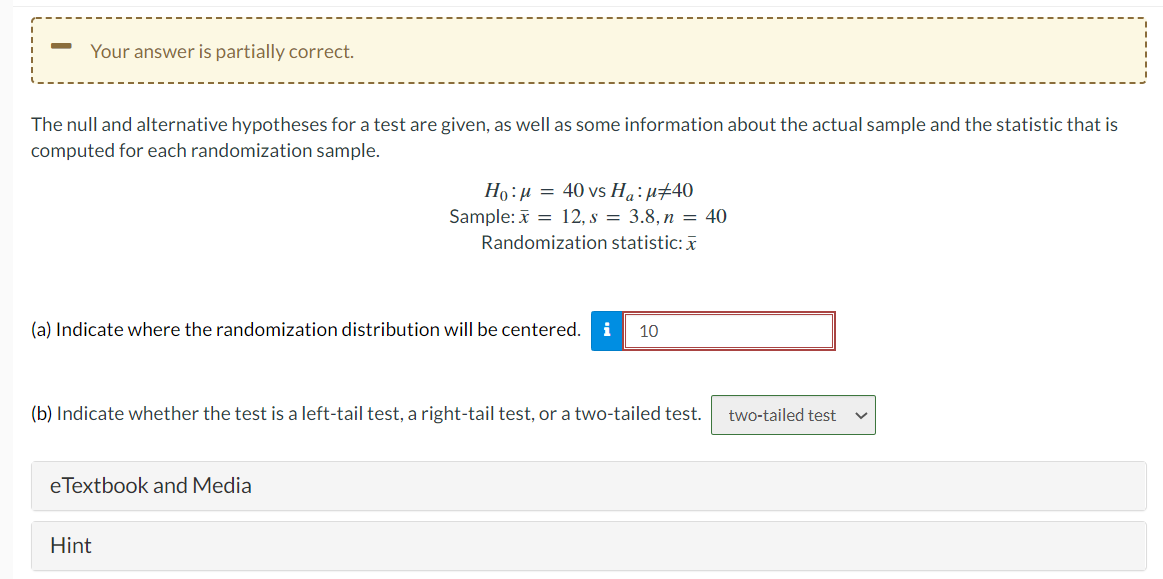
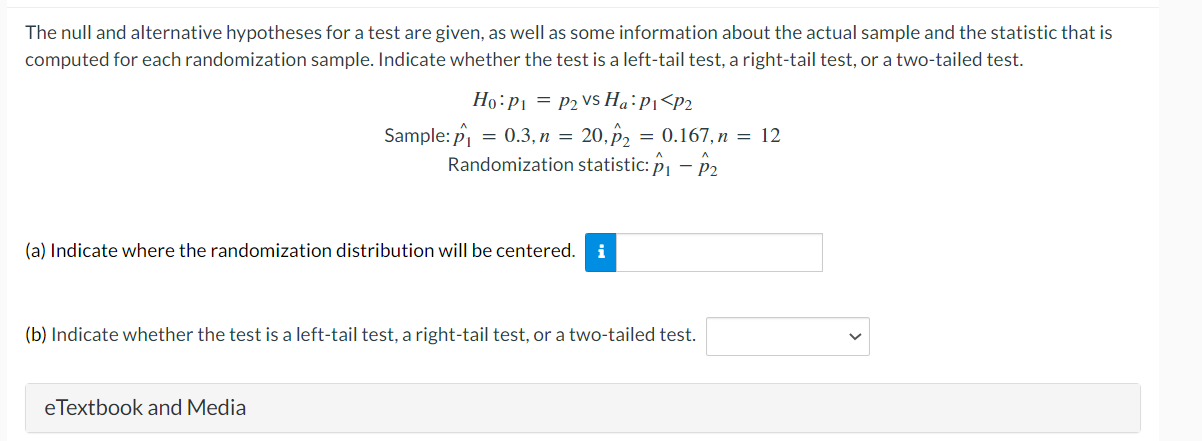
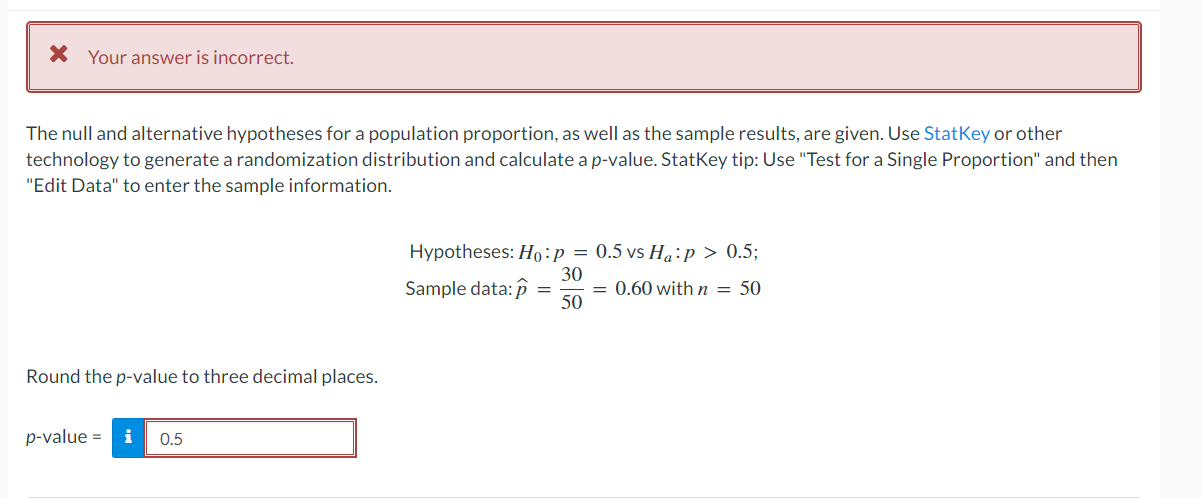
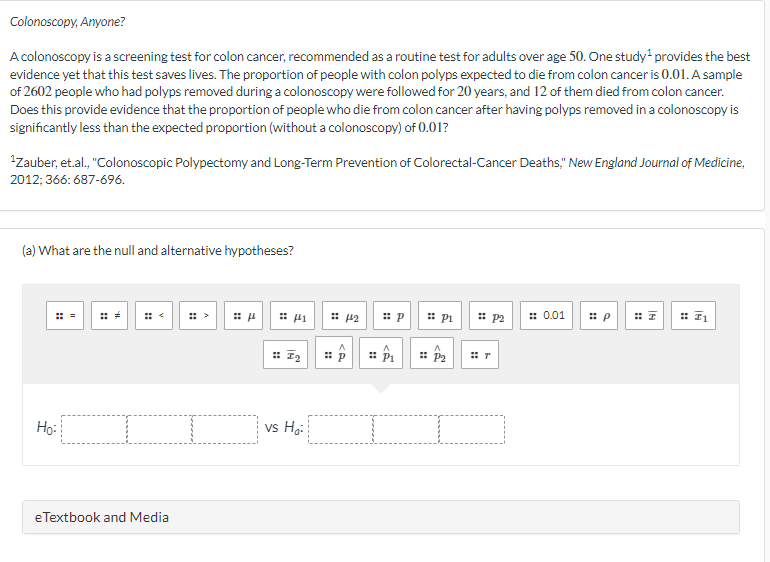
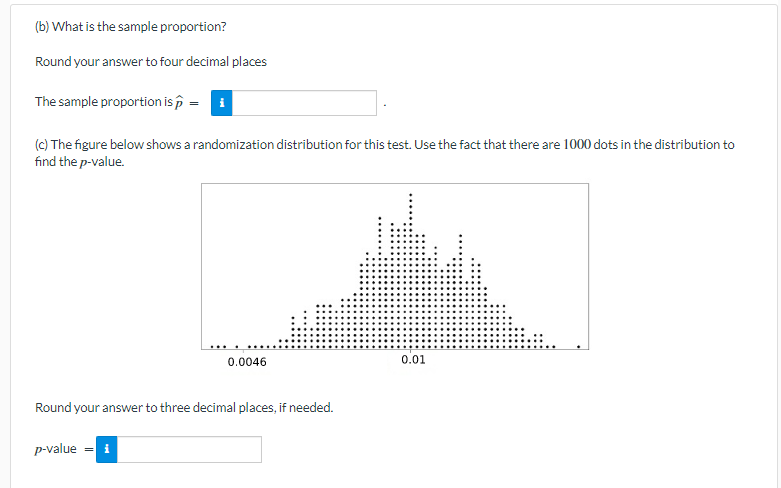
Your answer is partially correct. The null and alternative hypotheses for a test are given, as well as some information about the actual sample and the statistic that is computed for each randomization sample. Ho: H = 40 vs Ha : H#40 Sample: x = 12, s = 3.8,n = 40 Randomization statistic: x (a) Indicate where the randomization distribution will be centered. 10 (b) Indicate whether the test is a left-tail test, a right-tail test, or a two-tailed test. two-tailed test v eTextbook and Media HintThe null and alternative hypotheses for a test are given, as well as some information about the actual sample and the statistic that is computed for each randomization sample. Indicate whether the test is a left-tail test, a right-tail test, or a two-tailed test. Ho : P1 = P2 VS Ha : P1 0.5; A 30 Sample datazp = E = 0.60 withn = 50 Round the pevalue to three decimal places. Colonoscopy, Anyone? A colonoscopy is a screening test for colon cancer, recommended as a routine test for adults over age 50. One study provides the best evidence yet that this test saves lives. The proportion of people with colon polyps expected to die from colon cancer is 0.01. A sample of 2602 people who had polyps removed during a colonoscopy were followed for 20 years, and 12 of them died from colon cancer. Does this provide evidence that the proportion of people who die from colon cancer after having polyps removed in a colonoscopy is significantly less than the expected proportion (without a colonoscopy) of 0.01? Zauber, et.al., "ColonoscopiesPolypectomy and Long-Term Prevention of Colorectal-Cancer Deaths," New England Journal of Medicine, 2012; 366: 687-696. (a) What are the null and alternative hypotheses? : P1 " P2 #: 0/01 Pi 1: P2 HT Ho: VS Ha: eTextbook and Media(b) What is the sample proportion? Round your answer to four decimal places The sample proportion is p = i (c) The figure below shows a randomization distribution for this test. Use the fact that there are 1000 dots in the distribution to find the p-value. 0.0046 0.01 Round your answer to three decimal places, if needed. p-value
Step by Step Solution
There are 3 Steps involved in it
1 Expert Approved Answer
Step: 1 Unlock
Question Has Been Solved by an Expert!
Get step-by-step solutions from verified subject matter experts
Step: 2 Unlock
Step: 3 Unlock
Students Have Also Explored These Related Mathematics Questions!









 Study Help