







Question: Please answer the following questions. Wrong answers are provided. Incorrect Question 1 0 / 4 pts Interpret this graphic from a single-subject study to choose
Please answer the following questions. Wrong answers are provided.
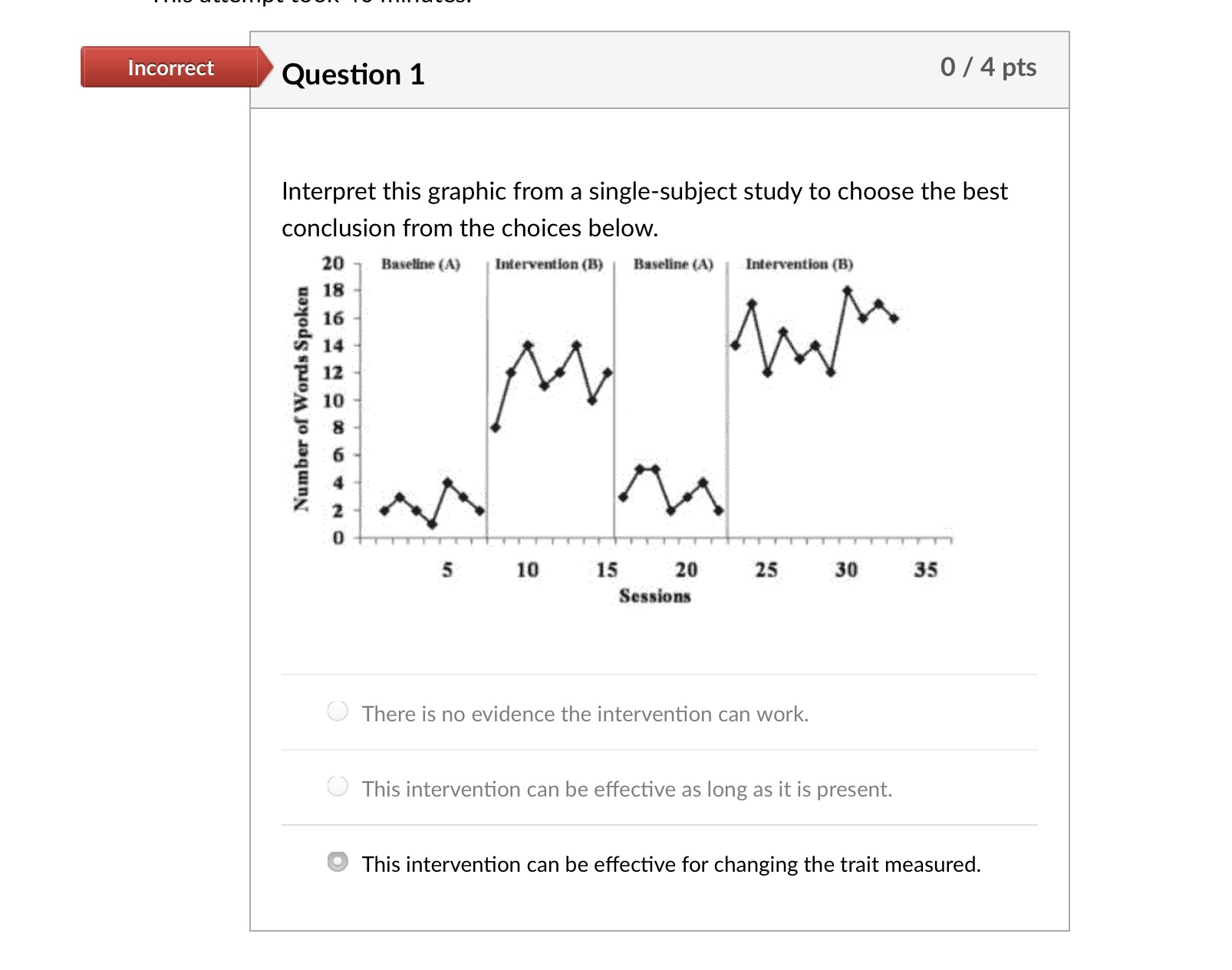
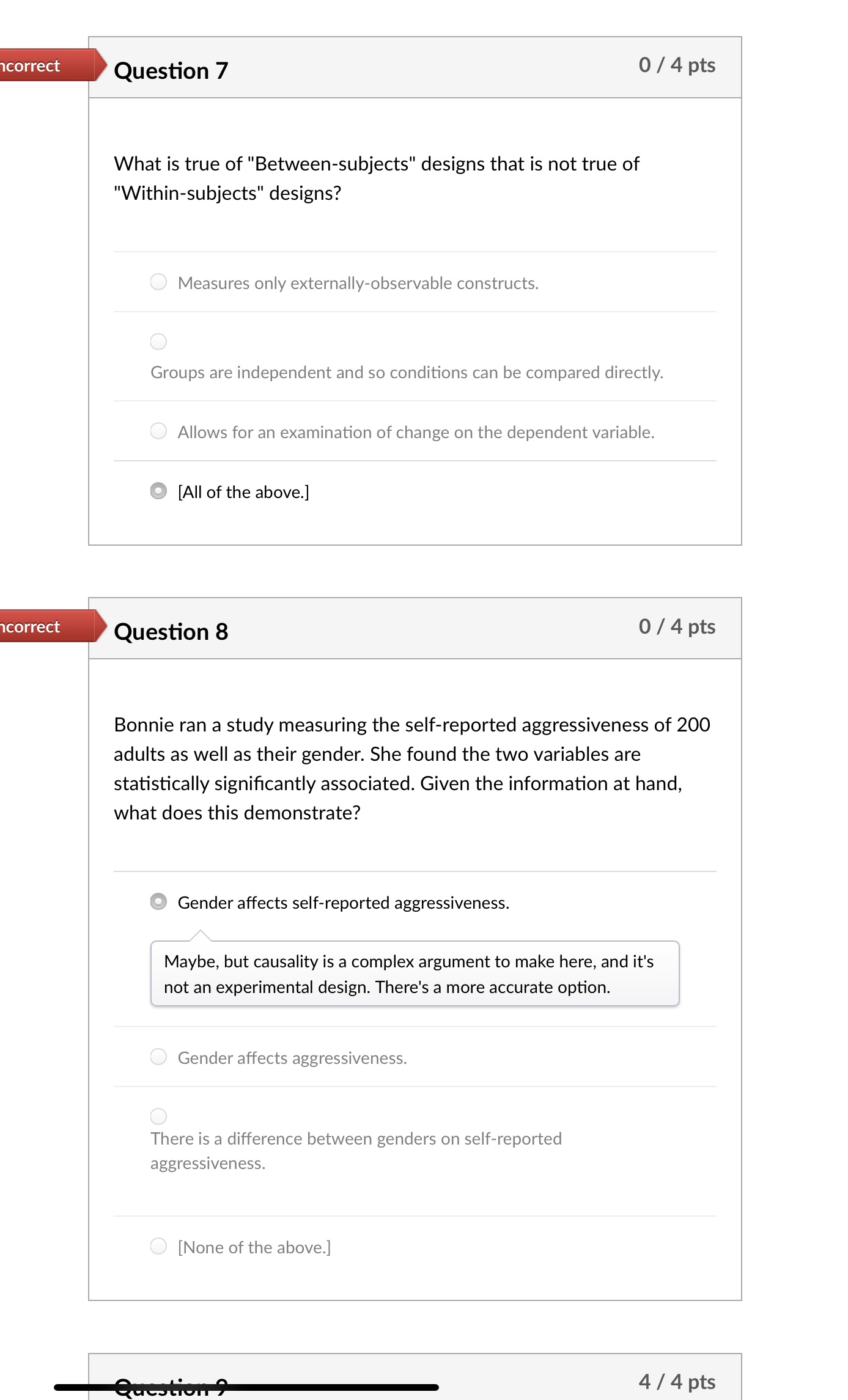
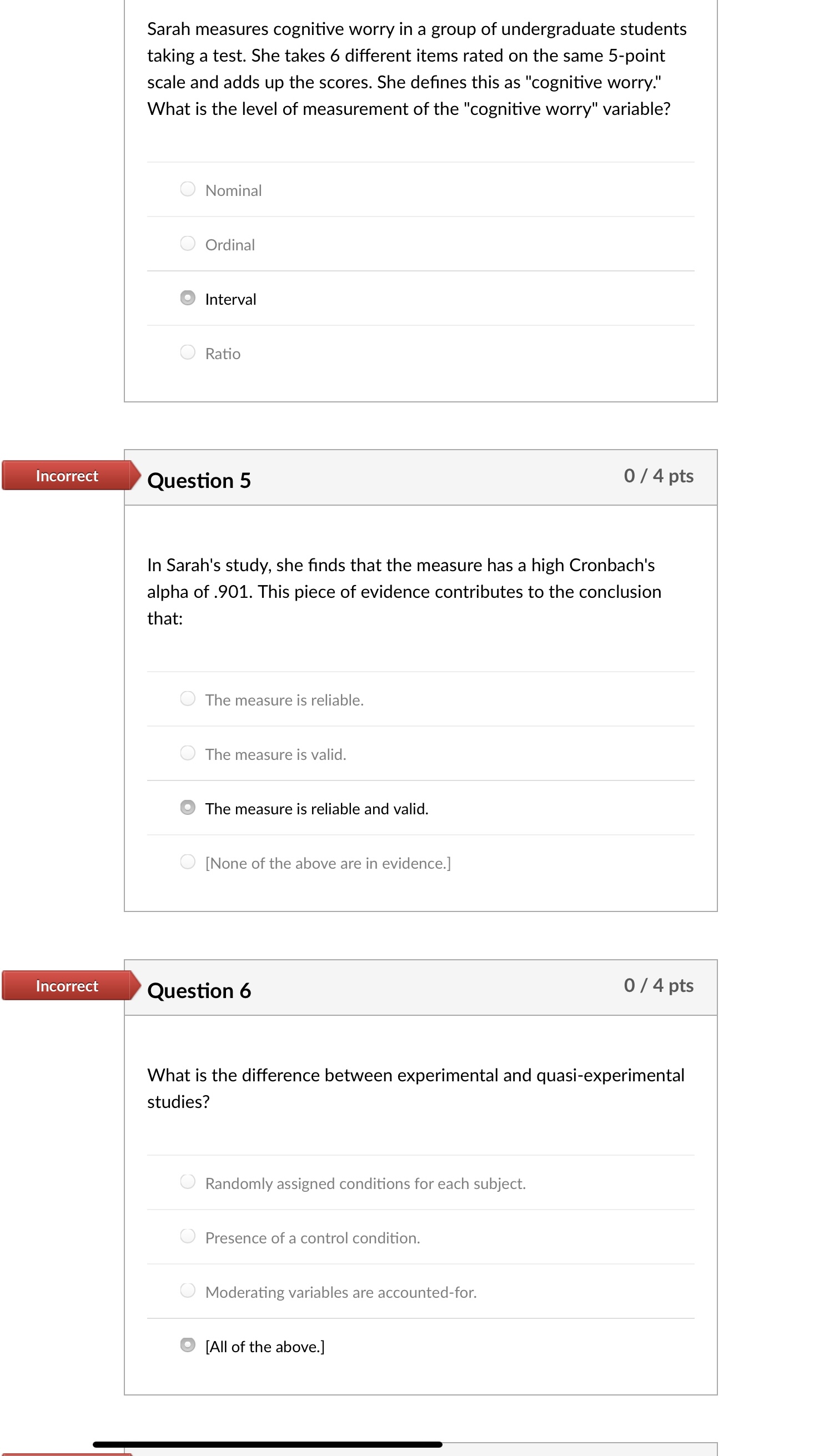
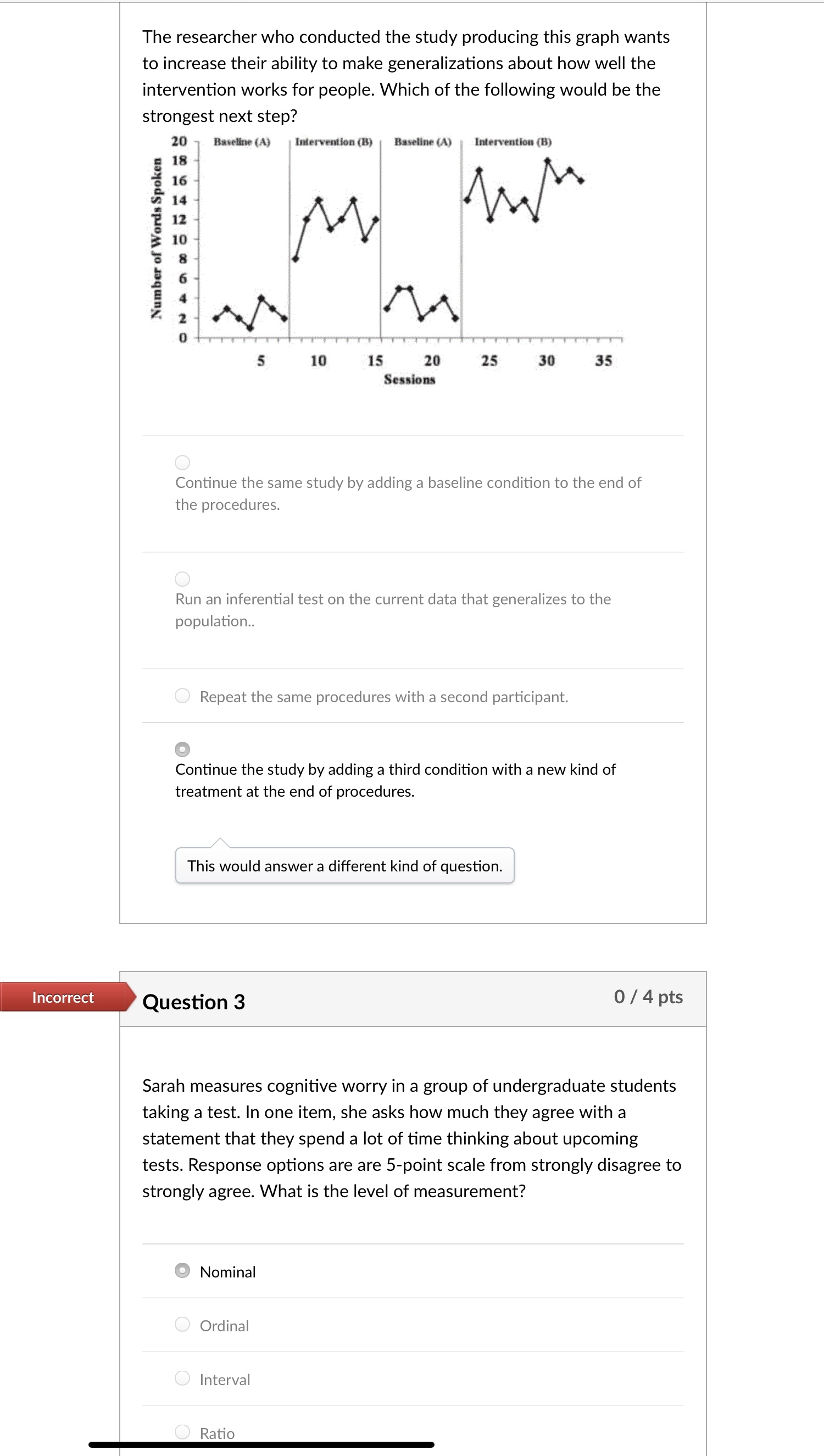
Incorrect Question 1 0 / 4 pts Interpret this graphic from a single-subject study to choose the best conclusion from the choices below. 20 Baseline (A) Intervention (B) Baseline (A) Intervention (B) 18 Number of Words Spoken NACOONE TTTTTT 5 10 15 20 25 30 35 Sessions O There is no evidence the intervention can work. This intervention can be effective as long as it is present. This intervention can be effective for changing the trait measured.Question 7 0 / 4 Pts What is true of "Between-subjects" designs that is not true of "Within-subjects" designs? Measures only externally-observable constructs. Groups are independent and 50 conditions can be compared directly. Allows for an examination of change on the dependent variable. 9 [All of the above] correct Question 8 0 / 4 ptS Bonnie ran a study measuring the self-reported aggressiveness of 200 adults as well as their gender. She found the two variables are statistically signicantly associated. Given the information at hand, what does this demonstrate? 9 Gender affects self-reported aggressiveness. Maybe, but causality is a complex argument to make here, and it's not an experimental design. There's a more accurate option. Gender affects aggressiveness. There is a difference between genders on self-reported aggressiveness. [None of the above] Sarah measures cognitive worry in a group of undergraduate students taking a test. She takes 6 different items rated on the same 5-point scale and adds up the scores. She denes this as "cognitive worry." What is the level of measurement of the "cognitive worry" variable? Nominal Ordinal Q Interval Ratio Question 5 0 / 4 Pts In Sarah's study, she nds that the measure has a high Cronbach's alpha of .901. This piece of evidence contributes to the conclusion that: The measure is reliable. The measure is valid. 9 The measure is reliable and valid. [None of the above are in evidence.] Question 6 What is the difference between experimental and quasi-experimental studies? Randomly assigned conditions for each subject. Presence of a control condition. Moderating variables are accounted-for. 9 [All of the above] The researcher who conducted the study producing this graph wants to increase their ability to make generalizations about how well the intervention works for people. Which of the following would be the strongest next step? 20 Baseline (A) Intervention (B) Baseline (A) Intervention (B) 18 Number of Words Spoken ON 5 10 15 20 25 30 35 Sessions O Continue the same study by adding a baseline condition to the end of the procedures. O Run an inferential test on the current data that generalizes to the population.. O Repeat the same procedures with a second participant. O Continue the study by adding a third condition with a new kind of treatment at the end of procedures. This would answer a different kind of question. Incorrect Question 3 0 / 4 pts Sarah measures cognitive worry in a group of undergraduate students taking a test. In one item, she asks how much they agree with a statement that they spend a lot of time thinking about upcoming tests. Response options are are 5-point scale from strongly disagree to strongly agree. What is the level of measurement? Nominal O Ordinal O Interval Ratio
Step by Step Solution
There are 3 Steps involved in it

Get step-by-step solutions from verified subject matter experts
 Study Help