



Question: Please answer the following - quite urgent !!! 5. Let N (t), t 2 0, be the number of claims an insurance company receives up
Please answer the following - quite urgent !!!
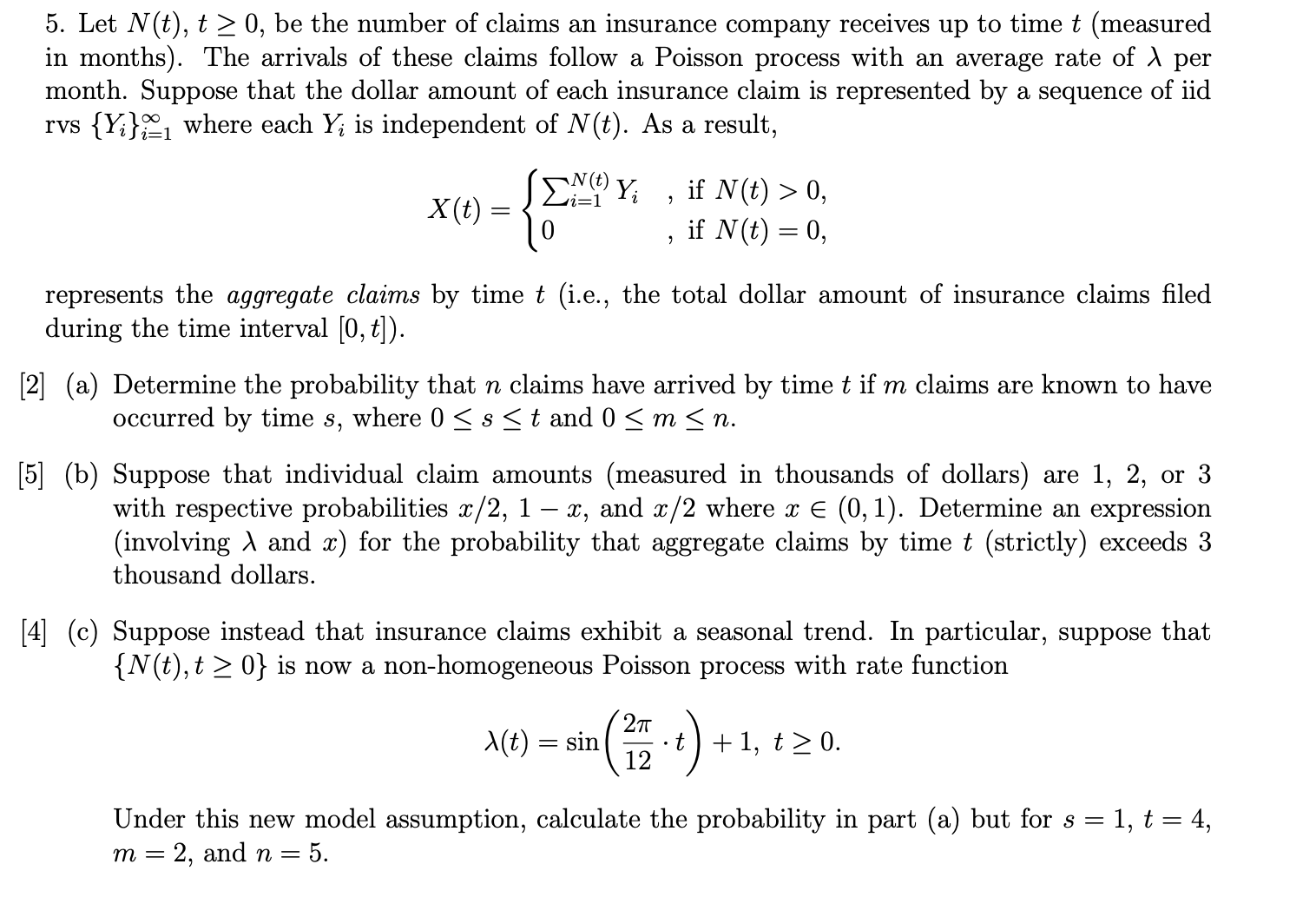
5. Let N (t), t 2 0, be the number of claims an insurance company receives up to time t (measured in months). The arrivals of these claims follow a Poisson process with an average rate of A per month. Suppose that the dollar amount of each insurance claim is represented by a sequence of iid rvs {Eh-\":1 where each Y,- is independent of N (15). As a result, X\") = ELEM , if W) > 0, ,Nm=a represents the aggregate claims by time t (i.e., the total dollar amount of insurance claims led during the time interval [0, 13]). [2] (a) Determine the probability that n claims have arrived by time t if m claims are known to have occurred by time 3, where 0 S 3 S t and 0 S m S n. [5] (b) Suppose that individual claim amounts (measured in thousands of dollars) are 1, 2, or 3 with respective probabilities sc/ 2, 1 as, and a: / 2 where a: E (O, 1). Determine an expression (involving A and m) for the probability that aggregate claims by time t (strictly) exceeds 3 thousand dollars. [4] (c) Suppose instead that insurance claims exhibit a seasonal trend. In particular, suppose that {N (t), t 2 0} is now a nonhomogeneous Poisson process with rate function 271' = ' - > . /\\(t) s111(12 t)+1, t_0 Under this new model assumption, calculate the probability in part (a) but for 3 = 1, t = 4, m = 2, and n = 5
Step by Step Solution
There are 3 Steps involved in it

Get step-by-step solutions from verified subject matter experts