


Question: PLEASE ANSWER THE HIGHLIGHTED QUESTIONS 1) A small clinic has one doctor on duty administering vaccines. Patients are served on a first-come-firstserved basis (no appointments)

PLEASE ANSWER THE HIGHLIGHTED QUESTIONS
PLEASE ANSWER THE HIGHLIGHTED QUESTIONS 1) A
PLEASE ANSWER THE HIGHLIGHTED QUESTIONS 1) A

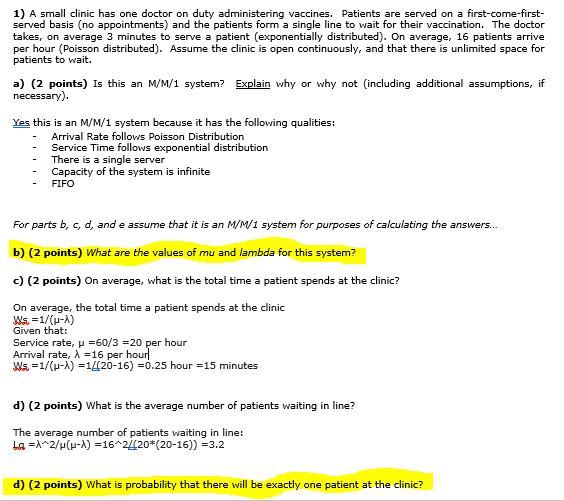
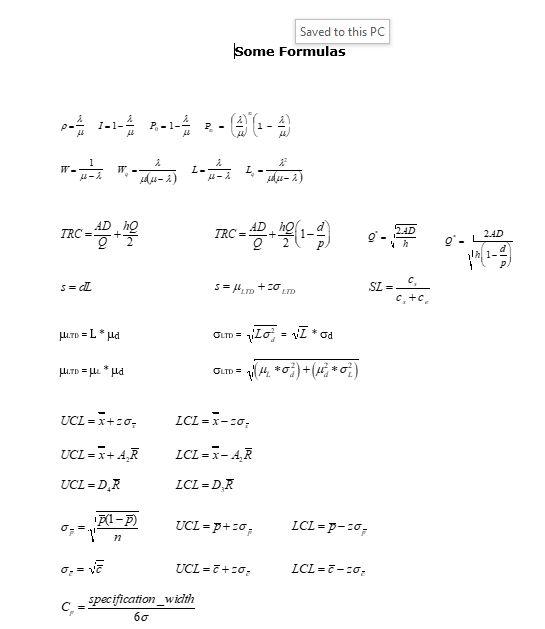
1) A small clinic has one doctor on duty administering vaccines. Patients are served on a first-come-firstserved basis (no appointments) and the patients form a single line to wait for their vaccination. The doctor takes, on average 3 minutes to serve a patient (exponentially distributed). On average, 16 patients arrive per hour (Poisson distributed). Assume the clinic is open continuously, and that there is unlimited space for patients to wait. a) (2 points) Is this an M/M/1 system? Explain why or why not (including additional assumptions, if necessary). Yes this is an M/M/1 system because it has the following qualities: - Arrival Rate followis Poisson Distribution - Service Time follows exponential distribution - There is a single server - Capacity of the system is infinite - FIFO For parts b,c,d, and e assume that it is an M/M/1 system for purposes of calculating the answers... b) (2 points) What are the values of mu and lambda for this system? c) (2 points) On average, what is the total time a patient spends at the clinic? On average, the total time a patient spends at the clinic Ws, =1/() Given that: Service rate, =60/3=20 per hour Arrival rate, =16 per hour Ws. =1/()=1((2016)=0.25 hour =15 minutes d) ( 2 points) What is the average number of patients waiting in line? The average number of patients waiting in line: L=2/()=162/(20(2016))=3.2 d) (2 points) What is probability that there will be exactly one patient at the clinic? Some Formulas \[ \begin{array}{l} e-\frac{\lambda}{\mu} \quad 1-1-\frac{\lambda}{\mu} \quad P_{0}-1-\frac{\lambda}{\mu} \quad P_{0}-\left(\frac{\lambda}{\mu} ight)^{0}\left(1-\frac{\lambda}{\mu} ight) \\ W-\frac{1}{\mu-\lambda} \quad W_{\varphi}-\frac{\lambda}{\mu(\mu-\lambda)} \quad L-\frac{\lambda}{\mu-\lambda} \quad L_{4}-\frac{\lambda^{2}}{\mu(\mu-\lambda)} \\ \operatorname{TRC}=\frac{A D}{Q}+\frac{h Q}{2} \\ \operatorname{TRC}=\frac{A D}{Q}+\frac{h Q}{2}\left(1-\frac{d}{p} ight) \quad Q=\frac{\sqrt{2 . A D}}{h} \\ s=d \mathbb{L} \\ s=\mu_{L D}+z \sigma_{L D} \\ S L=\frac{c_{y}}{c_{x}+c_{e}} \\ \mu_{I .70}=L^{*} \mu_{\mathrm{d}} \quad \sigma_{\mathrm{CD}}=\sqrt{i \sigma_{d}^{2}}=v_{i} \bar{L} * \sigma_{\mathrm{d}} \\ \mu_{\mathrm{ID}}=\mu_{\mathrm{L}} * \mu_{\mathrm{d}} \quad \quad \sigma \mathrm{LD}=\sqrt{\left(\mu_{L} * \sigma_{d}^{2} ight)+\left(\mu_{d}^{2} * \sigma_{L}^{2} ight)} \\ U C L=\bar{x}+z \sigma_{\bar{x}} \quad L C L=\bar{x}-z \sigma_{\bar{z}} \\ U C L=\bar{x}+A_{2} \bar{R} \quad L C L=\bar{x}-A_{2} \bar{R} \\ U C L=D_{4} \bar{R} \quad L C L=D_{3} \bar{R} \\ \sigma_{\bar{p}}=\left. ight|^{\frac{\bar{p} \bar{p}(1-\bar{p})}{n}} \quad U C L=\bar{p}+z \sigma_{\bar{p}} \quad L C L=\bar{p}-z \sigma_{\bar{p}} \\ \sigma_{z}=\sqrt{\bar{c}} \quad U C L=\bar{c}+z \sigma_{z} \quad L C L=\bar{c}-z \sigma_{z} \\ C_{f}=\frac{\text { specification_width }}{6 \sigma} \\ \end{array} \]

Step by Step Solution

There are 3 Steps involved in it

1 Expert Approved Answer
Step: 1 Unlock blur-text-image

Question Has Been Solved by an Expert!

Get step-by-step solutions from verified subject matter experts

Step: 2 Unlock
Step: 3 Unlock

Students Have Also Explored These Related General Management Questions!