



Question: Please answer the last 3 questions, I have also added the reference link below. Case Introduction The three-day corporate executive education program had just started,
Please answer the last 3 questions, I have also added the reference link below.
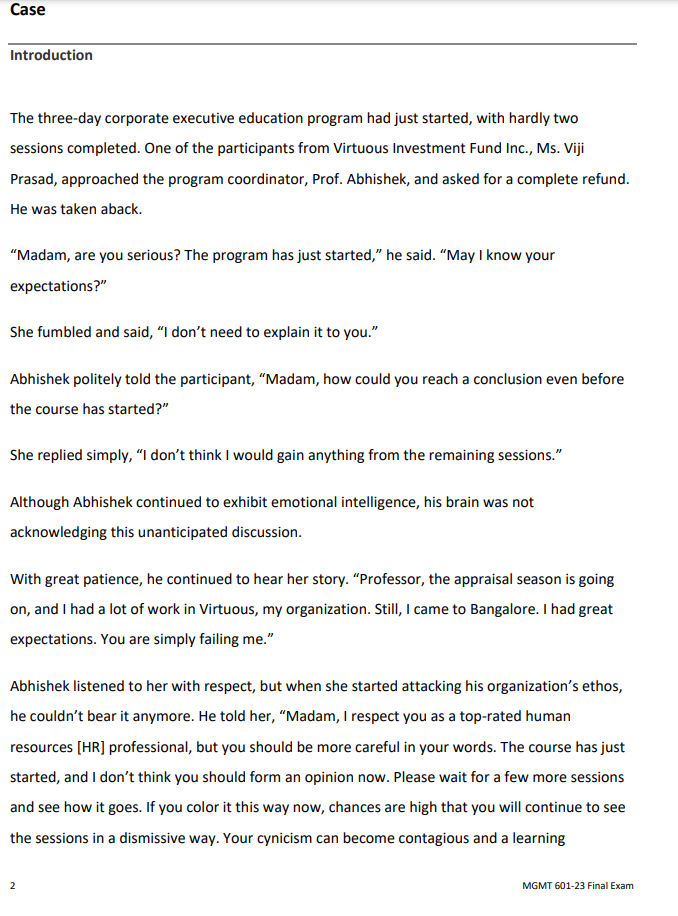
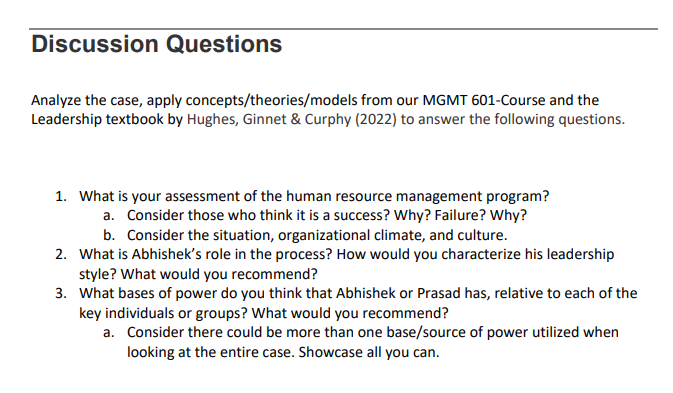
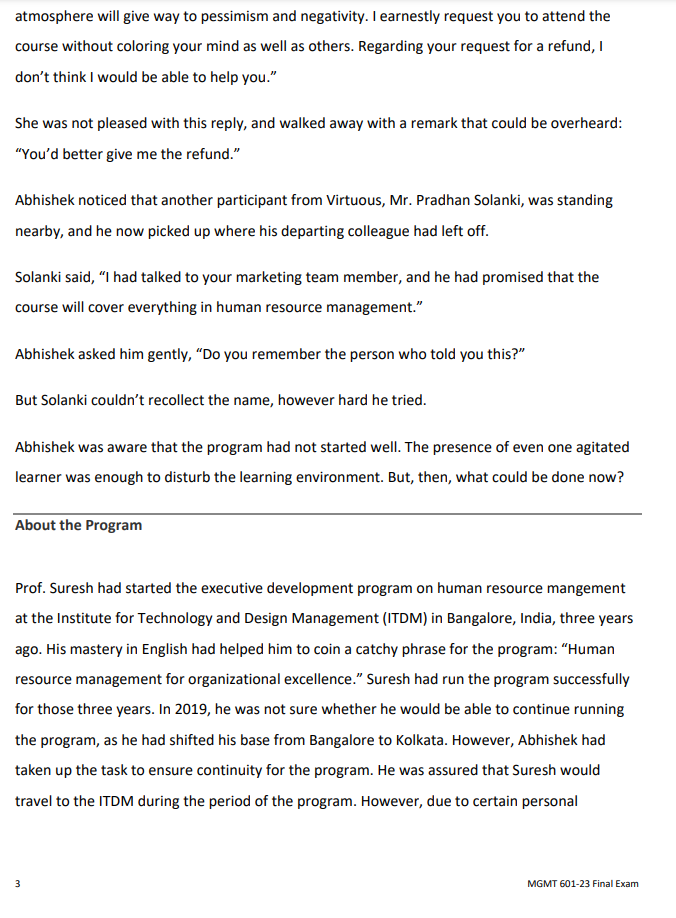
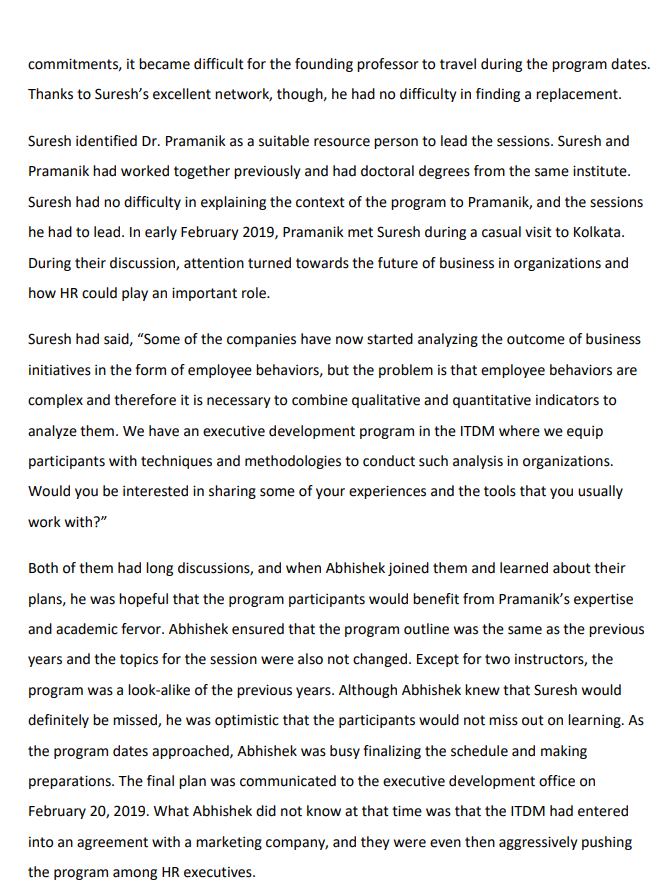
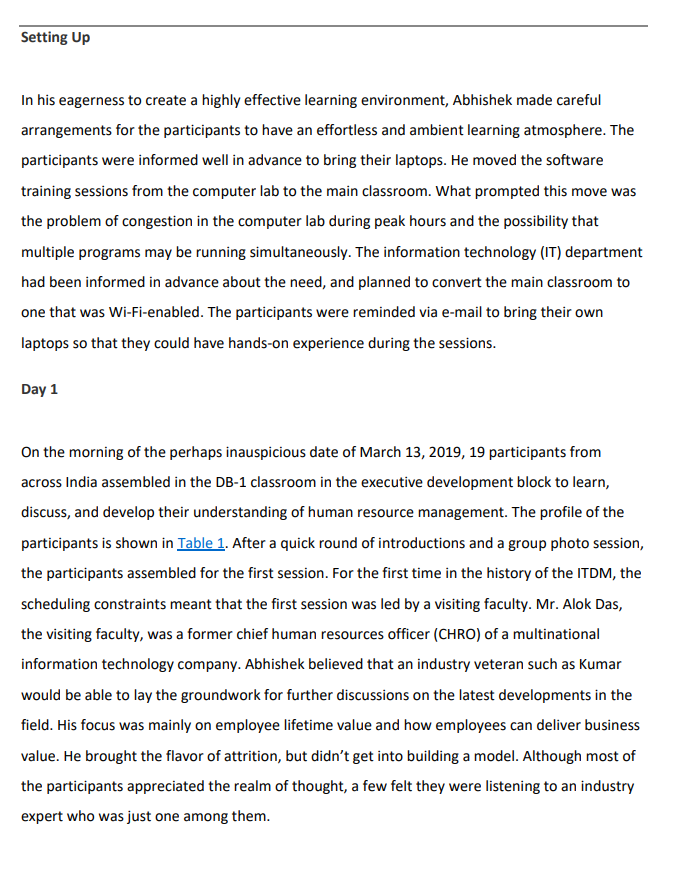
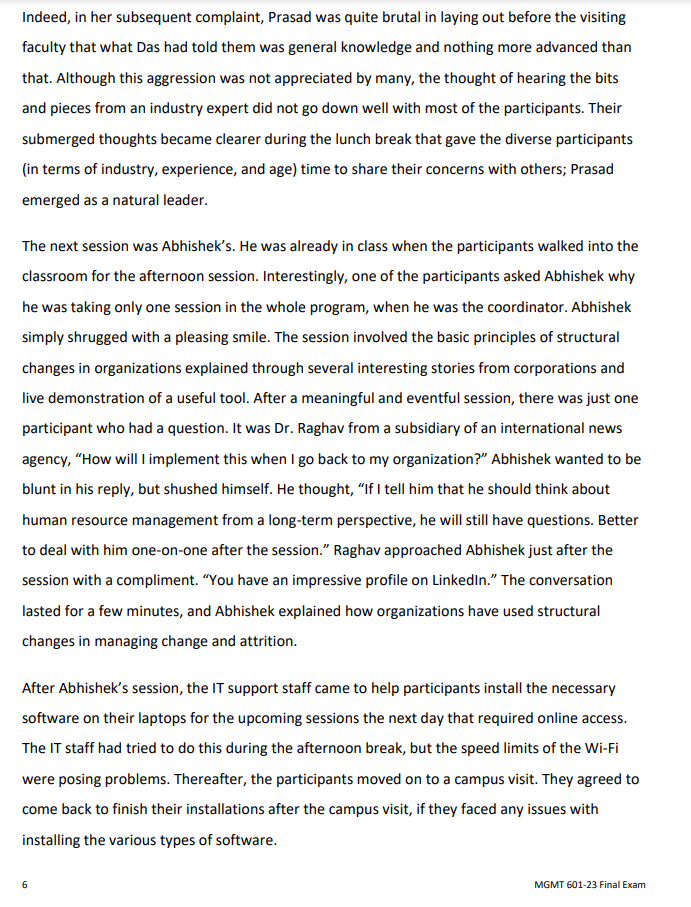
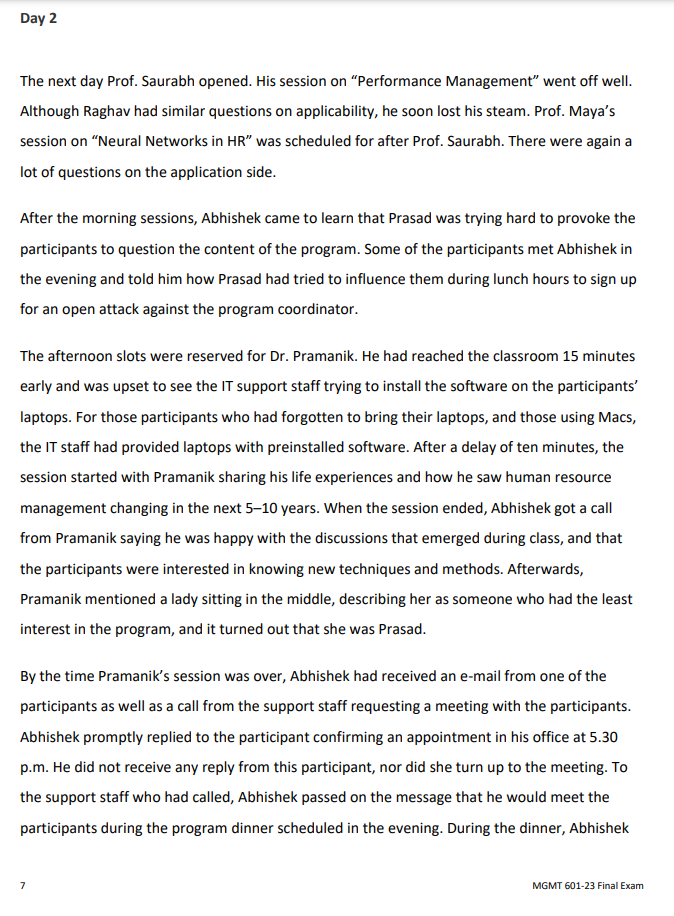
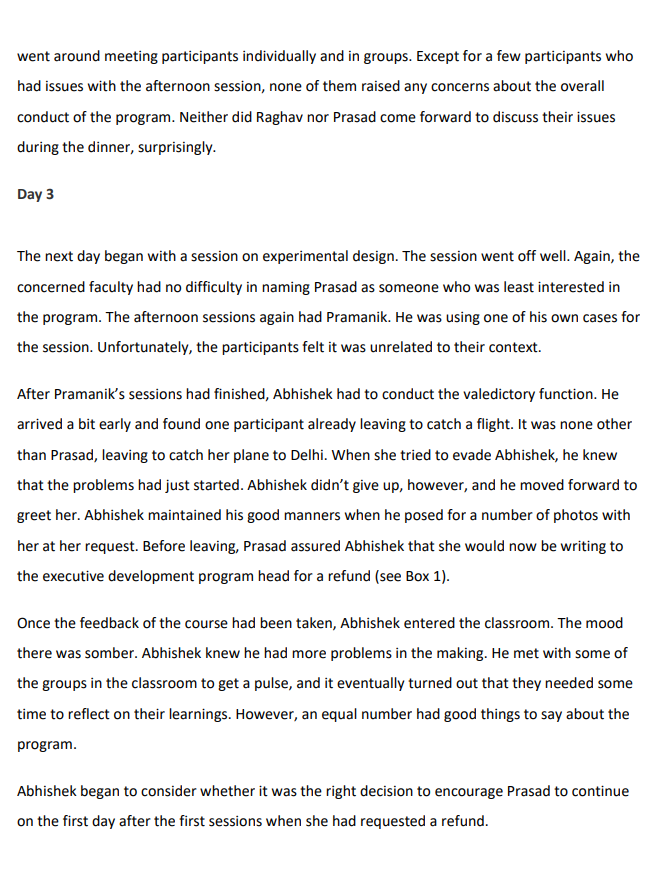
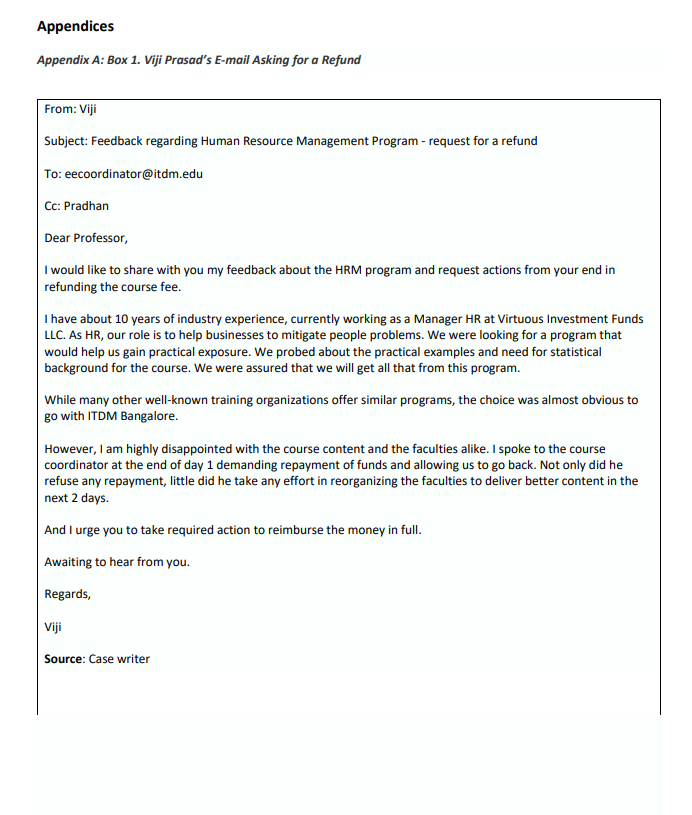
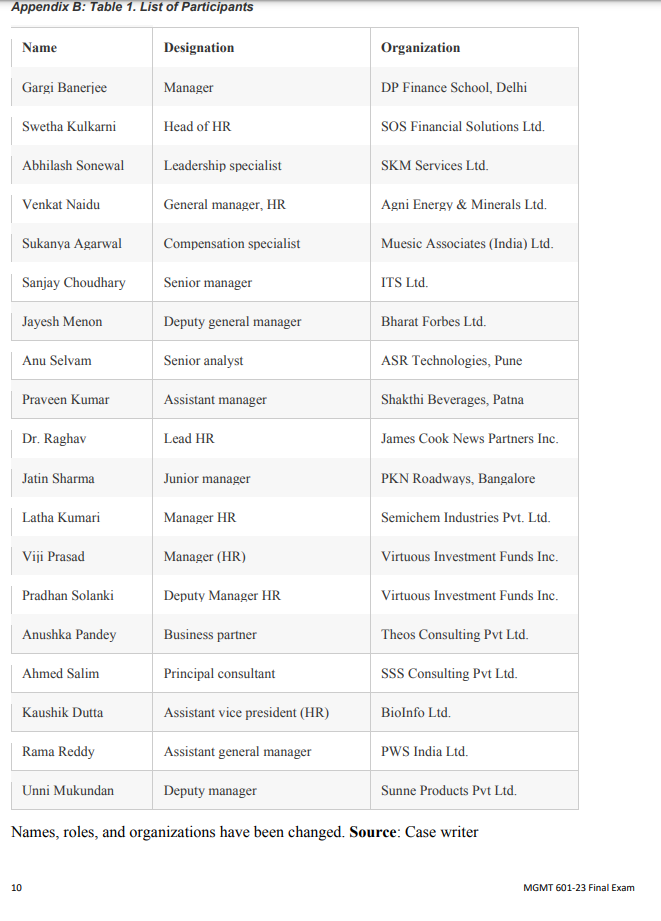
Case Introduction The three-day corporate executive education program had just started, with hardly two sessions completed. Dne ofthe participants from Iy'irtuous Investment Fund Inc., Ms. 1|ll'iji Prasad, approached the program coordinator, Prof. Abhishek, and asked for a complete refund. He was taken aback. "Madam, are you serious? The program has just started,\" he said. \"May I know your ex pectations ?" She fumbled and said, "I don't need to explain it to you.\" Abhishek politely told the participant, "Madam, how could you reach a conclusion even before the course has started?" She replied simply, "I don't think I would gain anything from the remaining sessions." Although Abhishek continued to exhibit emotional intelligence, his brain was not acknowledging this unanticipated discussion. With great patience, he continued to hear her story. \"Professor, the appraisal season is going on, and I had a lot of work in Virtuous, my organization. Still, I came to Bangalore. I had great expectations. ir'ou are simply failing me." I'ibhishek listened to her with respect, but when she started attacking his organization's ethos, he couldn't bear it anymore. He told her, "Madam, I respect you as a top-rated human resources [HR] professional, but you should be more careful in your words. The course has just started, and I don't think you should form an opinion now. Please wait for a few more sessions and see how it goes. If you color it this way now, chances are high that you will continue to see the sessions in a dismissiye way. Your cynicism can become contagious and a learning 2 MGMT 601-23 Final Exam Discussion Questions Analyze the case, apply conceptsftheoriesfmodels from our MGMT EDI-Course and the Leadership textbook by Hughes, Ginnet 3c Curphy [2022] to answer the following questions. 1. What is your assessment of the human resource management program? a. Consider those who think it is a success? Why? Failure? Why? h. Consider the situation, organizational climate, and culture. 2. What is Abhishek's role in the process? How would you characterize his leadership style? What would you recommend? 3. What bases of power do you think that Ahhishek or Prasad has, relative to each of the key indiyiduals or groups? What would you recommend? a. Consider there could be more than one hasefsource of power utilized when looking at the entire case. Showcase all you can. atmosphere will give way to pessimism and negativity. I earnestly request you to attend the course without coloring your mind as well as others. Regarding your request for a refund, I don't think I would be able to help you." She was not pleased with this reply, and walked away with a remark that could be overheard: "You'd better give me the refund." Abhishek noticed that another participant from v'irtuous, IvIr. Pradhan Solanki, was standing nearby, and he now picked up where his departing colleague had left off. Solanki said, \"I had talked to your marketing team member, and he had promised that the course will cover everything in human resource management." Abhishek asked him gently, "Do you remember the person who told you this?" But Solanki couldn't recollect the name, however hard he tried. Abhishek was aware that the program had not started well. The presence of even one agitated learner was enough to disturb the learning environment. But, then, what could be done now? About the Program Prof. Suresh had started the executive development program on human resource mangement at the Institute for Technology and Design Management {ITDM} in Bangalore, India, three years ago. His mastery in English had helped him to coin a catchy phrase for the program: "Human resource management for organizational excellence." Suresh had run the program successfully for those three years. In ZlEI, he was not sure whether he would be able to continue running the program, as he had shifted his base from Bangalore to Kolkata. However, Abhishek had taken up the task to ensure continuity for the program. He was assured that Suresh would travel to the ITDIv'I during the period of the program. However, due to certain personal 3 MG I'v'lT Sill-23 Final Exam commitments, it became difficult for the founding professor to travel during the program dates. Thanks to Suresh's excellent network, though, he had no difficulty in finding a replacement. Suresh identified Dr. Pramanik as a suitable resource person to lead the sessions. Suresh and Pramanik had worked together previously and had doctoral degrees from the same institute. Suresh had no difficulty in explaining the context of the program to Pramanik, and the sessions he had to lead. In early February EDIE), Pramanik met Suresh during a casual visit to Kolkata. During their discussion, attention turned towards the future of business in organizations and how HR could play an important role. Suresh had said, "Some of the companies have now started analyzing the outcome of business initiatives in the form of employee behaviors, but the problem is that employee behaviors are complex and therefore it is necessary to combine qualitative and quantitative indicators to analyze them. We have an executive development program in the ITDI'vl where we equip participants with techniques and methodologies to conduct such analysis in organizations. Would you be interested in sharing some of your experiences and the tools that you usually work with?" Both of them had long discussions, and when Abhishekjoined them and learned about their plans, he was hopeful that the program participants would benefit from Pramanik's expertise and academic fervor. Abhishek ensured that the program outline was the same as the previous years and the topics for the session were also not changed. Except for two instructors, the program was a look-alike of the previous years. Although Abhishek knew that Suresh would definitely be missed, he was optimistic that the participants would not miss out on learning. As the program dates approached, Abhishek was busy finalizing the schedule and making preparations. The final plan was communicated to the executive development office on February 2U, EDIE. What Abhishek did not know at that time was that the ITDM had entered into an agreement with a marketing company, and they were even then aggressively pushing the program among HR executives. Setting Up In his eagerness to create a highly effective learning environment, Abhishek made careful arrangements for the participants to have an effortless and ambient learning atmosphere. The participants were informed well in advance to bring their laptops. He moved the software training sessions from the computer lab to the main classroom. What prompted this move was the problem of congestion in the computer lab during peak hours and the possibility that multiple programs may be running simultaneously. The information technology {IT} department had been informed in advance about the need, and planned to convert the main classroom to one that was Wi-Fi-enabled. The participants were reminded via e-mail to bring their own laptops so that they could have hands-on experience during the sessions. Day 1 [in the morning ofthe perhaps inauspicious date of March 13, 242119, 19 participants from across India assembled in the DIE-1 classroom in the executive development block to learn, discuss, and develop their understanding of human resource management. The profile of the participants is shown in Llel. After a quick round of introductions and a group photo session, the participants assembled for the first session. For the rst time in the history of the ITDM, the scheduling constraints meant that the first session was led by a visiting faculty. lv'lr. Alok Das, the visiting faculty, was a former chief human resources officer lCHRU] of a multinational information technology company. Abhishek believed that an industry veteran such as Kumar would be able to lay the groundwork for further discussions on the latest developments in the field. His focus was mainly on employee lifetime value and how employees can deliver business value. He brought the flavor of attrition, but didn't get into building a model. Although most of the participants appreciated the realm of thought, a few felt they were listening to an industry expert who was just one among them. Indeed, in her subsequent complaint, Prasad was quite brutal in laying out before the visiting faculty that what Das had told them was general knowledge and nothing more advanced than that. Although this aggression was not appreciated by many, the thought of hearing the bits and pieces from an industry expert did not go down well with most of the participants. Their submerged thoughts became clearer during the lunch break that gave the diverse participants [in terms of industry, experience, and age} time to share their concerns with others; Prasad emerged as a natural leader. The next session was Abhishek's. He was already in class when the participants walked into the classroom for the afternoon session. Interestingly, one of the participants asked Abhishek why he was taking only one session in the whole program, when he was the coordinator. Abhishek simply shrugged with a pleasing smile. The session involved the basic principles of structural changes in organizations explained through several interesting stories from corporations and live demonstration of a useful tool. After a meaningful and eventful session, there was just one participant who had a question. It was Dr. Raghav from a subsidiary of an international news agency, "How will I implement this when I go back to my organization?" Abhishek wanted to be blunt in his reply, but shushed himself. He thought, "If I tell him that he should think about human resource management from a long-term perspective, he will still have questions. Better to deal with him one-on-one after the session." Raghav approached Abhishekjust after the session with a compliment. "You have an impressive profile on Linkedln." The conversation lasted for a few minutes, and Abhishek explained how organizations have used structural changes in managing change and attrition. After Abhishek's session, the IT support staff came to help participants install the necessary software on their laptops for the upcoming sessions the next day that required online access. The IT staff had tried to do this during the afternoon break, but the speed limits of the Wi-Fi were posing problems. Thereafter, the participants moved on to a campus visit. They agreed to come back to finish their installations after the campus visit, if they faced any issues with installing the various types of software. E MGMT EDI-23- Final Exam Dav 2 The next dav Prof. Saurabh opened. His session on \"Performance Management" went off well. Although Raghav had similar questions on applicability, he soon lost his steam. Prof. Mava's session on "Neural Networks in HR\" was scheduled for after Prof. Saurahh. There were again a lot of questions on the application side. After the morning sessions, Abhishek came to learn that Prasad was trving hard to provoke the participants to question the content ofthe program. Some of the participants met Abhishek in the evening and told him how Prasad had tried to inuence them during lunch hours to sign up for an open attack against the program coordinator. The afternoon slots were reserved for Dr. Pramanik. He had reached the classroom 15 minutes earlilr and was upset to see the IT support staff trving to install the software on the participants\" laptops. For those participants who had forgotten to bring their laptops, and those using l'v'lacs, the IT staff had provided laptops with preinstalled software. After a delav of ten minutes, the session started with Pramanik sharing his life experiences and how he saw human resource management changing in the next 51l] vears. When the session ended, Abhishek got a call from Pramanik saving he was happyI with the discussions that emerged during class, and that the participants were interested in knowing new techniques and methods. Afterwards, Pramanik. mentioned a lad!\"r sitting in the middle, describing her as someone who had the least interest in the program, and it turned out that she was Prasad. Ev the time Pramanik's session was over, Abhishek had received an e-mail from one of the participants as well as a call from the support staff requesting a meeting with the participants. Ahhishek promptlv replied to the participant confirming an appointment in his office at 5.3!] pm. He did not receive any replvI from this participant, nor did she turn up to the meeting. To the support staff who had called, Abhishek passed on the message that he would meet the participants during the program dinner scheduled in the evening. During the dinner, Abhishek F MGl'v'IT EDI-23 Final Exam went around meeting participants individually and in groups. Except for a few participants who had issues with the afternoon session, none of them raised any concerns about the overall conduct of the program. Neither did Raghav nor Prasad come forward to discuss their issues during the dinner, surprisingly. Day a The next day began with a session on experimental design. The session went off well. Again, the concerned faculty had no difficulty in naming Prasad as someone who was least interested in the program. The afternoon sessions again had Pramanik. He was using one of his own cases for the session. Unfortunately, the participants felt it was unrelated to their context. After Pramanik's sessions had finished, Abhishek had to conduct the valedictory function. He arrived a bit early and found one participant already leaving to catch a ight. It was none other than Prasad, leaving to catch her plane to Delhi. When she tried to evade Abhishek, he knew that the problems had just started. Abhishek didn't give up, however, and he moved forward to greet her. Abhishek maintained his good manners when he posed for a number of photos with her at her request. Before leaving, Prasad assured Abhishek that she would now be writing to the executive development program head for a refund [see Box 1]. Once the feedback of the course had been taken, Abhishek entered the classroom. The mood there was somber. Abhishek knew he had more problems in the making. He met with some of the groups in the classroom to get a pulse, and it eventually turned out that they needed some time to reect on their learnings. However, an equal number had good things to say about the progra m. Abhishek began to consider whether it was the right decision to encourage Prasad to continue on the first day after the first sessions when she had requested a refund. Appendices AppEndfsr A: Box 1. W' Praiad's Ema Asking for u Refund From: 'quiji Subject: Feedback regarding Human Resource Management Program - request for a refund To: eecoordinator@itdm.edu Cc: Prad han Dear Professor, I would like to share with you my feedback about the HEM program and request actions from your end in refunding the course fee. I ha ye about 10 years of industry experience, currently working as a Manager HP. at 1urirtuous Investment Funds LLC. As HR, our role is to help businesses to mitigate people problems. We were looking for a program that would help us gain practical Exposure. We pro bed about the practical examples and need for statistical background for the course. We were assured that we will get all that from this program. While many other well-known training organizations offer similar programs, the choice was almost obyious to go with ITDM Bangalore. However, I am highly disappointed with the course content and the faculties alike. I spoke to the course coordinator at the end of day 1 demanding repayment of funds and allowing us to go back. Not only did he refuse any repayment, little did he take any effort in reorganizing the faculties to deliyer better content in the next 2 days. and I urge you to take required action to reimburse the money in full. Awaiting to hear from you. Regards, Uiji Source: Ca se writer \f
Step by Step Solution
There are 3 Steps involved in it

Get step-by-step solutions from verified subject matter experts