







Question: Please answer the question 7 and 8 please give an answer briefly. THANKS IN ADVANCE Multi-Stakeholder Approach to Supply Chain Management and Business Planning Background
Please answer the question 7 and 8 please give an answer briefly.
THANKS IN ADVANCE
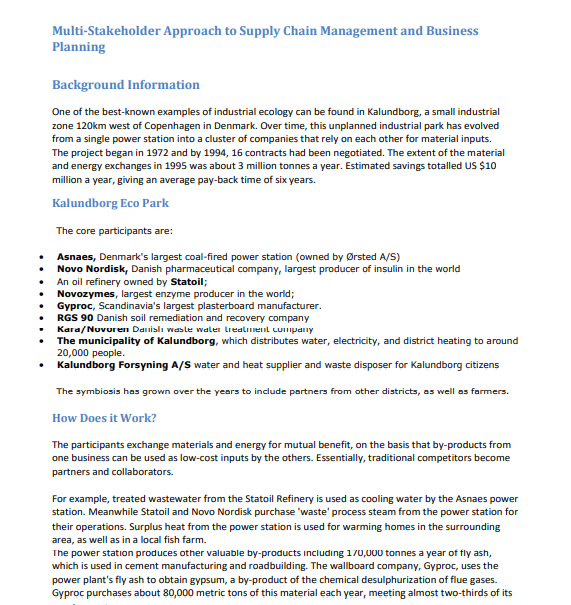
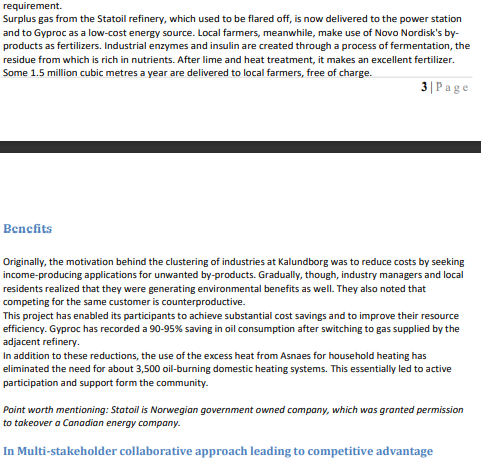
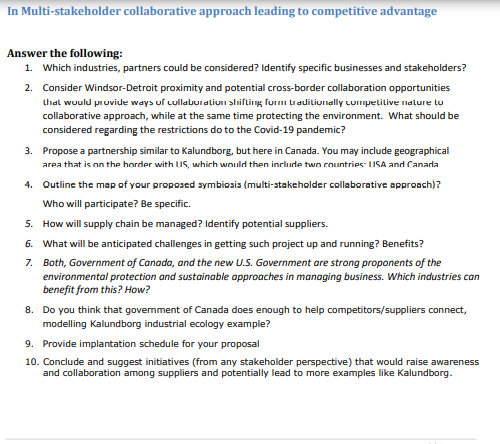
Multi-Stakeholder Approach to Supply Chain Management and Business Planning Background Information One of the best-known examples of industrial ecology can be found in Kalundborg, a small industrial zone 120km west of Copenhagen in Denmark. Over time, this unplanned industrial park has evolved from a single power station into a cluster of companies that rely on each other for material inputs. The project began in 1972 and by 1994, 16 contracts had been negotiated. The extent of the material and energy exchanges in 1995 was about 3 million tonnes a year. Estimated savings totalled US $10 million a year, giving an average pay-back time of six years. Kalundborg Eco Park The core participants are: Asnaes, Denmark's largest coal-fired power station (owned by rsted A/S) Novo Nordisk, Danish pharmaceutical company, largest producer of insulin in the world An oil refinery owned by Statoil; Novozymes, largest enzyme producer in the world; . Gyproc, Scandinavia's largest plasterboard manufacturer. RGS 90 Danish soil remediation and recovery company Kara/Nuvuren Danishi wale wale treatment company The municipality of Kalundborg, which distributes water, electricity, and district heating to around 20,000 people. Kalundborg Forsyning A/S water and heat supplier and waste disposer for Kalundborg citizens The symbiosis has grown over the years to include partners from other districts, as well as formers. How Does it work? The participants exchange materials and energy for mutual benefit, on the basis that by-products from one business can be used as low-cost inputs by the others. Essentially, traditional competitors become partners and collaborators. For example, treated wastewater from the Statoil Refinery is used as cooling water by the Asnaes power station. Meanwhile Statoil and Novo Nordisk purchase 'waste' process steam from the power station for their operations. Surplus heat from the power station is used for warming homes in the surrounding area, as well as in a local fish farm. The power station produces other valuable by-products including 170,000 tonnes a year of fly ash, which is used in cement manufacturing and roadbuilding. The wallboard company, Gyproc, uses the power plant's fly ash to obtain gypsum, a by-product of the chemical desulphurization of flue gases. Gyproc purchases about 80,000 metric tons of this material each year, meeting almost two-thirds of its requirement. Surplus gas from the Statoil refinery, which used to be flared off, is now delivered to the power station and to Gyproc as a low-cost energy source. Local farmers, meanwhile, make use of Novo Nordisk's by- products as fertilizers. Industrial enzymes and insulin are created through a process of fermentation, the residue from which is rich in nutrients. After lime and heat treatment, it makes an excellent fertilizer. Some 1.5 million cubic metres a year are delivered to local farmers, free of charge. 3 Page Bencfits Originally, the motivation behind the clustering of industries at Kalundborg was to reduce costs by seeking income-producing applications for unwanted by-products. Gradually, though, industry managers and local residents realized that they were generating environmental benefits as well. They also noted that competing for the same customer is counterproductive. This project has enabled its participants to achieve substantial cost savings and to improve their resource efficiency. Gyproc has recorded a 90-95% saving in oil consumption after switching to gas supplied by the adjacent refinery. In addition to these reductions, the use of the excess heat from Asnaes for household heating has eliminated the need for about 3,500 oil-burning domestic heating systems. This essentially led to active participation and support form the community. Point worth mentioning: Statoil is Norwegian government owned company, which was granted permission to takeover a Canadian energy company. In Multi-stakeholder collaborative approach leading to competitive advantage In Multi-stakeholder collaborative approach leading to competitive advantage Answer the following: 1. Which industries, partners could be considered? Identify specific businesses and stakeholders? 2. Consider Windsor-Detroit proximity and potential cross-border collaboration opportunities that would provide ways of collaboration shifting form Lraditionally competitive nature tu collaborative approach, while at the same time protecting the environment. What should be considered regarding the restrictions do to the Covid-19 pandemic? 3. Propose a partnership similar to Kalundborg, but here in Canada. You may include geographical area that is on the horder with US, which would then include two countries USA and Canada 4. Qutline the map of your proposed symbiosis (multi-stakeholder collaborative approach)? Who will participate? Be specific. 5. How will supply chain be managed? Identify potential suppliers. 6. What will be anticipated challenges in getting such project up and running? Benefits? 7. Both, Government of Canada, and the new U.S. Government are strong proponents of the environmental protection and sustainable approaches in managing business. Which industries can benefit from this? How? 8. Do you think that government of Canada does enough to help competitors/suppliers connect, modelling Kalundborg industrial ecology example? 9. Provide implantation schedule for your proposal 10. Conclude and suggest initiatives (from any stakeholder perspective) that would raise awareness and collaboration among suppliers and potentially lead to more examples like KalundborgStep by Step Solution
There are 3 Steps involved in it
1 Expert Approved Answer
Step: 1 Unlock

Question Has Been Solved by an Expert!
Get step-by-step solutions from verified subject matter experts
Step: 2 Unlock
Step: 3 Unlock
 Study Help