







Question: Please answer the question a, b and c 6. Assume that all individuals have identical preferences but some individuals are wealthier than others. Assume there
Please answer the question a, b and c
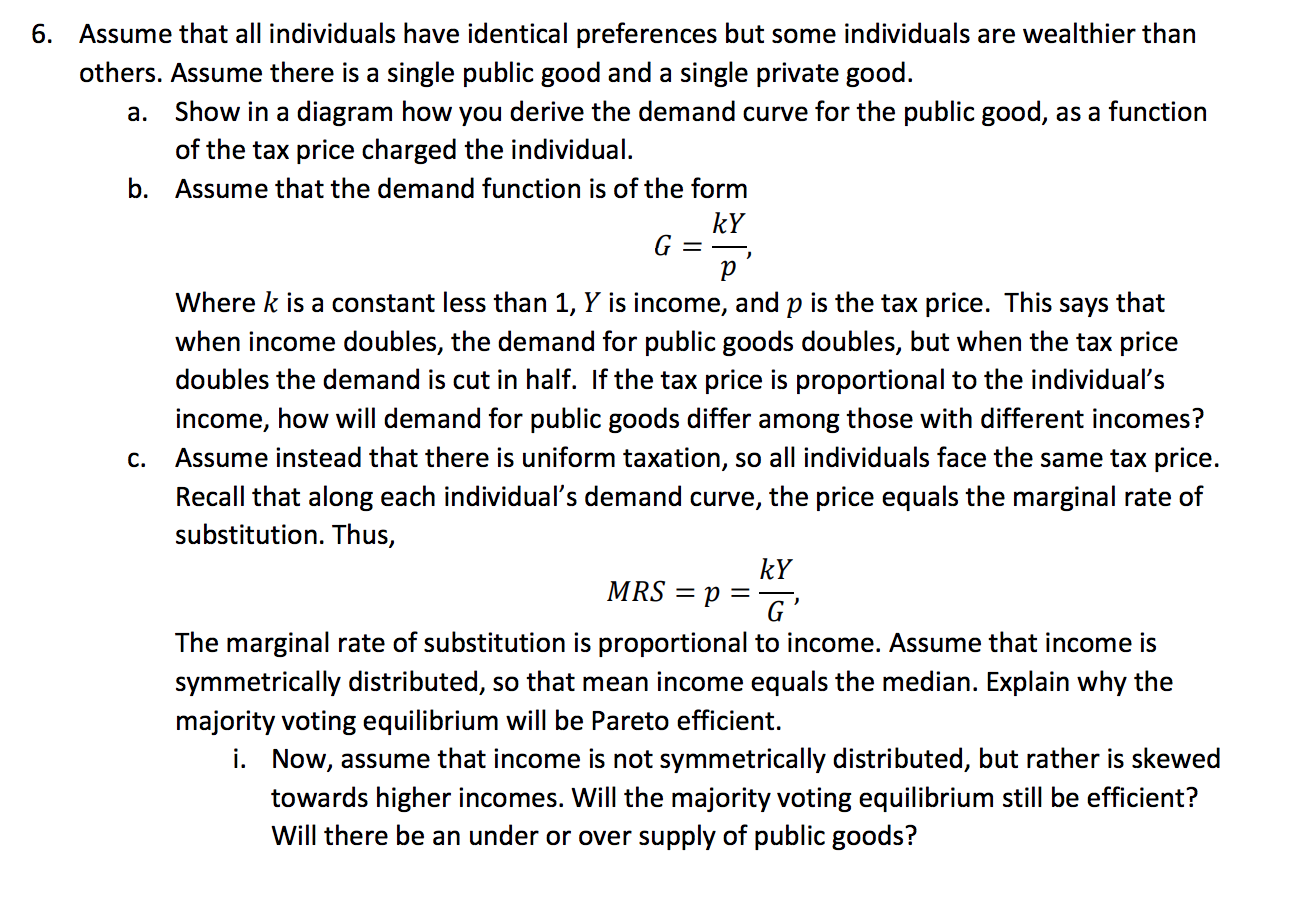
6. Assume that all individuals have identical preferences but some individuals are wealthier than others. Assume there is a single public good and a single private good. a. Show in a diagram how you derive the demand curve for the public good, as a function of the tax price charged the individual. Assume that the demand function is of the form kY G =, P Where k is a constant less than 1, Y is income, and p is the tax price. This says that when income doubles, the demand for public goods doubles, but when the tax price doubles the demand is cut in half. If the tax price is proportional to the individual's income, how will demand for public goods differ among those with different incomes? Assume instead that there is uniform taxation, so all individuals face the same tax price. Recall that along each individual's demand curve, the price equals the marginal rate of substitution. Thus, kY MRS = = , p G The marginal rate of substitution is proportional to income. Assume that income is symmetrically distributed, so that mean income equals the median. Explain why the majority voting equilibrium will be Pareto efficient. i. Now, assume that income is not symmetrically distributed, but rather is skewed towards higher incomes. Will the majority voting equilibrium still be efcient? Will there be an under or over supply of public goods
Step by Step Solution
There are 3 Steps involved in it

Get step-by-step solutions from verified subject matter experts
 Study Help