







Question: please answer the question and explain. use example 2.14 as a reference. a 2.276. Mass transfer in a hollow-fiber boiler feedwater deaerator (a) Consider the
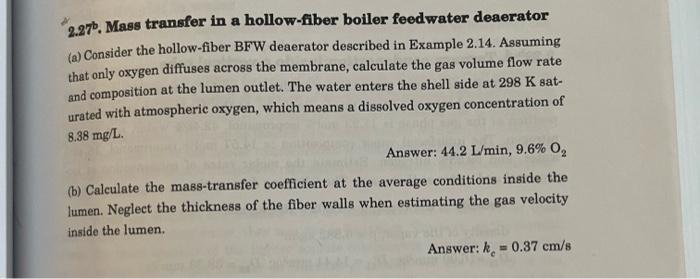
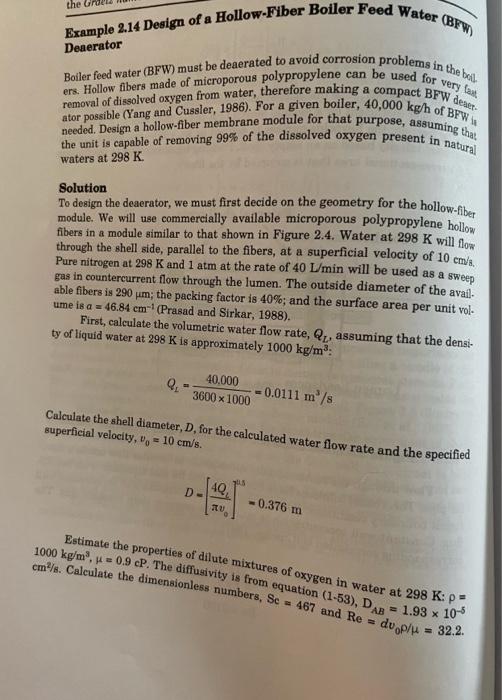
a 2.276. Mass transfer in a hollow-fiber boiler feedwater deaerator (a) Consider the hollow-fiber BFW deaerator described in Example 2.14. Assuming that only oxygen diffuses across the membrane, calculate the gas volume flow rate and composition at the lumen outlet. The water enters the shell side at 298 K sat- urated with atmospheric oxygen, which means a dissolved oxygen concentration of 8.38 mg/L. Answer: 44.2 L/min, 9.6% 0, (b) Calculate the mass-transfer coefficient at the average conditions inside the lumen. Neglect the thickness of the fiber walls when estimating the gas velocity inside the lumen. Answer: k, = 0.37 cm/s the U Denerator Example 2.14 Design of a Hollow-Fiber Boiler Feed Water (BF) ers. Hollow fibers made of microporous polypropylene can be used for very last Boiler feed water (BFW) must be deaerated to avoid corrosion problems in the bar ator possible (Yang and Cussler, 1986). For a given boiler, 40,000 kg/h of BEW removal of dissolved oxygen from water, therefore making a compact BFW dear needed. Design a hollow-fiber membrane module for that purpose, assuming that the unit is capable of removing 99% of the dissolved oxygen present in natural waters at 298 K. Solution To design the deaerator, we must first decide on the geometry for the hollow-fiber module. We will use commercially available microporous polypropylene hollow fibers in a module similar to that shown in Figure 2.4. Water at 298 K will flow through the shell side, parallel to the fibers, at a superficial velocity of 10 cm/s Pure nitrogen at 298 K and 1 atm at the rate of 40 L/min will be used as a sweep gas in countercurrent flow through the lumen. The outside diameter of the avail able fibers is 290 um; the packing factor is 40%; and the surface area per unit vol- ume is a = 46.84 cm-' (Prasad and Sirkar, 1988). First, calculate the volumetric water flow rate, Q,, assuming that the densi- ty of liquid water at 298 K is approximately 1000 kg/m: 40.000 3600 x 1000 0.0111 m/s Calculate the shell diameter, D, for the calculated water flow rate and the specified superficial velocity, v, - 10 cm/s. D- Delete -0.376 m TU Estimate the properties of dilute mixtures of oxygen in water at 298 K: PS 1000 kg/m = 0.9 cP. The diffusivity is from equation (1-53), DAB = 1.93 em/s. Calculate the dimensionless numbers, Sc 467 and Re du.pl 10- = 32.2
Step by Step Solution
There are 3 Steps involved in it

Get step-by-step solutions from verified subject matter experts
 Study Help