







Question: Please answer the question at the end: at least 250 words, thank you International Strategy in the Sharing Economy OPENING CASE Small, medium-sized, and large
Please answer the question at the end: at least 250 words, thank you
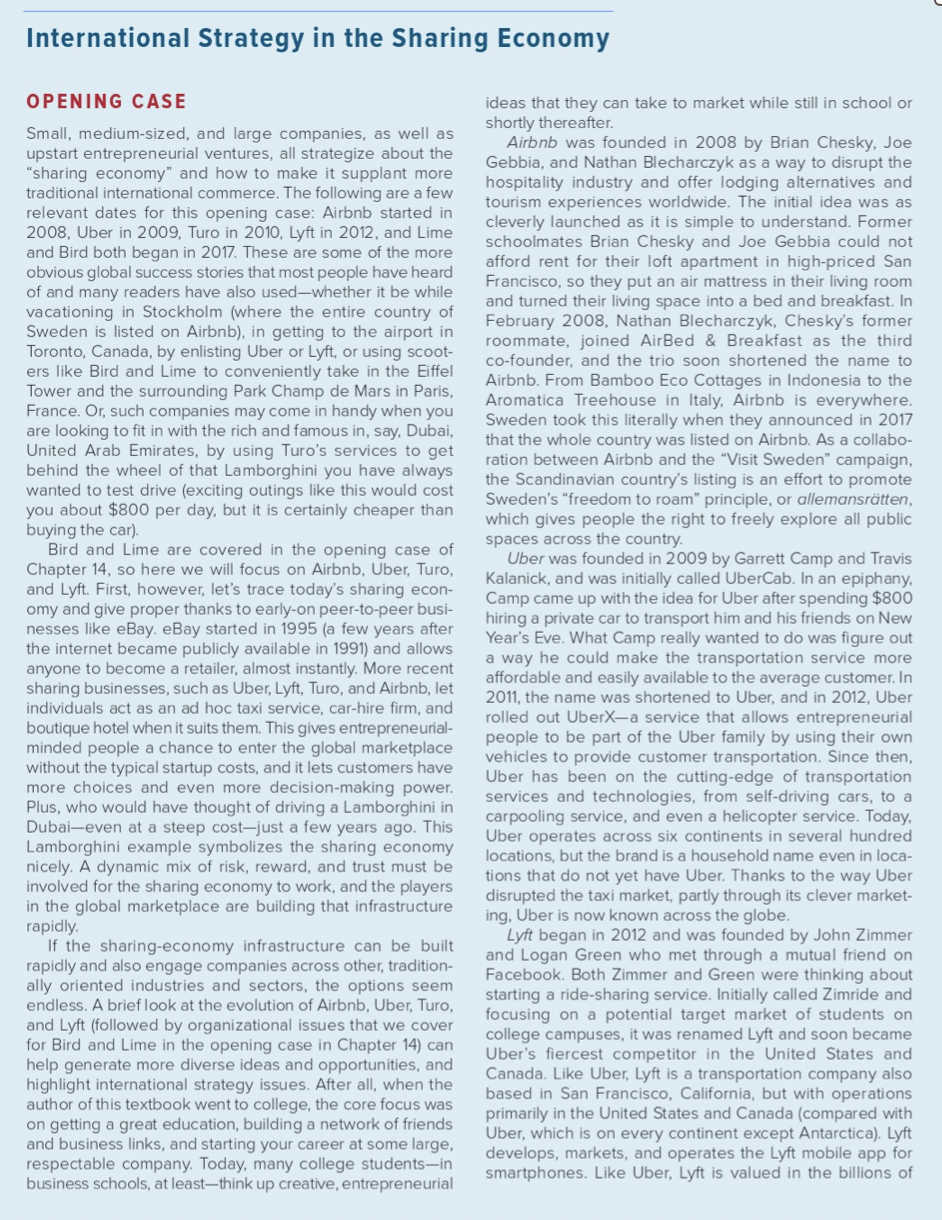
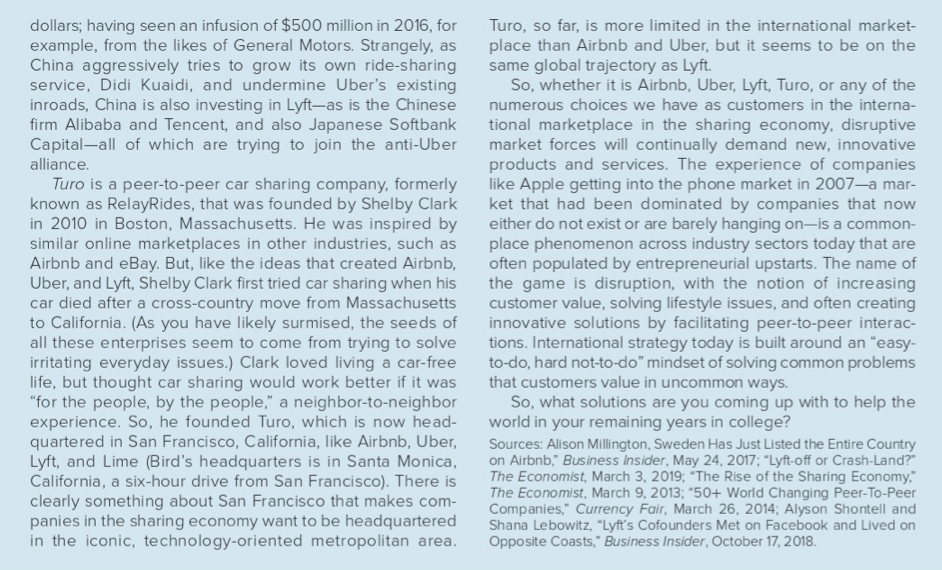
International Strategy in the Sharing Economy OPENING CASE Small, medium-sized, and large companies, as well as upstart entrepreneurial ventures, all strategize about the "sharing economy" and how to make it supplant more traditional international commerce. The following are a few relevant dates for this opening case: Airbnb started in 2008, Uber in 2009, Turo in 2010, Lyft in 2012, and Lime and Bird both began in 2017. These are some of the more obvious global success stories that most people have heard of and many readers have also used-whether it be while vacationing in Stockholm (where the entire country of Sweden is listed on Airbnb), in getting to the airport in Toronto, Canada, by enlisting Uber or Lyft, or using scoot- ers like Bird and Lime to conveniently take in the Eiffel Tower and the surrounding Park Champ de Mars in Paris, France. Or, such companies may come in handy when you are looking to fit in with the rich and famous in, say, Dubai, United Arab Emirates, by using Turo's services to get behind the wheel of that Lamborghini you have always wanted to test drive (exciting outings like this would cost you about $800 per day, but it is certainly cheaper than buying the car) Bird and Lime are covered in the opening case of Chapter 14, so here we will focus on Airbnb, Uber, Turo, and Lyft. First, however, let's trace today's sharing econ- omy and give proper thanks to early-on peer-to-peer busi- nesses like eBay. eBay started in 1995 (a few years after the internet became publicly available in 1991) and allows anyone to become a retailer, almost instantly. More recent sharing businesses, such as Uber, Lyft, Turo, and Airbnb, let individuals act as an ad hoc taxi service, car-hire firm, and boutique hotel when it suits them. This gives entrepreneurial- minded people a chance to enter the global marketplace without the typical startup costs, and it lets customers have more choices and even more decision-making power. Plus, who would have thought of driving a Lamborghini in Dubai-even at a steep cost-just a few years ago. This Lamborghini example symbolizes the sharing economy nicely. A dynamic mix of risk, reward, and trust must be involved for the sharing economy to work, and the players in the global marketplace are building that infrastructure rapidly. If the sharing-economy infrastructure can be built rapidly and also engage companies across other, tradition- ally oriented industries and sectors, the options seem endless. A brief look at the evolution of Airbnb, Uber, Turo, and Lyft (followed by organizational issues that we cover for Bird and Lime in the opening case in Chapter 14) can help generate more diverse ideas and opportunities, and highlight international strategy issues. After all, when the author of this textbook went to college, the core focus was on getting a great education, building a network of friends and business links, and starting your career at some large, respectable company. Today, many college students-in business schools, at leastthink up creative, entrepreneurial ideas that they can take to market while still in school or shortly thereafter. Airbnb was founded in 2008 by Brian Chesky, Joe Gebbia, and Nathan Blecharczyk as a way to disrupt the hospitality industry and offer lodging alternatives and tourism experiences worldwide. The initial idea was as cleverly launched as it is simple to understand. Former schoolmates Brian Chesky and Joe Gebbia could not afford rent for their loft apartment in high-priced San Francisco, so they put an air mattress in their living room and turned their living space into a bed and breakfast. In February 2008, Nathan Blecharczyk, Chesky's former roommate, joined AirBed & Breakfast as the third co-founder, and the trio soon shortened the name to Airbnb. From Bamboo Eco Cottages in Indonesia to the Aromatica Treehouse in Italy, Airbnb is everywhere. Sweden took this literally when they announced in 2017 that the whole country was listed on Airbnb. As a collabo- ration between Airbnb and the "Visit Sweden" campaign, the Scandinavian country's listing is an effort to promote Sweden's "freedom to roam" principle, or allemansrtten, which gives people the right to freely explore all public spaces across the country. Uber was founded in 2009 by Garrett Camp and Travis Kalanick, and was initially called UberCab. In an epiphany, Camp came up with the idea for Uber after spending $800 hiring a private car to transport him and his friends on New Year's Eve. What Camp really wanted to do was figure out a way he could make the transportation service more affordable and easily available to the average customer. In 2011, the name was shortened to Uber, and in 2012, Uber rolled out UberX-a service that allows entrepreneurial people to be part of the Uber family by using their own vehicles to provide customer transportation. Since then, Uber has been on the cutting-edge of transportation services and technologies, from self-driving cars, to a carpooling service, and even a helicopter service. Today, Uber operates across six continents in several hundred locations, but the brand is a household name even in loca- tions that do not yet have Uber. Thanks to the way Uber disrupted the taxi market, partly through its clever market- ing, Uber is now known across the globe. Lyft began in 2012 and was founded by John Zimmer and Logan Green who met through a mutual friend on Facebook. Both Zimmer and Green were thinking about starting a ride-sharing service. Initially called Zimride and focusing on a potential target market of students on college campuses, it was renamed Lyft and soon became Uber's fiercest competitor in the United States and Canada. Like Uber, Lyft is a transportation company also based in San Francisco, California, but with operations primarily in the United States and Canada (compared with Uber, which is on every continent except Antarctica). Lyft develops, markets, and operates the Lyft mobile app for smartphones. Like Uber, Lyft is valued in the billions of dollars; having seen an infusion of $500 million in 2016, for example, from the likes of General Motors. Strangely, as China aggressively tries to grow its own ride-sharing service, Didi Kuaidi, and undermine Uber's existing inroads, China is also investing in Lyft-as is the Chinese firm Alibaba and Tencent, and also Japanese Softbank Capital-all of which are trying to join the anti-Uber alliance. Turo is a peer-to-peer car sharing company, formerly known as RelayRides, that was founded by Shelby Clark in 2010 in Boston, Massachusetts. He was inspired by similar online marketplaces in other industries, such as Airbnb and eBay. But, like the ideas that created Airbnb, Uber, and Lyft, Shelby Clark first tried car sharing when his car died after a cross-country move from Massachusetts to California. (As you have likely surmised, the seeds of all these enterprises seem to come from trying to solve irritating everyday issues.) Clark loved living a car-free life, but thought car sharing would work better if it was "for the people, by the people," a neighbor-to-neighbor experience. So, he founded Turo, which is now head- quartered in San Francisco, California, like Airbnb, Uber, Lyft, and Lime (Bird's headquarters is in Santa Monica, California, a six-hour drive from San Francisco). There is clearly something about San Francisco that makes com- panies in the sharing economy want to be headquartered in the iconic, technology-oriented metropolitan area. Turo, so far, is more limited in the international market- place than Airbnb and Uber, but it seems to be on the same global trajectory as Lyft. So, whether it is Airbnb, Uber, Lyft, Turo, or any of the numerous choices we have as customers in the interna- tional marketplace in the sharing economy, disruptive market forces will continually demand new, innovative products and services. The experience of companies like Apple getting into the phone market in 2007a mar- ket that had been dominated by companies that now either do not exist or are barely hanging onis a common- place phenomenon across industry sectors today that are often populated by entrepreneurial upstarts. The name of the game is disruption, with the notion of increasing customer value, solving lifestyle issues, and often creating innovative solutions by facilitating peer-to-peer interac- tions. International strategy today is built around an "easy- to-do, hard not-to-do mindset of solving common problems that customers value in uncommon ways. So, what solutions are you coming up with to help the world in your remaining years in college? Sources: Alison Millington, Sweden Has Just Listed the Entire Country on Airbnb." Business Insider, May 24, 2017; "Lyft-off or Crash-Land? The Economist, March 3, 2019; "The Rise of the Sharing Economy." The Economist, March 9, 2013: "50+ World Changing Peer-To-Peer Companies," Currency Fair, March 26, 2014; Alyson Shontell and Shana Lebowitz, "Lyft's Cofounders Met on Facebook and Lived on Opposite Coasts, Business Insider, October 17, 2018. International Strategy in the Sharing Economy OPENING CASE Small, medium-sized, and large companies, as well as upstart entrepreneurial ventures, all strategize about the "sharing economy" and how to make it supplant more traditional international commerce. The following are a few relevant dates for this opening case: Airbnb started in 2008, Uber in 2009, Turo in 2010, Lyft in 2012, and Lime and Bird both began in 2017. These are some of the more obvious global success stories that most people have heard of and many readers have also used-whether it be while vacationing in Stockholm (where the entire country of Sweden is listed on Airbnb), in getting to the airport in Toronto, Canada, by enlisting Uber or Lyft, or using scoot- ers like Bird and Lime to conveniently take in the Eiffel Tower and the surrounding Park Champ de Mars in Paris, France. Or, such companies may come in handy when you are looking to fit in with the rich and famous in, say, Dubai, United Arab Emirates, by using Turo's services to get behind the wheel of that Lamborghini you have always wanted to test drive (exciting outings like this would cost you about $800 per day, but it is certainly cheaper than buying the car) Bird and Lime are covered in the opening case of Chapter 14, so here we will focus on Airbnb, Uber, Turo, and Lyft. First, however, let's trace today's sharing econ- omy and give proper thanks to early-on peer-to-peer busi- nesses like eBay. eBay started in 1995 (a few years after the internet became publicly available in 1991) and allows anyone to become a retailer, almost instantly. More recent sharing businesses, such as Uber, Lyft, Turo, and Airbnb, let individuals act as an ad hoc taxi service, car-hire firm, and boutique hotel when it suits them. This gives entrepreneurial- minded people a chance to enter the global marketplace without the typical startup costs, and it lets customers have more choices and even more decision-making power. Plus, who would have thought of driving a Lamborghini in Dubai-even at a steep cost-just a few years ago. This Lamborghini example symbolizes the sharing economy nicely. A dynamic mix of risk, reward, and trust must be involved for the sharing economy to work, and the players in the global marketplace are building that infrastructure rapidly. If the sharing-economy infrastructure can be built rapidly and also engage companies across other, tradition- ally oriented industries and sectors, the options seem endless. A brief look at the evolution of Airbnb, Uber, Turo, and Lyft (followed by organizational issues that we cover for Bird and Lime in the opening case in Chapter 14) can help generate more diverse ideas and opportunities, and highlight international strategy issues. After all, when the author of this textbook went to college, the core focus was on getting a great education, building a network of friends and business links, and starting your career at some large, respectable company. Today, many college students-in business schools, at leastthink up creative, entrepreneurial ideas that they can take to market while still in school or shortly thereafter. Airbnb was founded in 2008 by Brian Chesky, Joe Gebbia, and Nathan Blecharczyk as a way to disrupt the hospitality industry and offer lodging alternatives and tourism experiences worldwide. The initial idea was as cleverly launched as it is simple to understand. Former schoolmates Brian Chesky and Joe Gebbia could not afford rent for their loft apartment in high-priced San Francisco, so they put an air mattress in their living room and turned their living space into a bed and breakfast. In February 2008, Nathan Blecharczyk, Chesky's former roommate, joined AirBed & Breakfast as the third co-founder, and the trio soon shortened the name to Airbnb. From Bamboo Eco Cottages in Indonesia to the Aromatica Treehouse in Italy, Airbnb is everywhere. Sweden took this literally when they announced in 2017 that the whole country was listed on Airbnb. As a collabo- ration between Airbnb and the "Visit Sweden" campaign, the Scandinavian country's listing is an effort to promote Sweden's "freedom to roam" principle, or allemansrtten, which gives people the right to freely explore all public spaces across the country. Uber was founded in 2009 by Garrett Camp and Travis Kalanick, and was initially called UberCab. In an epiphany, Camp came up with the idea for Uber after spending $800 hiring a private car to transport him and his friends on New Year's Eve. What Camp really wanted to do was figure out a way he could make the transportation service more affordable and easily available to the average customer. In 2011, the name was shortened to Uber, and in 2012, Uber rolled out UberX-a service that allows entrepreneurial people to be part of the Uber family by using their own vehicles to provide customer transportation. Since then, Uber has been on the cutting-edge of transportation services and technologies, from self-driving cars, to a carpooling service, and even a helicopter service. Today, Uber operates across six continents in several hundred locations, but the brand is a household name even in loca- tions that do not yet have Uber. Thanks to the way Uber disrupted the taxi market, partly through its clever market- ing, Uber is now known across the globe. Lyft began in 2012 and was founded by John Zimmer and Logan Green who met through a mutual friend on Facebook. Both Zimmer and Green were thinking about starting a ride-sharing service. Initially called Zimride and focusing on a potential target market of students on college campuses, it was renamed Lyft and soon became Uber's fiercest competitor in the United States and Canada. Like Uber, Lyft is a transportation company also based in San Francisco, California, but with operations primarily in the United States and Canada (compared with Uber, which is on every continent except Antarctica). Lyft develops, markets, and operates the Lyft mobile app for smartphones. Like Uber, Lyft is valued in the billions of dollars; having seen an infusion of $500 million in 2016, for example, from the likes of General Motors. Strangely, as China aggressively tries to grow its own ride-sharing service, Didi Kuaidi, and undermine Uber's existing inroads, China is also investing in Lyft-as is the Chinese firm Alibaba and Tencent, and also Japanese Softbank Capital-all of which are trying to join the anti-Uber alliance. Turo is a peer-to-peer car sharing company, formerly known as RelayRides, that was founded by Shelby Clark in 2010 in Boston, Massachusetts. He was inspired by similar online marketplaces in other industries, such as Airbnb and eBay. But, like the ideas that created Airbnb, Uber, and Lyft, Shelby Clark first tried car sharing when his car died after a cross-country move from Massachusetts to California. (As you have likely surmised, the seeds of all these enterprises seem to come from trying to solve irritating everyday issues.) Clark loved living a car-free life, but thought car sharing would work better if it was "for the people, by the people," a neighbor-to-neighbor experience. So, he founded Turo, which is now head- quartered in San Francisco, California, like Airbnb, Uber, Lyft, and Lime (Bird's headquarters is in Santa Monica, California, a six-hour drive from San Francisco). There is clearly something about San Francisco that makes com- panies in the sharing economy want to be headquartered in the iconic, technology-oriented metropolitan area. Turo, so far, is more limited in the international market- place than Airbnb and Uber, but it seems to be on the same global trajectory as Lyft. So, whether it is Airbnb, Uber, Lyft, Turo, or any of the numerous choices we have as customers in the interna- tional marketplace in the sharing economy, disruptive market forces will continually demand new, innovative products and services. The experience of companies like Apple getting into the phone market in 2007a mar- ket that had been dominated by companies that now either do not exist or are barely hanging onis a common- place phenomenon across industry sectors today that are often populated by entrepreneurial upstarts. The name of the game is disruption, with the notion of increasing customer value, solving lifestyle issues, and often creating innovative solutions by facilitating peer-to-peer interac- tions. International strategy today is built around an "easy- to-do, hard not-to-do mindset of solving common problems that customers value in uncommon ways. So, what solutions are you coming up with to help the world in your remaining years in college? Sources: Alison Millington, Sweden Has Just Listed the Entire Country on Airbnb." Business Insider, May 24, 2017; "Lyft-off or Crash-Land? The Economist, March 3, 2019; "The Rise of the Sharing Economy." The Economist, March 9, 2013: "50+ World Changing Peer-To-Peer Companies," Currency Fair, March 26, 2014; Alyson Shontell and Shana Lebowitz, "Lyft's Cofounders Met on Facebook and Lived on Opposite Coasts, Business Insider, October 17, 2018Step by Step Solution
There are 3 Steps involved in it
1 Expert Approved Answer
Step: 1 Unlock

Question Has Been Solved by an Expert!
Get step-by-step solutions from verified subject matter experts
Step: 2 Unlock
Step: 3 Unlock
 Study Help