







Question: Please answer the question. I will give the good feedback. THANK YOU SO MUCH. Please answer the question. THANK YOU SO MUCH. I will give
Please answer the question. I will give the good feedback. THANK YOU SO MUCH. Please answer the question. THANK YOU SO MUCH. I will give the good feedback.
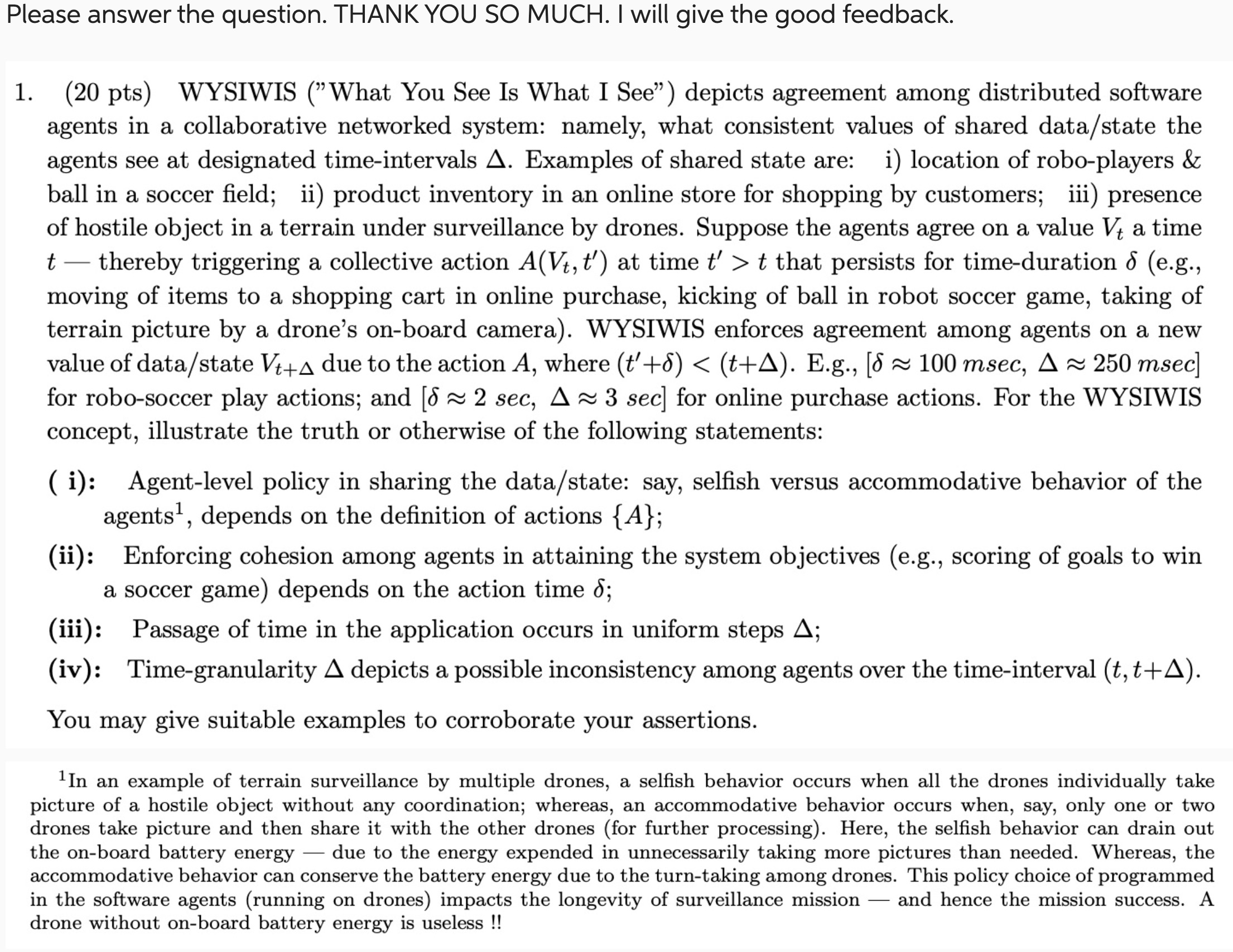
pts WYSIWIS What You See Is What I See" depicts agreement among distributed software
agents in a collaborative networked system: namely, what consistent values of shared datastate the
agents see at designated timeintervals Examples of shared state are: i location of roboplayers &
ball in a soccer field; ii product inventory in an online store for shopping by customers; iii presence
of hostile object in a terrain under surveillance by drones. Suppose the agents agree on a value a time
thereby triggering a collective action at time that persists for timeduration eg
moving of items to a shopping cart in online purchase, kicking of ball in robot soccer game, taking of
terrain picture by a drone's onboard camera WYSIWIS enforces agreement among agents on a new
value of datastate due to the action where Eg~~msec,~~msec
for robosoccer play actions; and ~~~~ for online purchase actions. For the WYSIWIS
concept, illustrate the truth or otherwise of the following statements:
i: Agentlevel policy in sharing the datastate: say, selfish versus accommodative behavior of the
agents depends on the definition of actions ;
ii: Enforcing cohesion among agents in attaining the system objectives eg scoring of goals to win
a soccer game depends on the action time ;
iii: Passage of time in the application occurs in uniform steps ;
iv: Timegranularity depicts a possible inconsistency among agents over the timeinterval
You may give suitable examples to corroborate your assertions.
In an example of terrain surveillance by multiple drones, a selfish behavior occurs when all the drones individually take
picture of a hostile object without any coordination; whereas, an accommodative behavior occurs when, say, only one or two
drones take picture and then share it with the other drones for further processing Here, the selfish behavior can drain out
the onboard battery energy due to the energy expended in unnecessarily taking more pictures than needed. Whereas, the
accommodative behavior can conserve the battery energy due to the turntaking among drones. This policy choice of programmed
in the software agents running on drones impacts the longevity of surveillance mission and hence the mission success. A
drone without onboard battery energy is useless
Step by Step Solution
There are 3 Steps involved in it
1 Expert Approved Answer
Step: 1 Unlock

Question Has Been Solved by an Expert!
Get step-by-step solutions from verified subject matter experts
Step: 2 Unlock
Step: 3 Unlock
 Study Help