







Question: Please Answer the questions, thank you! Question 1 (No Calculator) [Maximum mark: 12] E Let HI) = 3:3 + 29:2 + k2: 3. Part of
Please Answer the questions, thank you!
![12] E Let HI) = 3:3 + 29:2 + k2: 3. Part](https://dsd5zvtm8ll6.cloudfront.net/si.experts.images/questions/2024/10/670a818d51a19_773670a818d39791.jpg)
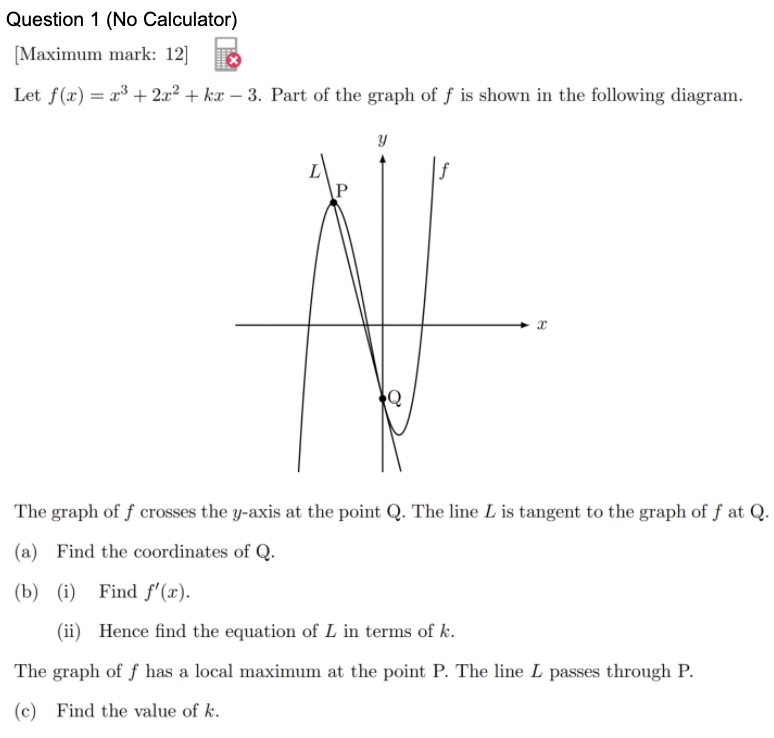
Question 1 (No Calculator) [Maximum mark: 12] E Let HI) = 3:3 + 29:2 + k2: 3. Part of the graph of f is shown in the following diagram. The graph of f crosses the y-axis at the point Q. The line L is tangent to the graph of f at Q. (9.) Find the coordinates of Q. ('0) (0 Find NI)- (ij) Hence nd the equation of L in terms of k. The graph of f has a local maximum at the point P. The line L passea through P. {c} Find the value of k. Question 5 (Calculator is allowed) [Maximum mark: 15} E Note: In this question, distance is in metres and time is in seconds. A particle P moves in a straight line for six seoonds. Its acceleration during this period is given by a(t) = 212 + 13t 15, for U 5 t 5 6. (3.) Write down the values of t when the particle's acceleration is zero. (b) Hence or otherwise, nd all possible values of t for which the velocity of P is increasing. The particle has an initial velocity of 7 IDSl. (c) Find an expression for the velocity of P at time t. ((1) Find the total distance travelled by P when its velocity is decreasing
Step by Step Solution
There are 3 Steps involved in it

Get step-by-step solutions from verified subject matter experts
 Study Help