Question: Please answer the questions :) will give thumbs up! Case Study 2 Shell's Top Recruiter Takes His Cues from Marketing When Navjot Singh joined Royal
Please answer the questions :) will give thumbs up!

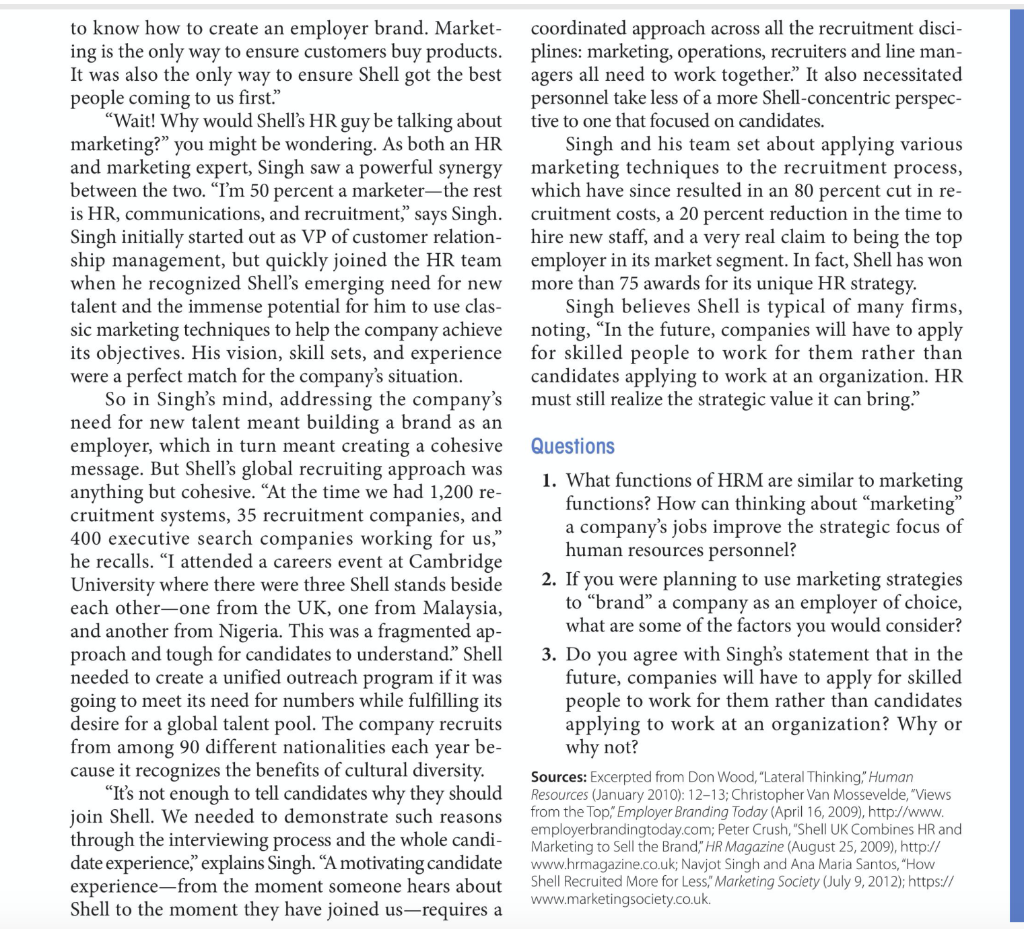
Case Study 2 Shell's Top Recruiter Takes His Cues from Marketing When Navjot Singh joined Royal Dutch Shell in the early 2000s, the company was facing an extraordinary challenge: The rate at which Shell's engineers were retiring meant the global firm needed to more than triple the number of new recruits it hired, which was about 2,500, to nearly 8,000. Yet at the time, Shell was not considered an employer of choice. The global oil and gas company needed to project a new image- fast. Says Singh, In the same way marketers know they need to advertise to be a market leader, HR had coordinated approach across all the recruitment disci- plines: marketing, operations, recruiters and line man- agers all need to work together. It also necessitated personnel take less of a more Shell-concentric perspec- tive to one that focused on candidates. Singh and his team set about applying various marketing techniques to the recruitment process, which have since resulted in an 80 percent cut in re- cruitment costs, a 20 percent reduction in the time to hire new staff, and a very real claim to being the top employer in its market segment. In fact, Shell has won more than 75 awards for its unique HR strategy. Singh believes Shell is typical of many firms, noting, In the future, companies will have to apply for skilled people to work for them rather than candidates applying to work at an organization. HR must still realize the strategic value it can bring. to know how to create an employer brand. Market- ing is the only way to ensure customers buy products. It was also the only way to ensure Shell got the best people coming to us first." Wait! Why would Shell's HR guy be talking about marketing?" you might be wondering. As both an HR and marketing expert, Singh saw a powerful synergy between the two. I'm 50 percent a marketerthe rest is HR, communications, and recruitment," says Singh. Singh initially started out as VP of customer relation- ship management, but quickly joined the HR team when he recognized Shell's emerging need for new talent and the immense potential for him to use clas- sic marketing techniques to help the company achieve its objectives. His vision, skill sets, and experience were a perfect match for the company's situation. So in Singh's mind, addressing the company's need for new talent meant building a brand as an employer, which in turn meant creating a cohesive message. But Shell's global recruiting approach was anything but cohesive. At the time we had 1,200 re- cruitment systems, 35 recruitment companies, and 400 executive search companies working for us, he recalls. I attended a careers event at Cambridge University where there were three Shell stands beside each other one from the UK, one from Malaysia, and another from Nigeria. This was a fragmented ap- proach and tough for candidates to understand. Shell needed to create a unified outreach program if it was going to meet its need for numbers while fulfilling its desire for a global talent pool. The company recruits from among 90 different nationalities each year be- cause it recognizes the benefits of cultural diversity. It's not enough to tell candidates why they should join Shell. We needed to demonstrate such reasons through the interviewing process and the whole candi- date experience explains Singh. A motivating candidate experiencefrom the moment someone hears about Shell to the moment they have joined us-requires a Questions 1. What functions of HRM are similar to marketing functions? How can thinking about marketing a company's jobs improve the strategic focus of human resources personnel? 2. If you were planning to use marketing strategies to brand a company as an employer of choice, what are some of the factors you would consider? 3. Do you agree with Singh's statement that in the future, companies will have to apply for skilled people to work for them rather than candidates applying to work at an organization? Why or why not? Sources: Excerpted from Don Wood, "Lateral Thinking." Human Resources (January 2010):12-13; Christopher Van Mossevelde, "Views from the Top"Employer Branding Today (April 16, 2009), http://www. employerbrandingtoday.com; Peter Crush, "Shell UK Combines HR and Marketing to sell the Brand" HR Magazine (August 25, 2009), http:// www.hrmagazine.co.uk; Navjot Singh and Ana Maria Santos, "How Shell Recruited more for Less," Marketing Society (July 9, 2012); https:// www.marketingsociety.co.uk









 Study Help