Question: please answer the two questions from the text. 2 page length slight improvements-to 69% male (75% of leadership positions and 80% of technical jobs), 56%
 please answer the two questions from the text. 2 page length
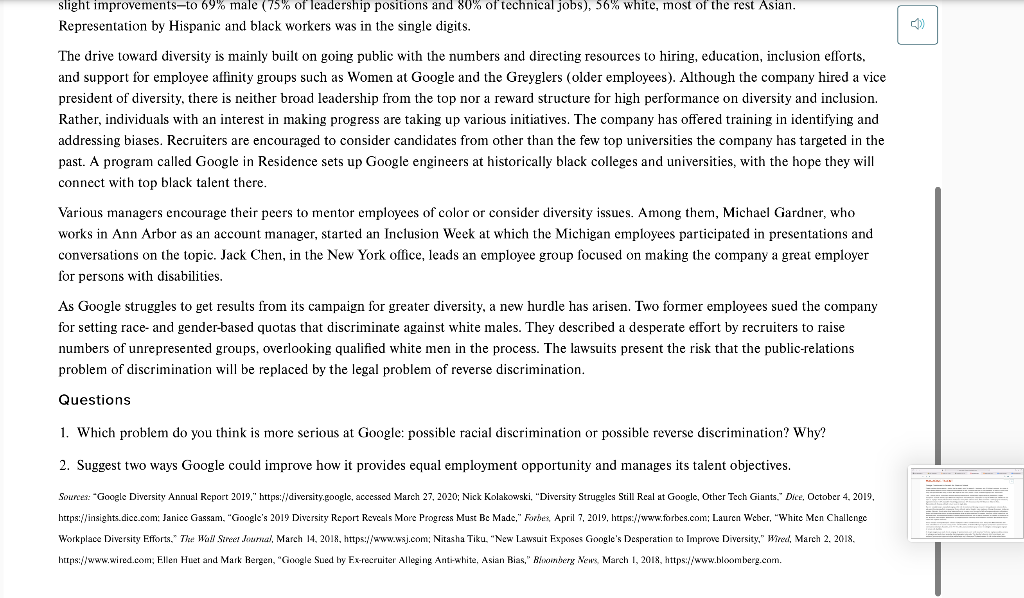
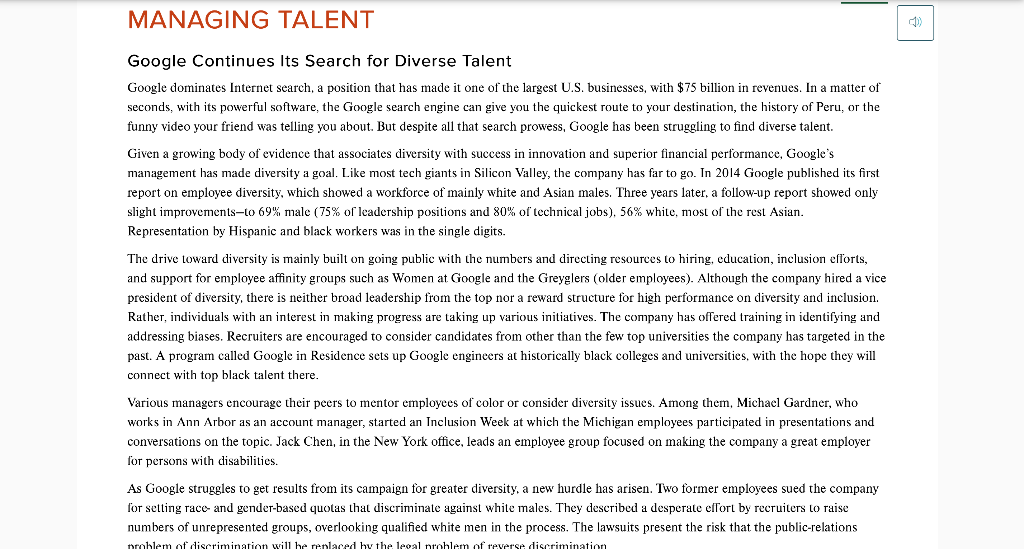
slight improvements-to 69% male (75% of leadership positions and 80% of technical jobs), 56% white, most of the rest Asian. Representation by Hispanic and black workers was in the single digits. CO) The drive toward diversity is mainly built on going public with the numbers and directing resources to hiring, education, inclusion efforts, and support for employee affinity groups such as Women at Google and the Greyglers (older employees). Although the company hired a vice president of diversity, there is neither broad leadership from the top nor a reward structure for high performance on diversity and inclusion. Rather, individuals with an interest in making progress are taking up various initiatives. The company has offered training in identifying and addressing biases. Recruiters are encouraged to consider candidates from other than the few top universities the company has targeted in the past. A program called Google in Residence sets up Google engineers at historically black colleges and universities, with the hope they will connect with top black talent there. Various managers encourage their peers to mentor employees of color or consider diversity issues. Among them, Michael Gardner, who works in Ann Arbor as an account manager, started an Inclusion Week at which the Michigan employees participated in presentations and conversations on the topic. Jack Chen, in the New York office, leads an employee group focused on making the company a great employer for persons with disabilities. As Google struggles to get results from its campaign for greater diversity, a new hurdle has arisen. Two former employees sued the company for setting race and gender-based quotas that discriminate against white males. They described a desperate effort by recruiters to raise numbers of unrepresented groups, overlooking qualified white men in the process. The lawsuits present the risk that the public relations problem of discrimination will be replaced by the legal problem of reverse discrimination. Questions 1. Which problem do you think is more serious at Google: possible racial discrimination or possible reverse discrimination? Why? 2. Suggest two ways Google could improve how it provides equal employment opportunity and manages its talent objectives. Sources: "Google Diversity Annual Report 2019," https://diversity.google, accessed March 27, 2020; Nick Kolakowski, "Diversity Strugeles Still Real at Google, Other Tech Giants." Dice, October 4, 2019, https://insights.dicc.com: Janice Gassam, "Google's 2019 Diversity Report Revals More Progress Must Be Made," Forbes, April 7, 2019, https://www.forbes.com: Lauren Weber, "White Mon Challenge Workplace Diversity Efforts, The Wall Street Journal, March 14, 2018, https://www.wsj.com: Nitasha Tiku. "New Lawsuit Exposes Google's Desperation to Improve Diversity," Wirel, March 2. 2018, https://www.wired.com, Ellen Huet and Mark Bergen, "Google Sued by Ex-recruiter Alleging Anti-white, Asian Bias," Blomberg Now March 1, 2018, https://www.bloomberg.com. MANAGING TALENT 2 Google Continues Its Search for Diverse Talent Google dominates Internet search, a position that has made it one of the largest U.S. businesses, with $75 billion in revenues. In a matter of seconds, with its powerful software, the Google search engine can give you the quickest route to your destination, the history of Peru, or the funny video your friend was telling you about. But despite all that search prowess, Google has been struggling to find diverse talent. Given a growing body of evidence that associates diversity with success in innovation and superior financial performance, Google's management has made diversity a goal. Like most tech giants in Silicon Valley, the company has far to go. In 2014 Google published its first report on employee diversity, which showed a workforce of mainly white and Asian males. Three years later, a follow-up report showed only slight improvements-to 69% male (75% of leadership positions and 80% of technical jobs), 56% white, most of the rest Asian. Representation by Hispanic and black workers was in the single digits. The drive toward diversity is mainly built on going public with the numbers and directing resources to hiring, education, inclusion efforts, and support for employee affinity groups such as Women at Google and the Greyglers (older employees). Although the company hired a vice president of diversity, there is neither broad leadership from the top nor a reward structure for high performance on diversity and inclusion. Rather, individuals with an interest in making progress are taking up various initiatives. The company has offered training in identifying and addressing biases. Recruiters are encouraged to consider candidates from other than the few top universities the company has targeted in the past. A program called Google in Residence sets up Google engineers at historically black colleges and universities, with the hope they will connect with top black talent there. Various managers encourage their peers to mentor employees of color or consider diversity issues. Among them, Michael Gardner, who works in Ann Arbor as an account manager, started an Inclusion Week at which the Michigan employees participated in presentations and conversations on the topic. Jack Chen, in the New York office, leads an employee group focused on making the company a great employer for persons with disabilities. As Google struggles to get results from its campaign for greater diversity, a new hurdle has arisen. Two former employees sued the company for setting race and gender-based quotas that discriminate against white males. They described a desperate effort by recruiters to raise numbers of unrepresented groups, overlooking qualified white men in the process. The lawsuits present the risk that the public-relations problem of discrimination will be replaced by the legal problem of reverse discrimination









 Study Help