







Question: Please answer them all and i will put an upvote. Thank you so much 14. Shawn is reviewing a performance appraisal instrument with a scale
Please answer them all and i will put an upvote.
Thank you so much
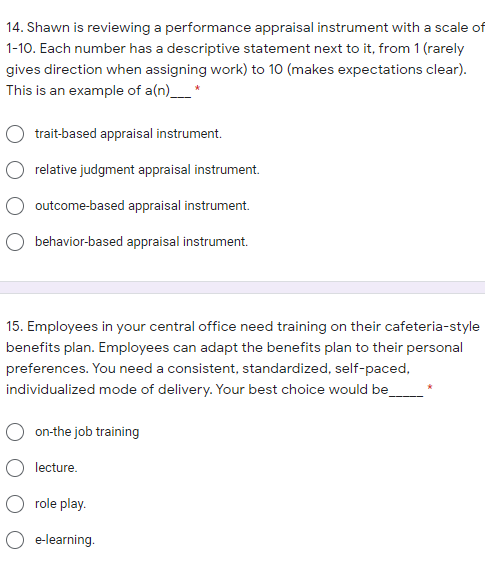
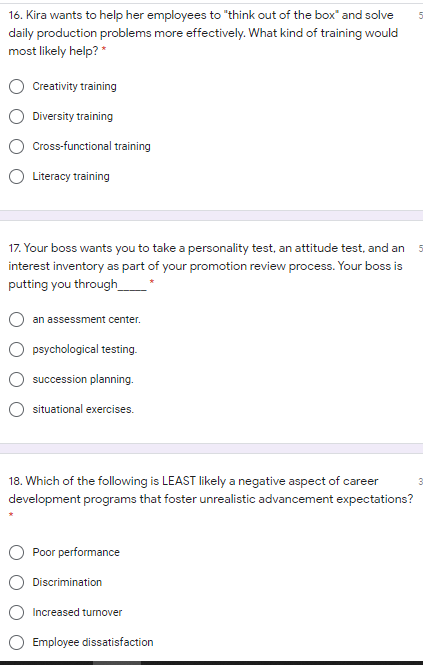
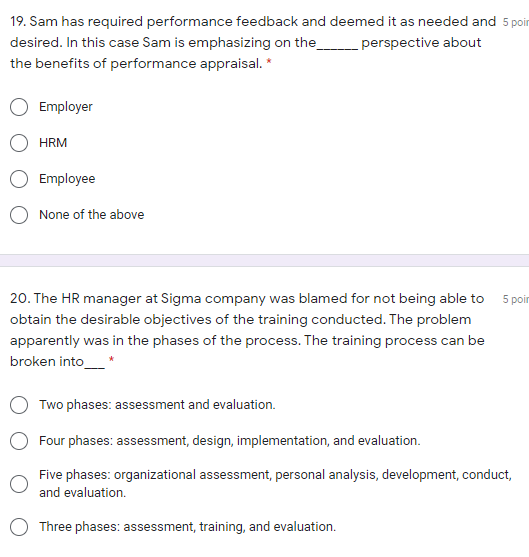
14. Shawn is reviewing a performance appraisal instrument with a scale of 1-10. Each number has a descriptive statement next to it, from 1 (rarely gives direction when assigning work) to 10 (makes expectations clear). This is an example of a(n)___* Otrait-based appraisal instrument O relative judgment appraisal instrument. O outcome-based appraisal instrument. Obehavior-based appraisal instrument. 15. Employees in your central office need training on their cafeteria-style benefits plan. Employees can adapt the benefits plan to their personal preferences. You need a consistent, standardized, self-paced, individualized mode of delivery. Your best choice would be O on the job training lecture. role play. e-learning 16. Kira wants to help her employees to "think out of the box' and solve daily production problems more effectively. What kind of training would most likely help? Creativity training Diversity training Cross-functional training Literacy training 17. Your boss wants you to take a personality test, an attitude test, and an interest inventory as part of your promotion review process. Your boss is putting you through an assessment center. psychological testing succession planning. situational exercises 18. Which of the following is LEAST likely a negative aspect of career development programs that foster unrealistic advancement expectations? Poor performance Discrimination Increased turnover Employee dissatisfaction 19. Sam has required performance feedback and deemed it as needed and 5 poir desired. In this case Sam is emphasizing on the _perspective about the benefits of performance appraisal. * Employer HRM Employee None of the above 5 poir 20. The HR manager at Sigma company was blamed for not being able to obtain the desirable objectives of the training conducted. The problem apparently was in the phases of the process. The training process can be broken into Two phases: assessment and evaluation. Four phases: assessment, design, implementation, and evaluation Five phases: organizational assessment, personal analysis, development, conduct, and evaluation Three phases: assessment, training, and evaluationStep by Step Solution
There are 3 Steps involved in it
1 Expert Approved Answer
Step: 1 Unlock

Question Has Been Solved by an Expert!
Get step-by-step solutions from verified subject matter experts
Step: 2 Unlock
Step: 3 Unlock
 Study Help