







Question: Please answer these questions with explanations , do not copy from other answers from chegg! much appreciated. question 4. please anawer with explanation. 4. Multi
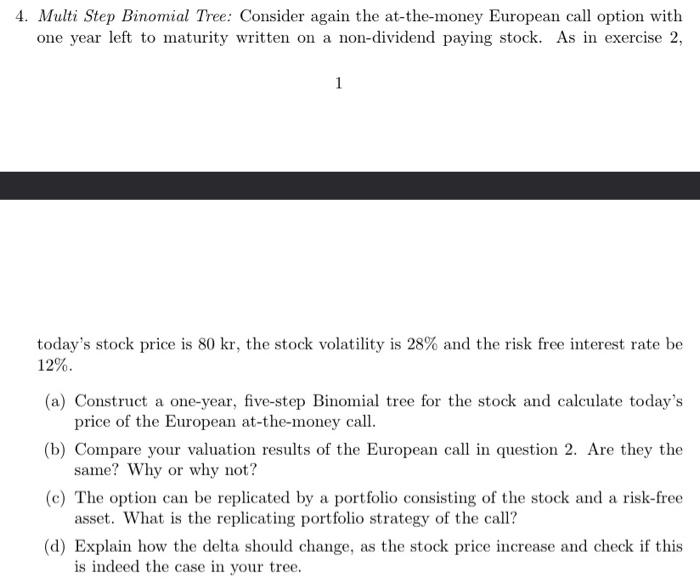
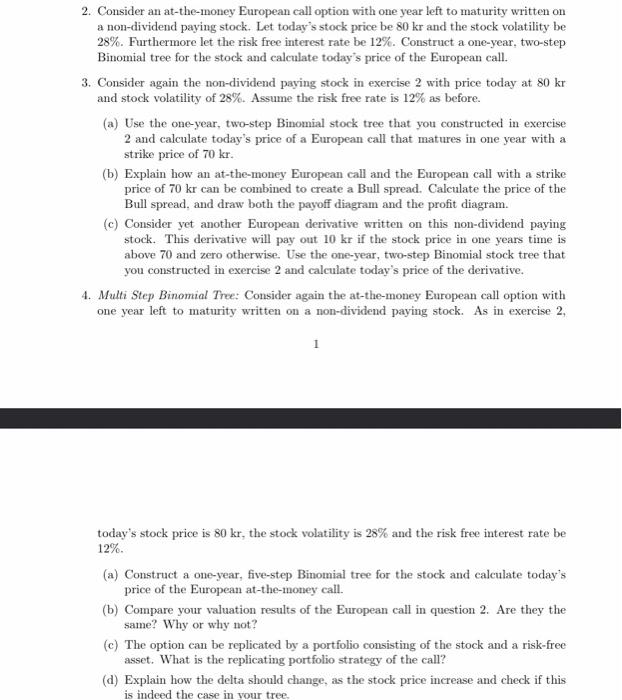
4. Multi Step Binomial Tree: Consider again the at-the-money European call option with one year left to maturity written on a non-dividend paying stock. As in exercise 2, 1 today's stock price is 80 kr, the stock volatility is 28% and the risk free interest rate be 12%. (a) Construct a one-year, five-step Binomial tree for the stock and calculate today's price of the European at-the-money call. (b) Compare your valuation results of the European call in question 2. Are they the same? Why or why not? (c) The option can be replicated by a portfolio consisting of the stock and a risk-free a asset. What is the replicating portfolio strategy of the call? (d) Explain how the delta should change, as the stock price increase and check if this is indeed the case in your tree. 2. Consider an at-the-money European call option with one year left to maturity written on a non-dividend paying stock. Let today's stock price be 80 kr and the stock volatility be 28%. Furthermore let the risk free interest rate be 12%. Construct a one-year, two-step Binomial tree for the stock and calculate today's price of the European call. 3. Consider again the non-dividend paying stock in exercise 2 with price today at 80 kr and stock volatility of 28%. Assume the risk free rate is 12% as before. (a) Use the one-year, two-step Binomial stock tree that you constructed in exercise 2 and calculate today's price of a European call that matures in one year with a strike price of 70 kr. (b) Explain how an at-the-money European call and the European call with a strike price of 70 kr can be combined to create a Bull spread. Calculate the price of the Bull spread, and draw both the payoff diagram and the profit diagram. (c) Consider yet another European derivative written on this non-dividend paying stock. This derivative will pay out 10 kr if the stock price in one years time is above 70 and zero otherwise. Use the one-year, two-step Binomial stock tree that you constructed in exercise 2 and calculate today's price of the derivative. 4. Multi Step Binomial Tree: Consider again the at-the-money European call option with one year left to maturity written on a non-dividend paying stock. As in exercise 2, 1 today's stock price is 80 kr, the stock volatility is 28% and the risk free interest rate be 12% (a) Construct a one-year, five-step Binomial tree for the stock and calculate today's price of the European at-the-money call. (b) Compare your valuation results of the European call in question 2. Are they the same? Why or why not? (c) The option can be replicated by a portfolio consisting of the stock and a risk-free asset. What is the replicating portfolio strategy of the call? (d) Explain how the delta should change, as the stock price increase and check if this is indeed the case in your tree. 4. Multi Step Binomial Tree: Consider again the at-the-money European call option with one year left to maturity written on a non-dividend paying stock. As in exercise 2, 1 today's stock price is 80 kr, the stock volatility is 28% and the risk free interest rate be 12%. (a) Construct a one-year, five-step Binomial tree for the stock and calculate today's price of the European at-the-money call. (b) Compare your valuation results of the European call in question 2. Are they the same? Why or why not? (c) The option can be replicated by a portfolio consisting of the stock and a risk-free a asset. What is the replicating portfolio strategy of the call? (d) Explain how the delta should change, as the stock price increase and check if this is indeed the case in your tree. 2. Consider an at-the-money European call option with one year left to maturity written on a non-dividend paying stock. Let today's stock price be 80 kr and the stock volatility be 28%. Furthermore let the risk free interest rate be 12%. Construct a one-year, two-step Binomial tree for the stock and calculate today's price of the European call. 3. Consider again the non-dividend paying stock in exercise 2 with price today at 80 kr and stock volatility of 28%. Assume the risk free rate is 12% as before. (a) Use the one-year, two-step Binomial stock tree that you constructed in exercise 2 and calculate today's price of a European call that matures in one year with a strike price of 70 kr. (b) Explain how an at-the-money European call and the European call with a strike price of 70 kr can be combined to create a Bull spread. Calculate the price of the Bull spread, and draw both the payoff diagram and the profit diagram. (c) Consider yet another European derivative written on this non-dividend paying stock. This derivative will pay out 10 kr if the stock price in one years time is above 70 and zero otherwise. Use the one-year, two-step Binomial stock tree that you constructed in exercise 2 and calculate today's price of the derivative. 4. Multi Step Binomial Tree: Consider again the at-the-money European call option with one year left to maturity written on a non-dividend paying stock. As in exercise 2, 1 today's stock price is 80 kr, the stock volatility is 28% and the risk free interest rate be 12% (a) Construct a one-year, five-step Binomial tree for the stock and calculate today's price of the European at-the-money call. (b) Compare your valuation results of the European call in question 2. Are they the same? Why or why not? (c) The option can be replicated by a portfolio consisting of the stock and a risk-free asset. What is the replicating portfolio strategy of the call? (d) Explain how the delta should change, as the stock price increase and check if this is indeed the case in your tree
Step by Step Solution
There are 3 Steps involved in it

Get step-by-step solutions from verified subject matter experts
 Study Help