



Question: please answer this 1. What are some reasons why you might prefer UDP over TCP when running these protocols over an unreliable or poorly connecting
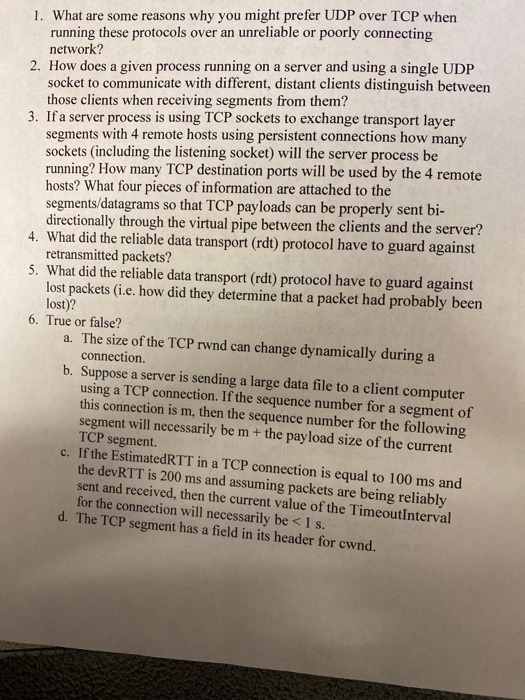
1. What are some reasons why you might prefer UDP over TCP when running these protocols over an unreliable or poorly connecting network? 2. How does a given process running on a server and using a single UDP socket to communicate with different, distant clients distinguish between those clients when receiving segments from them? 3. If a server process is using TCP sockets to exchange transport layer segments with 4 remote hosts using persistent connections how many sockets (including the listening socket) will the server process be running? How many TCP destination ports will be used by the 4 remote hosts? What four pieces of information are attached to the segments/datagrams so that TCP payloads can be properly sent bi- directionally through the virtual pipe between the clients and the server? 4. What did the reliable data transport (rdt) protocol have to guard against retransmitted packets? 5. What did the reliable data transport (rdt) protocol have to guard against lost packets (i.e. how did they determine that a packet had probably been lost)? 6. True or false? a. The size of the TCP rwnd can change dynamically during a connection. b. Suppose a server is sending a large data file to a client computer using a TCP connection. If the sequence number for a segment of this connection is m, then the sequence number for the following segment will necessarily be m + the payload size of the current TCP segment. c. If the EstimatedRTT in a TCP connection is equal to 100 ms and the devRTT is 200 ms and assuming packets are being reliably sent and received, then the current value of the TimeoutInterval for the connection will necessarily be
Step by Step Solution
There are 3 Steps involved in it

Get step-by-step solutions from verified subject matter experts