







Question: Please answer this 5 question from the case Snow Job ever, wanted to make something-better cold-weather If we were to produce garments in the U.S.,
Please answer this 5 question from the case
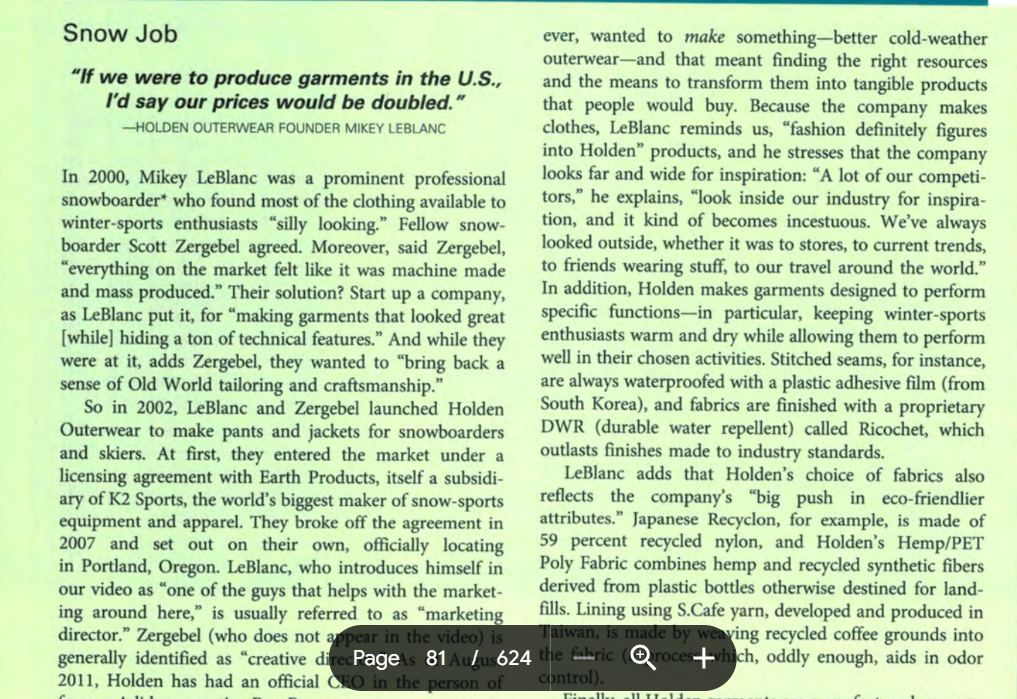
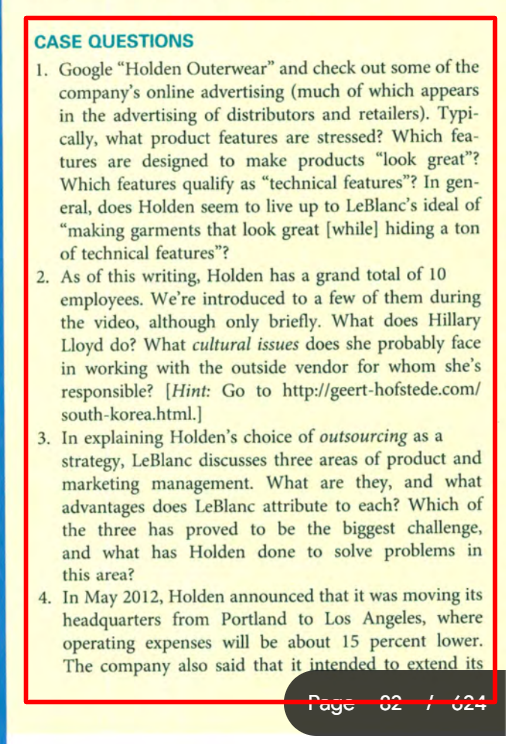
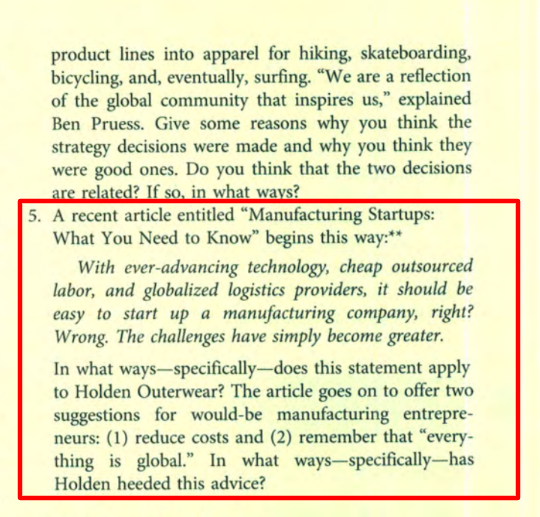
Snow Job ever, wanted to make something-better cold-weather "If we were to produce garments in the U.S., outerwear-and that meant finding the right resources I'd say our prices would be doubled." and the means to transform them into tangible products clothes, LeBlanc reminds us, "fashion definitely figures into Holden" products, and he stresses that the company In 2000, Mikey LeBlanc was a prominent professional looks far and wide for inspiration: "A lot of our competisnowboarder* who found most of the clothing available to tors," he explains, "look inside our industry for inspirawinter-sports enthusiasts "silly looking." Fellow snow- tion, and it kind of becomes incestuous. We've always boarder Scott Zergebel agreed. Moreover, said Zergebel, looked outside, whether it was to stores, to current trends, "everything on the market felt like it was machine made to friends wearing stuff, to our travel around the world." and mass produced." Their solution? Start up a company, In addition, Holden makes garments designed to perform as LeBlanc put it, for "making garments that looked great specific functions-in particular, keeping winter-sports [while] hiding a ton of technical features." And while they enthusiasts warm and dry while allowing them to perform were at it, adds Zergebel, they wanted to "bring back a well in their chosen activities. Stitched seams, for instance, sense of Old World tailoring and craftsmanship." are always waterproofed with a plastic adhesive film (from So in 2002, LeBlanc and Zergebel launched Holden South Korea), and fabrics are finished with a proprietary Outerwear to make pants and jackets for snowboarders DWR (durable water repellent) called Ricochet, which and skiers. At first, they entered the market under a outlasts finishes made to industry standards. licensing agreement with Earth Products, itself a subsidi- LeBlanc adds that Holden's choice of fabrics also ary of K2 Sports, the world's biggest maker of snow-sports reflects the company's "big push in eco-friendlier equipment and apparel. They broke off the agreement in attributes." Japanese Recyclon, for example, is made of 2007 and set out on their own, officially locating 59 percent recycled nylon, and Holden's Hemp/PET in Portland, Oregon. LeBlanc, who introduces himself in Poly Fabric combines hemp and recycled synthetic fibers our video as "one of the guys that helps with the market- derived from plastic bottles otherwise destined for landing around here," is usually referred to as "marketing fills. Lining using S.Cafe yarn, developed and produced in director." Zergebel (who does not appear in the video) is I Iawan, is made by weaving recycled coffee grounds into CASE QUESTIONS 1. Google "Holden Outerwear" and check out some of the company's online advertising (much of which appears in the advertising of distributors and retailers). Typically, what product features are stressed? Which features are designed to make products "look great"? Which features qualify as "technical features"? In general, does Holden seem to live up to LeBlanc's ideal of "making garments that look great [while] hiding a ton of technical features"? 2. As of this writing, Holden has a grand total of 10 employees. We're introduced to a few of them during the video, although only briefly. What does Hillary Lloyd do? What cultural issues does she probably face in working with the outside vendor for whom she's responsible? [Hint: Go to http://geert-hofstede.com/ south-korea.html.] 3. In explaining Holden's choice of outsourcing as a strategy, LeBlanc discusses three areas of product and marketing management. What are they, and what advantages does LeBlanc attribute to each? Which of the three has proved to be the biggest challenge, and what has Holden done to solve problems in this area? 4. In May 2012, Holden announced that it was moving its headquarters from Portland to Los Angeles, where operating expenses will be about 15 percent lower. The company also said that it intended to extend its product lines into apparel for hiking, skateboarding, bicycling, and, eventually, surfing. "We are a reflection of the global community that inspires us," explained Ben Pruess. Give some reasons why you think the strategy decisions were made and why you think they were good ones. Do you think that the two decisions are related? If so, in what ways? 5. A recent article entitled "Manufacturing Startups: What You Need to Know" begins this way:** With ever-advancing technology, cheap outsourced labor, and globalized logistics providers, it should be easy to start up a manufacturing company, right? Wrong. The challenges have simply become greater. In what ways-specifically-does this statement apply to Holden Outerwear? The article goes on to offer two suggestions for would-be manufacturing entrepreneurs: (1) reduce costs and (2) remember that "everything is global." In what ways-specifically-has Holden heeded this advice
Step by Step Solution
There are 3 Steps involved in it

Get step-by-step solutions from verified subject matter experts
 Study Help