







Question: please take time and please read this book pages very carefully and write a summary what did you understand and your own analysis please write
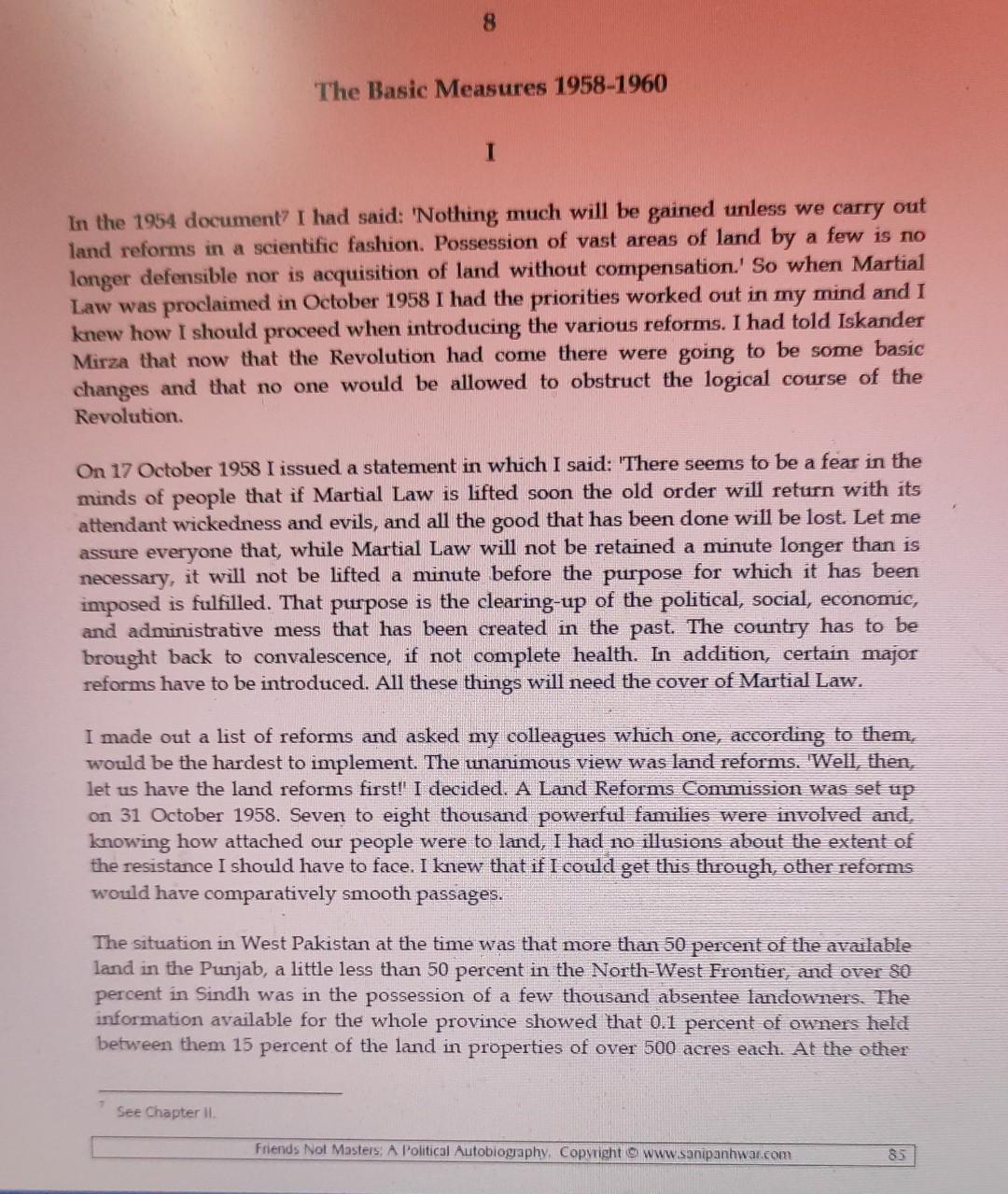
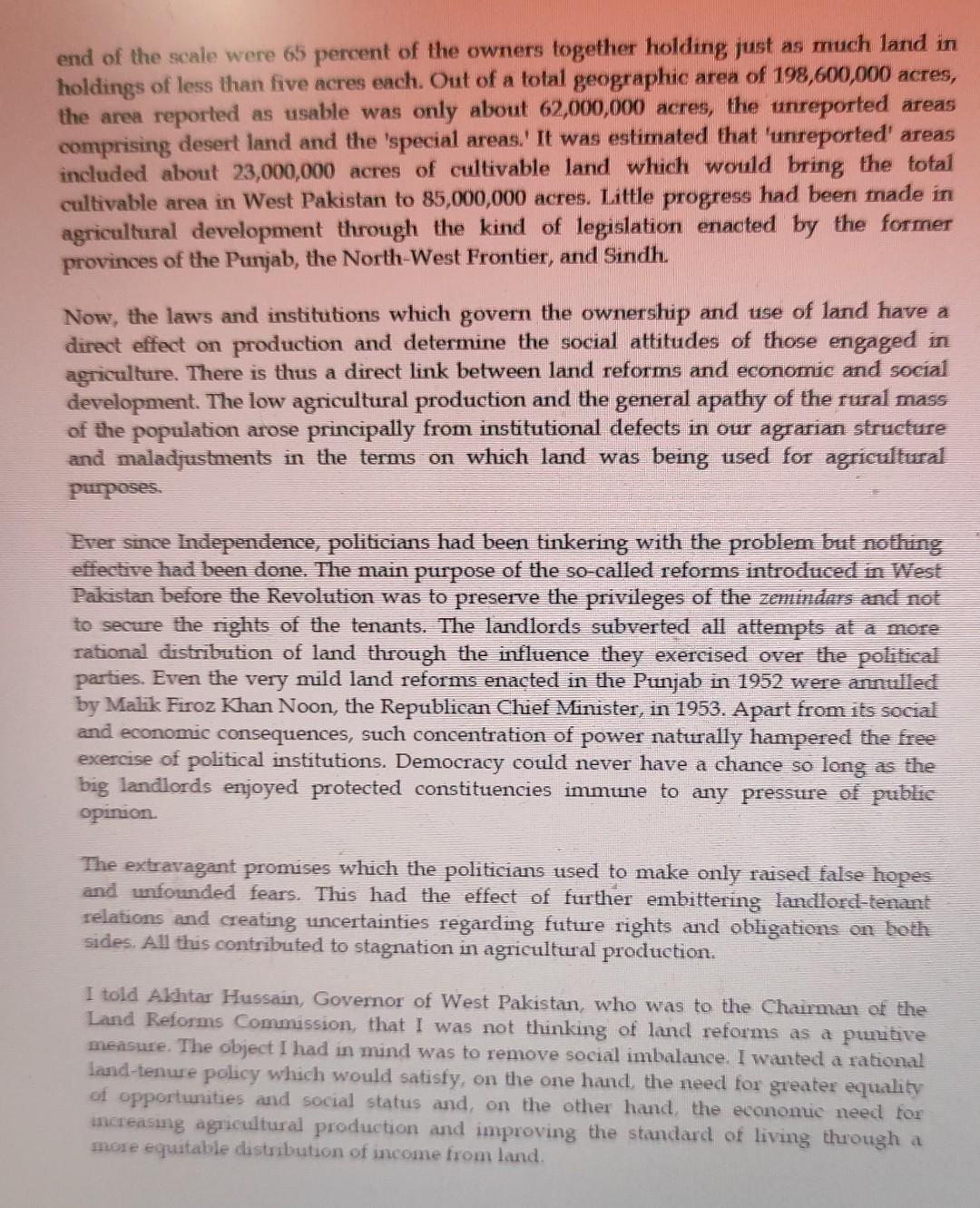
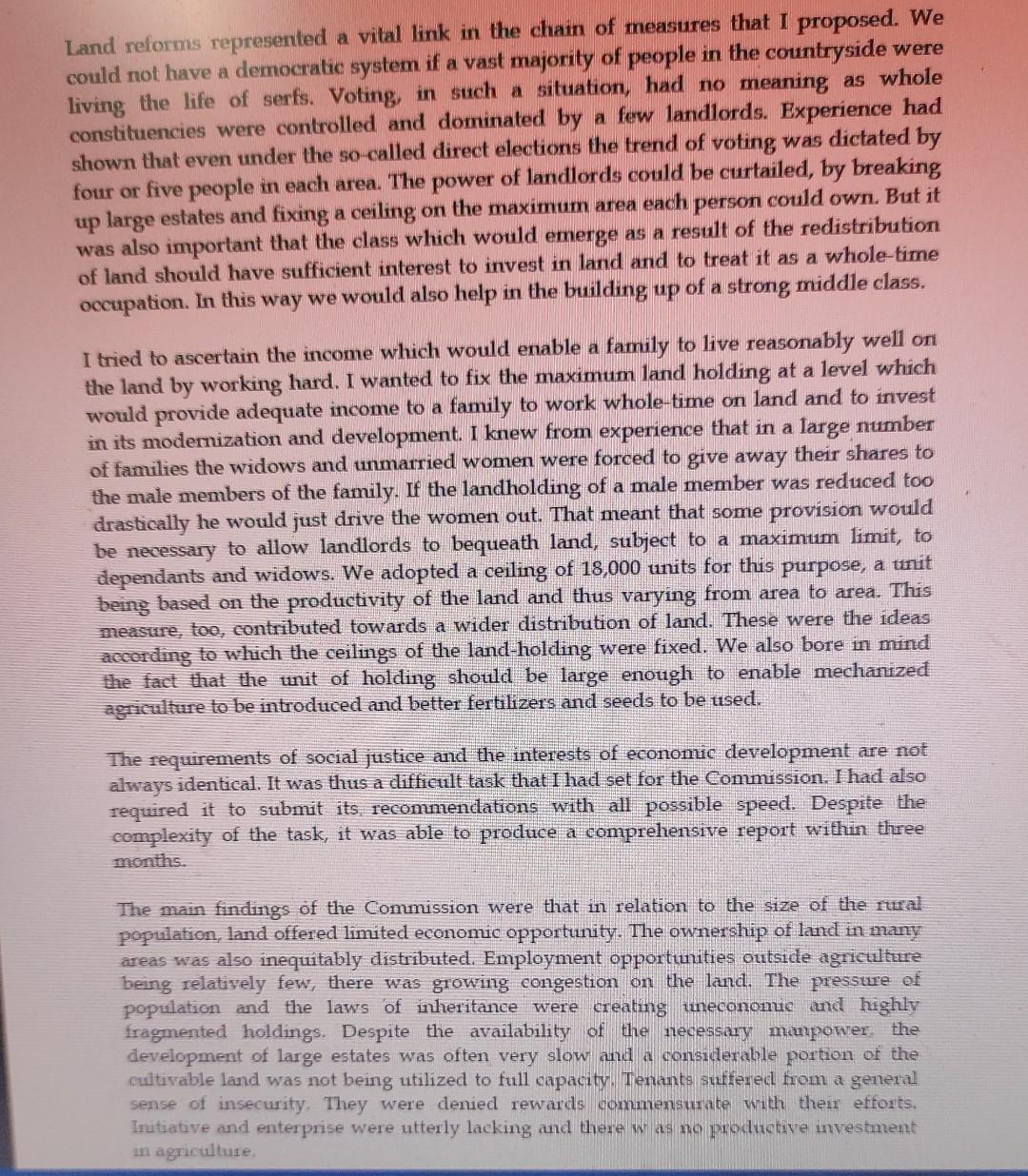
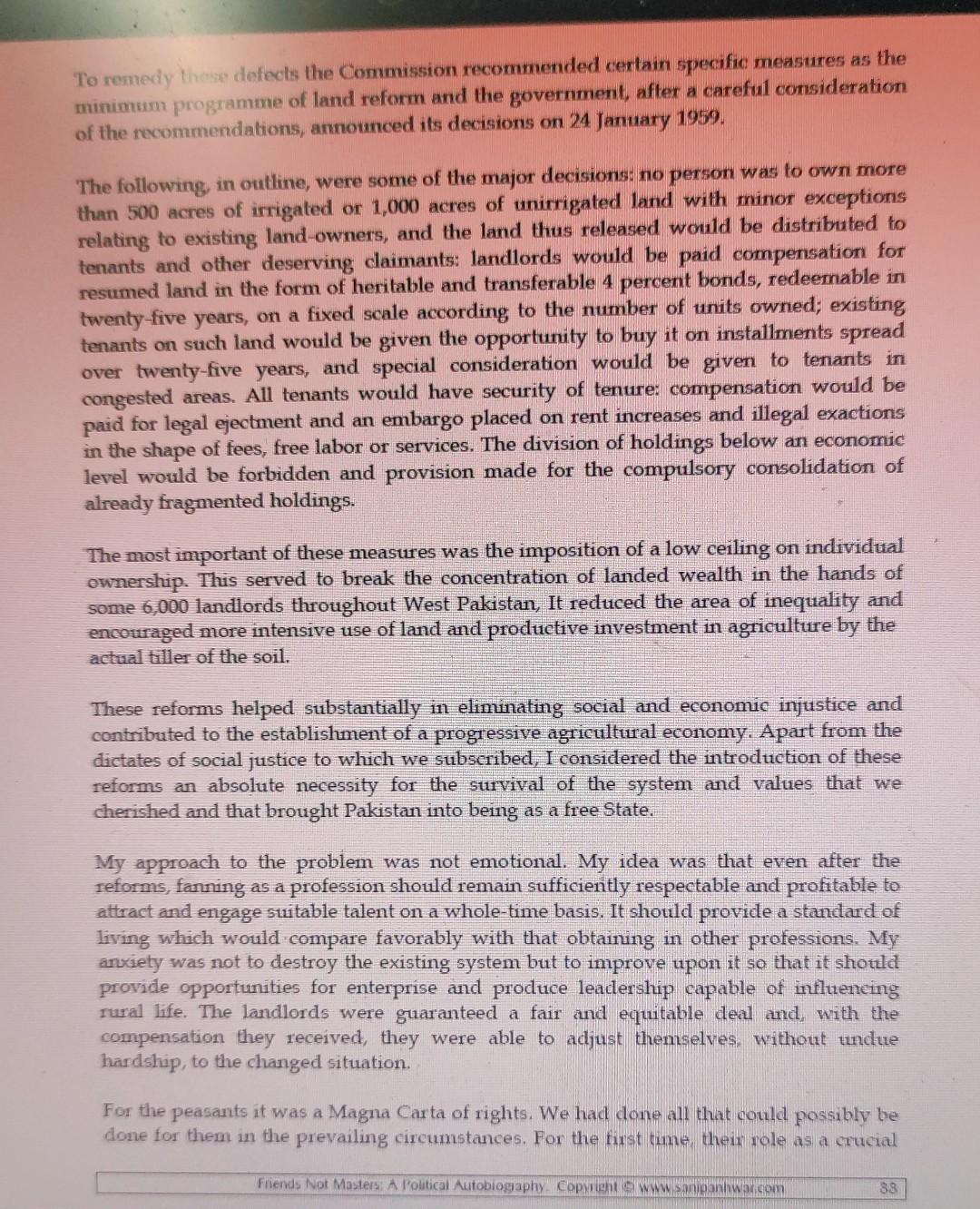
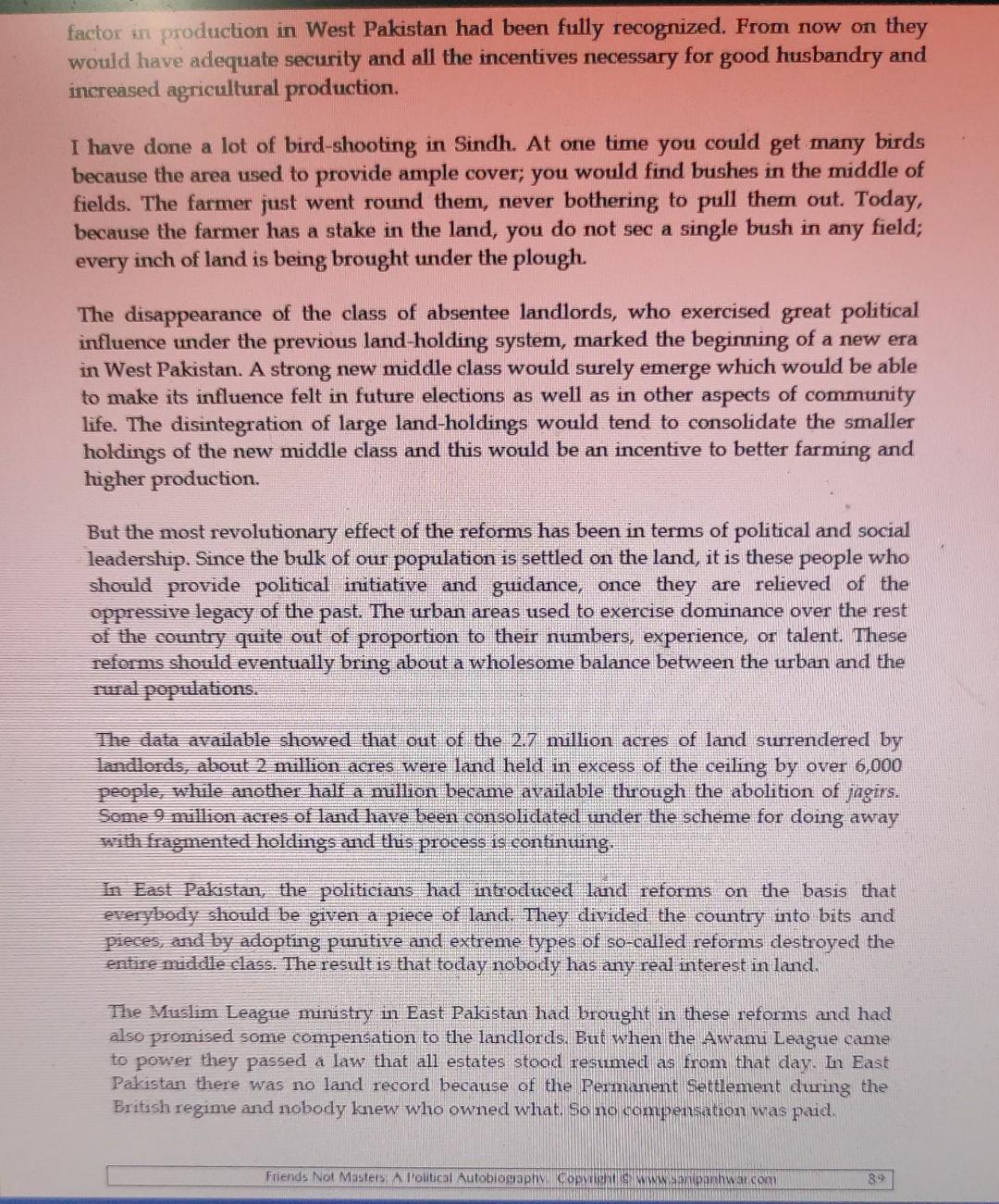
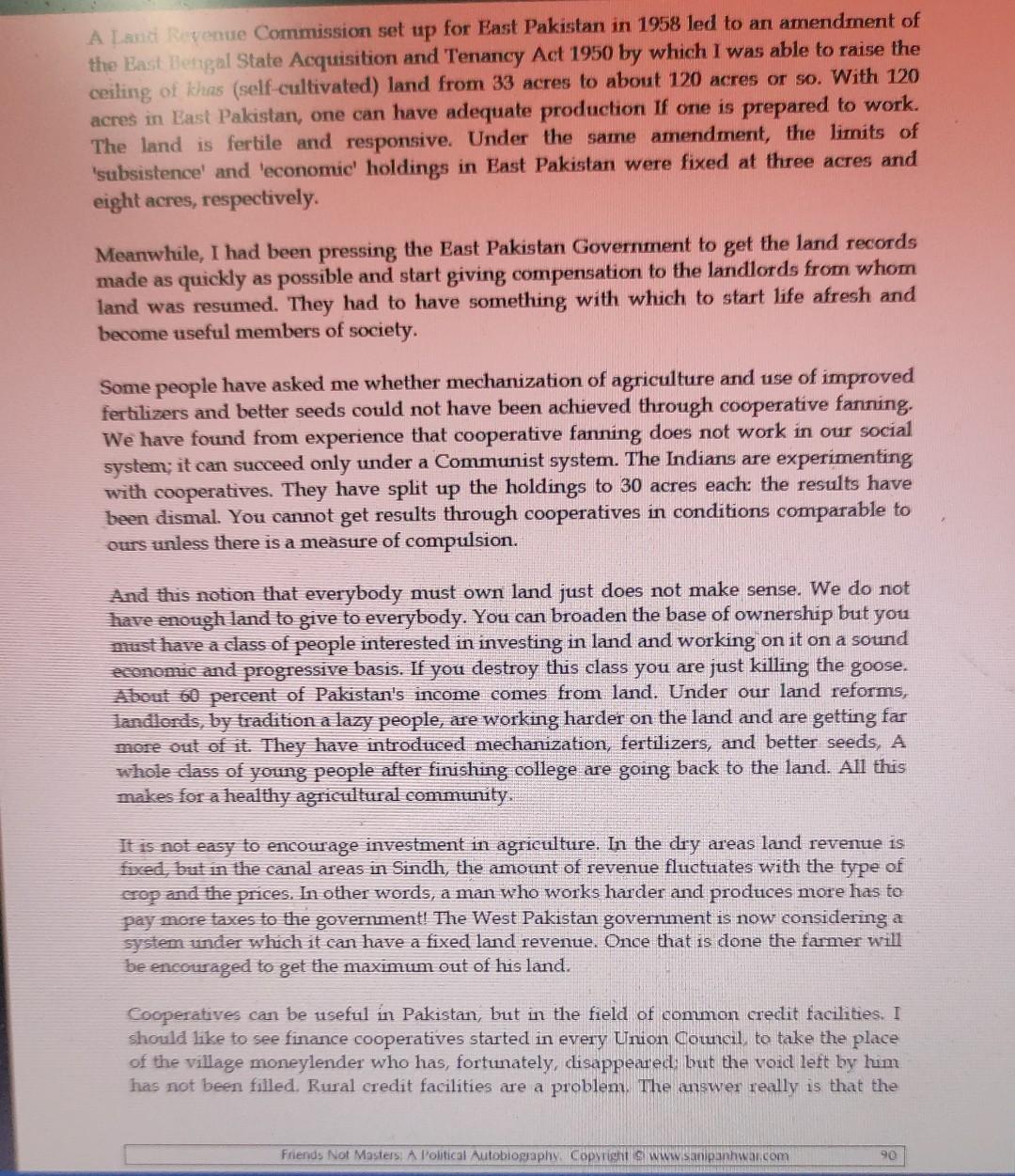
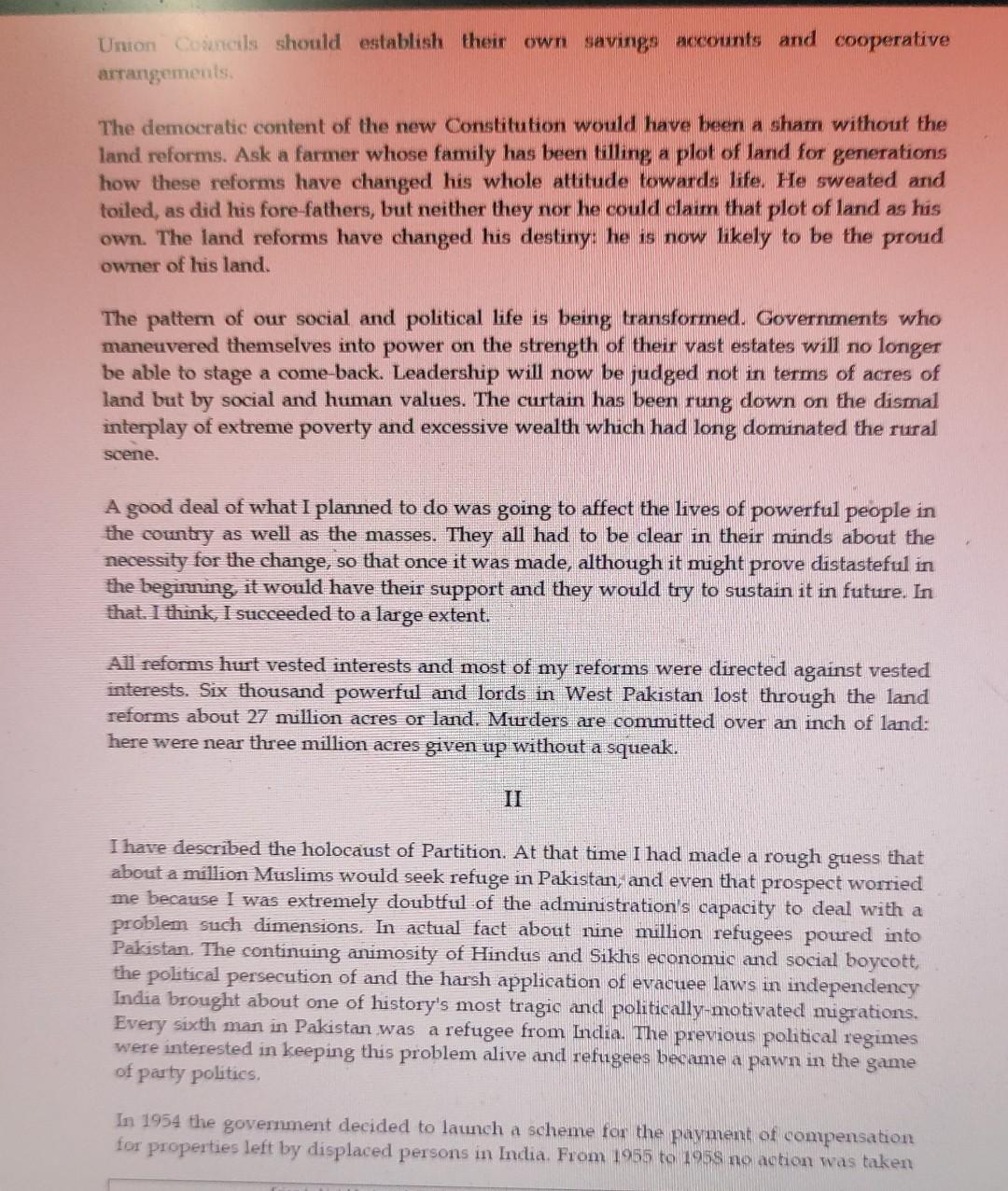
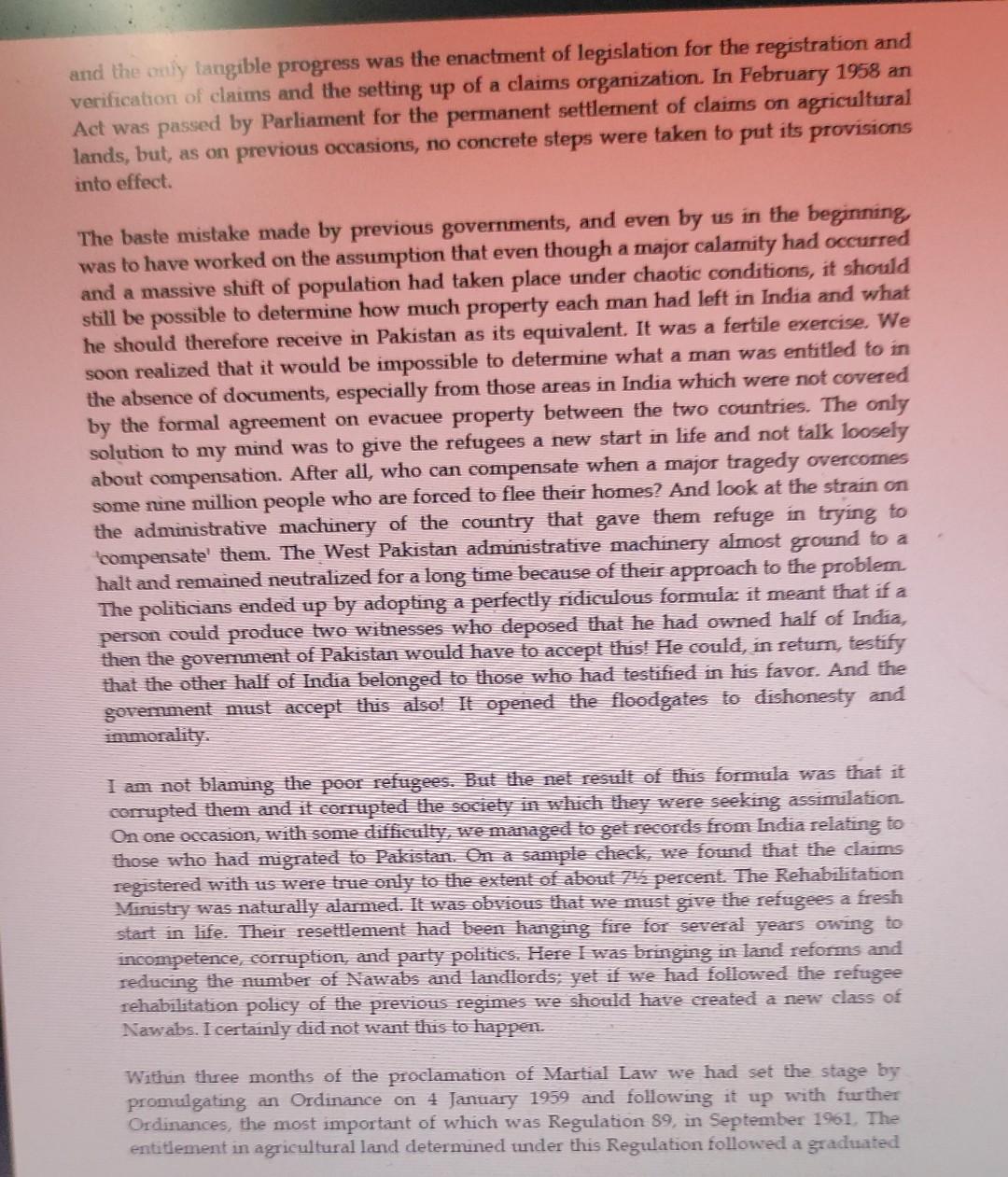
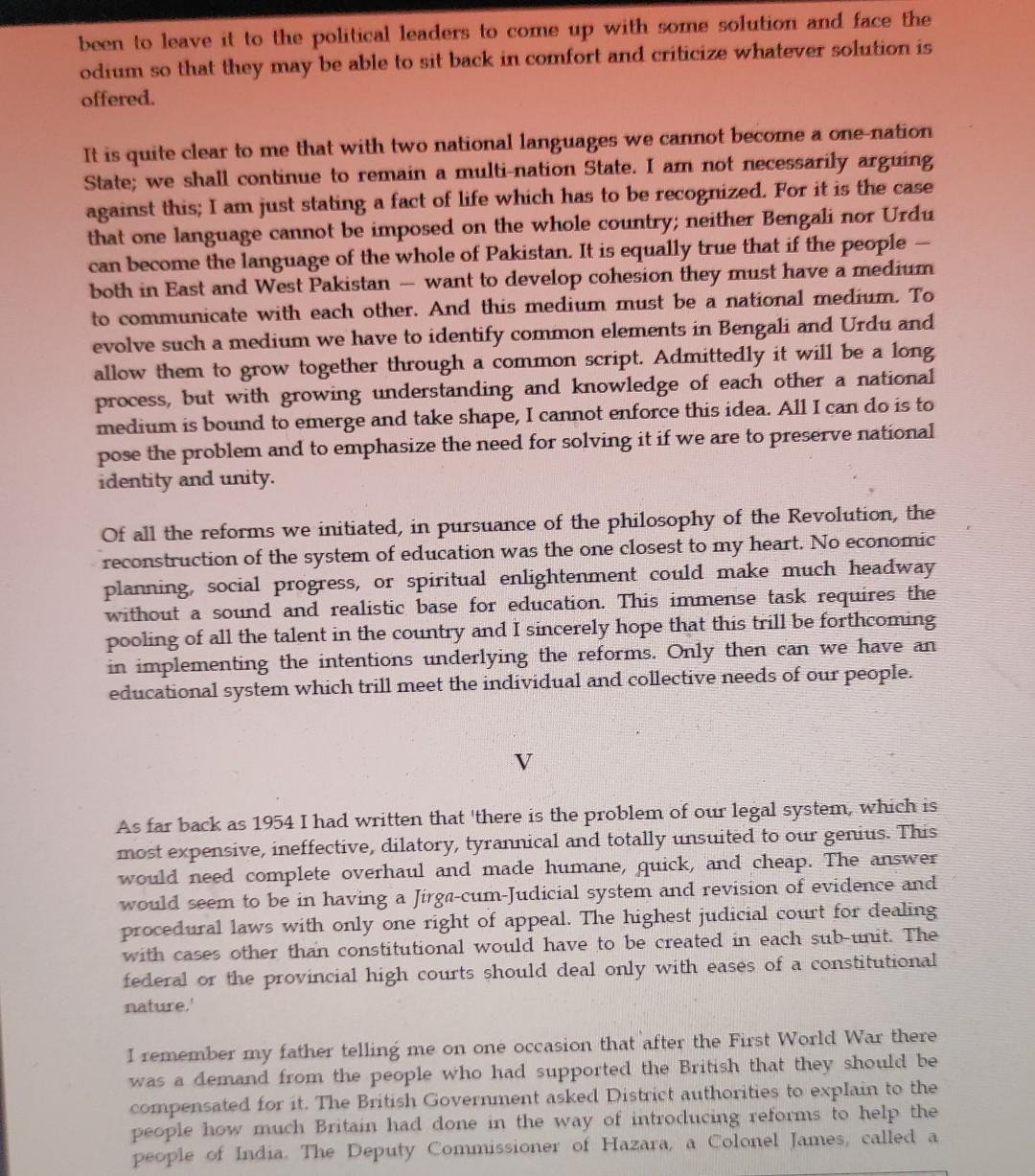
please take time and please read this book pages very carefully and write a summary what did you understand and your own analysis please write it please don't copy internet and other sources it's a request I gave you a vote ..please do it for me word limit 1800-2200 thanks...
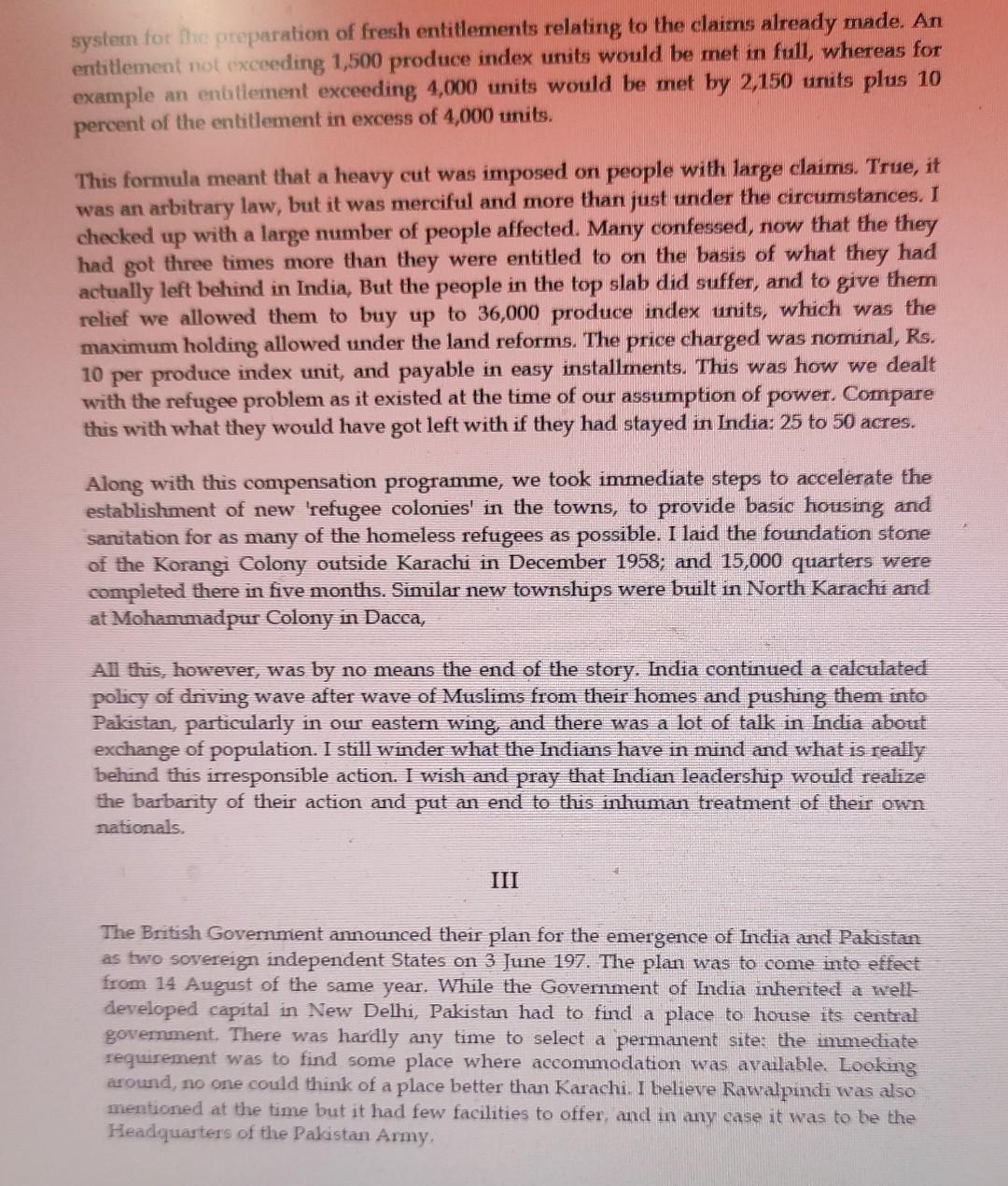
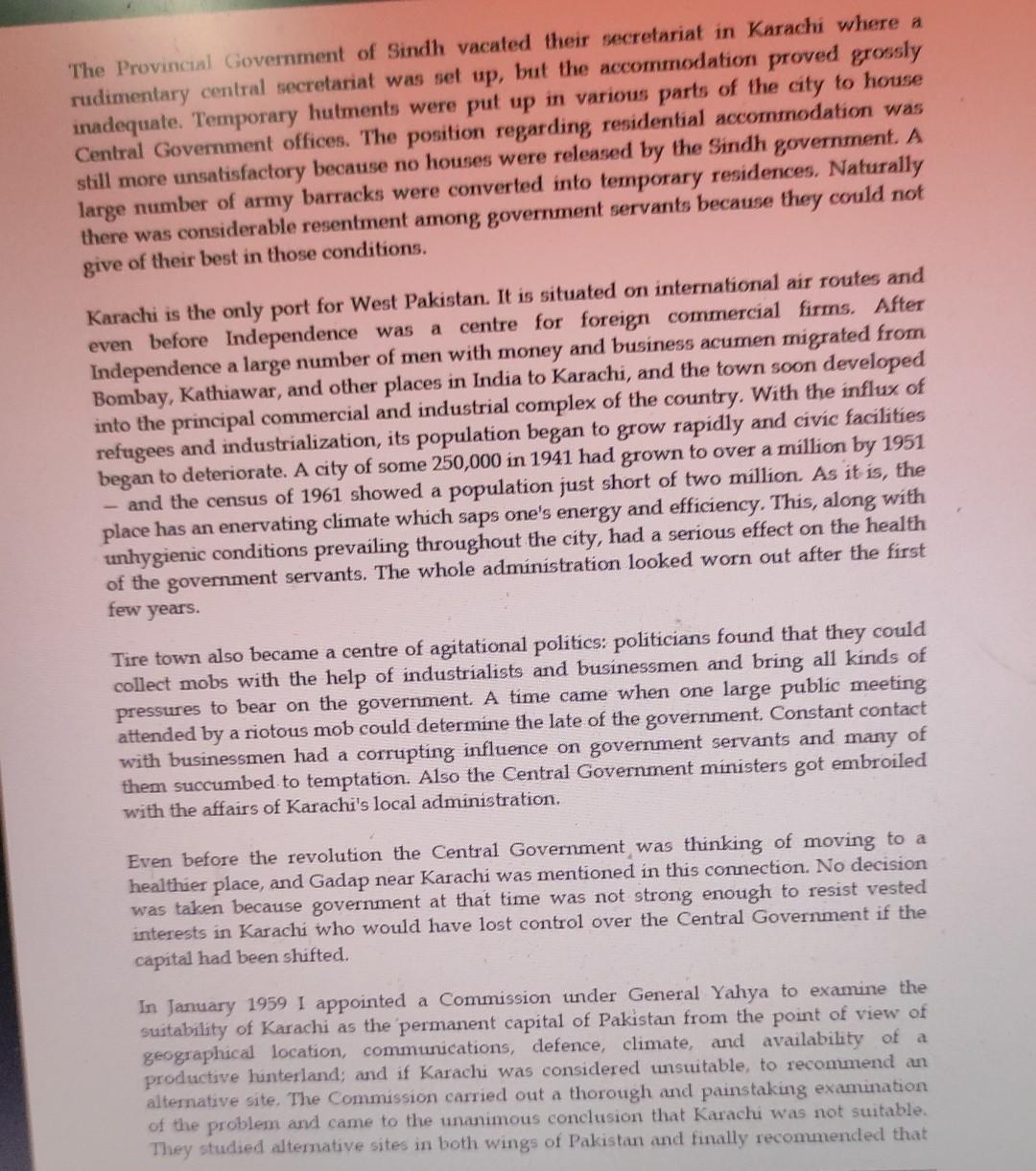
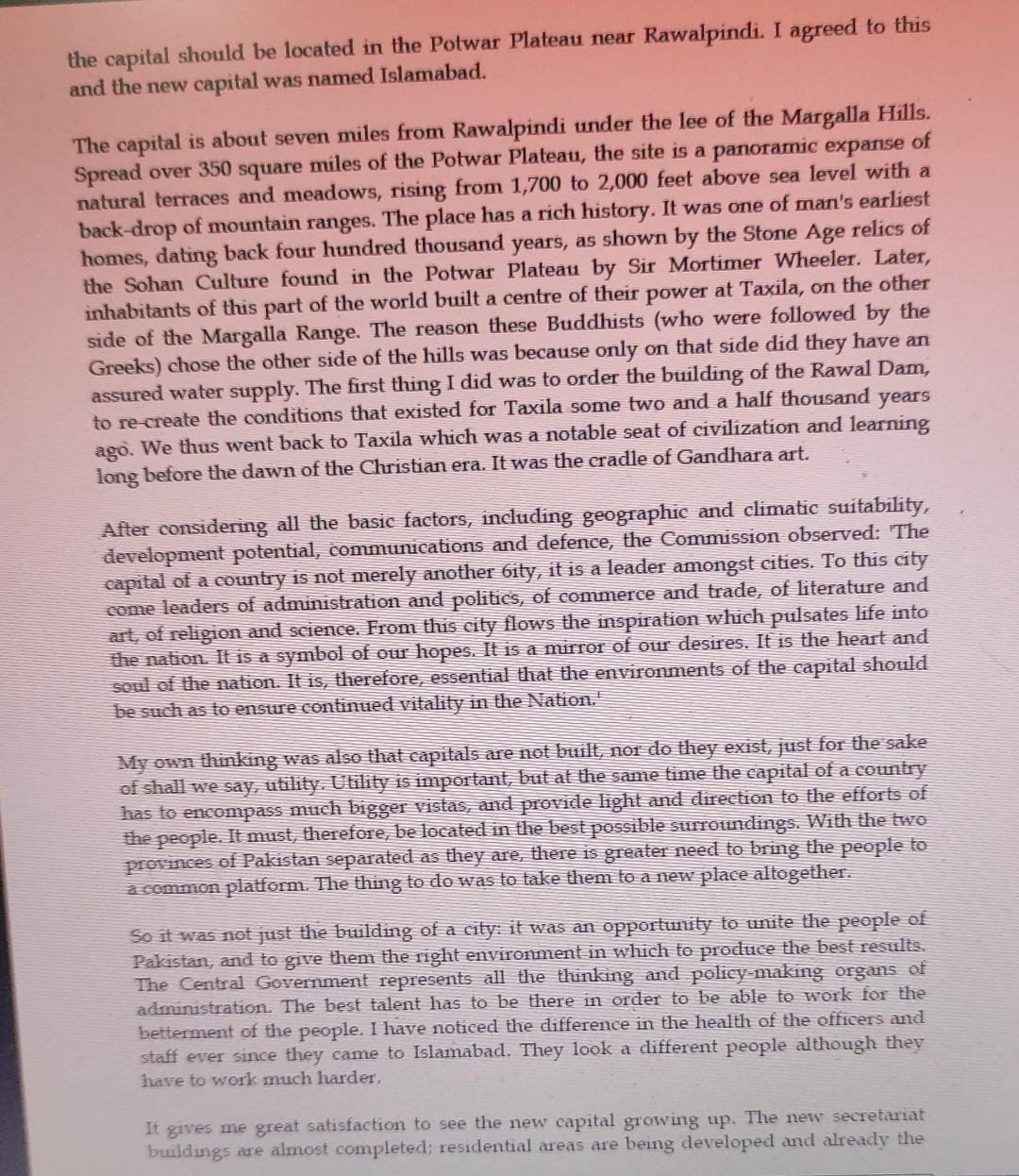
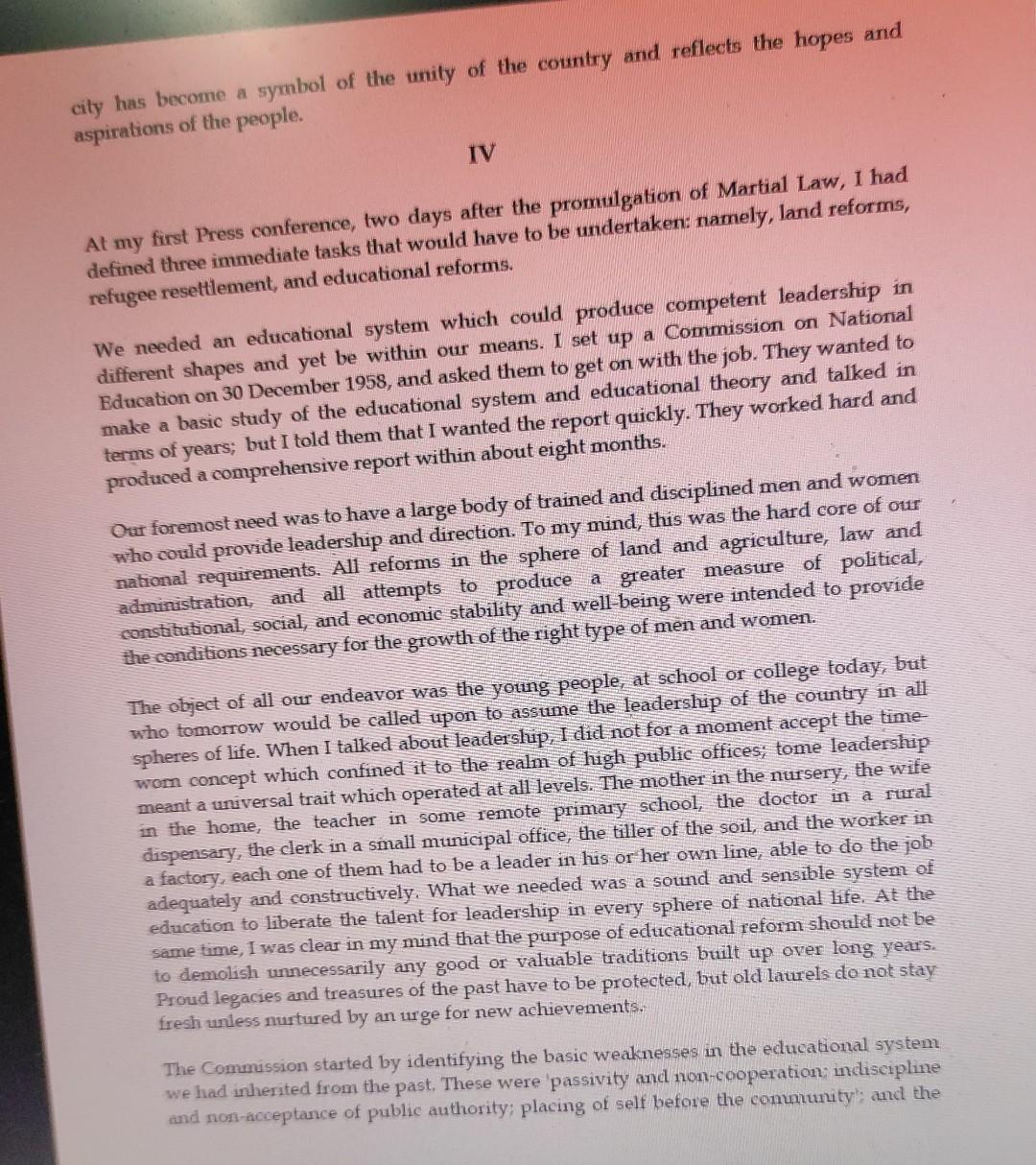
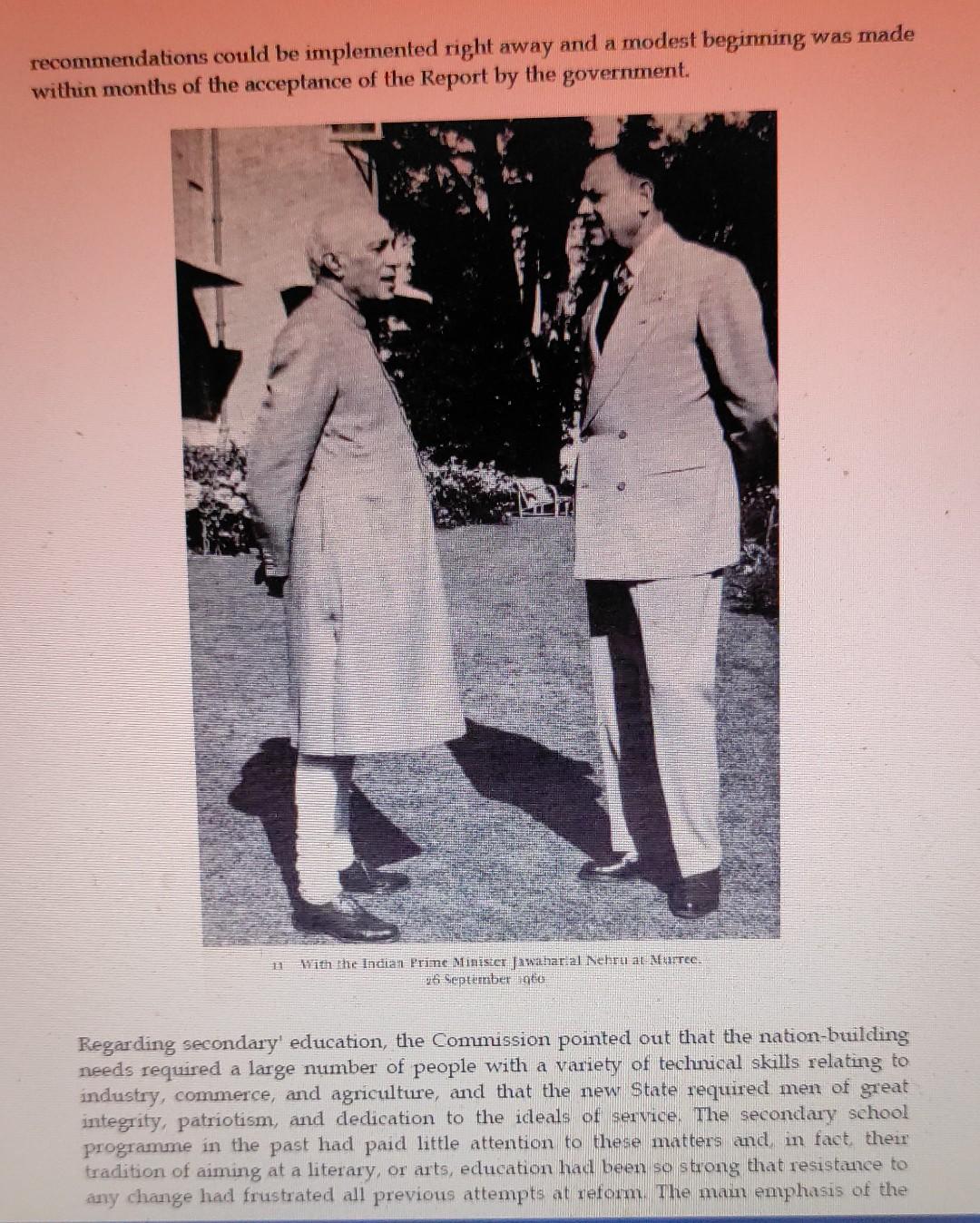
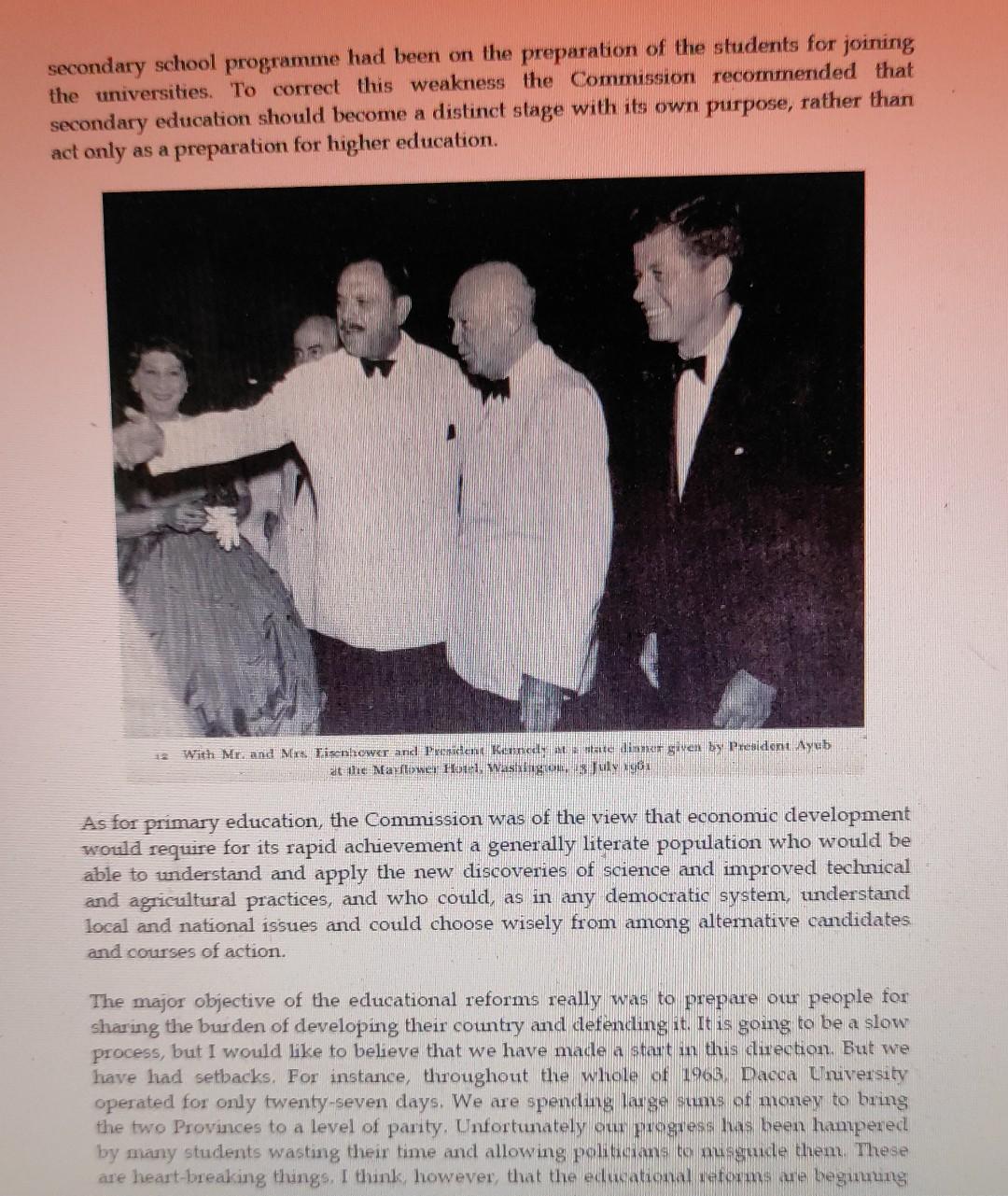
The Basic Measures 1958-1960 In the 1954 document7 I had said: 'Nothing much will be gained unless we carry out land reforms in a scientific fashion. Possession of vast areas of land by a few is no longer defensible nor is acquisition of land without compensation.' So when Martial Law was proclaimed in October 1958 I had the priorities worked out in my mind and I knew how I should proceed when introducing the various reforms. I had told Iskander Mirza that now that the Revolution had come there were going to be some basic changes and that no one would be allowed to obstruct the logical course of the Revolution. On 17 October 1958 I issued a statement in which I said: 'There seems to be a fear in the minds of people that if Martial Law is lifted soon the old order will return with its attendant wickedness and evils, and all the good that has been done will be lost. Let me assure everyone that, while Martial Law will not be retained a minute longer than is necessary, it will not be lifted a minute before the purpose for which it has been imposed is fulfilled. That purpose is the clearing-up of the political, social, economic, and administrative mess that has been created in the past. The country has to be brought back to convalescence, if not complete health. In addition, certain major reforms have to be introduced. All these things will need the cover of Martial Law. I made out a list of reforms and asked my colleagues which one, according to them, would be the hardest to implement. The unanimous view was land reforms. 'Well, then, let us have the land reforms first!' I decided. A Land Reforms Commission was set up on 31 October 1958. Seven to eight thousand powerful families were involved and, knowing how attached our people were to land, I had no illusions about the extent of the resistance I should have to face. I knew that if I could get this through, other reforms would have comparatively smooth passages. The situation in West Pakistan at the time was that more than 50 percent of the available land in the Punjab, a little less than 50 percent in the North-West Frontier, and over se percent in Sindh was in the possession of a few thousand absentee landowners. The information available for the whole province showed that 0.1 percent of owners held between them 15 percent of the land in properties of over 500 acres each. At the other See Chapter II. end of the scale were 65 percent of the owners together holding just as much land in holdings of less than five acres each. Out of a total geographic area of 198,600,000 acres, the area reported as usable was only about 62,000,000 acres, the unreported areas comprising desert land and the 'special areas.' It was estimated that 'unreported' areas included about 23,000,000 acres of cultivable land which would bring the total cultivable area in West Pakistan to 85,000,000 acres. Little progress had been made in agricultural development through the kind of legislation enacted by the former provinces of the Punjab, the North-West Frontier, and Sindh. Now, the laws and institutions which govern the ownership and use of land have a direct effect on production and determine the social attitudes of those engaged in agriculture. There is thus a direct link between land reforms and economic and social development. The low agricultural production and the general apathy of the rural mass of the population arose principally from institutional defects in our agrarian structure and maladjustments in the terms on which land was being used for agricultural purposes. Ever since Independence, politicians had been tinkering with the problem but nothing effective had been done. The main purpose of the so-called reforms introduced in West Palistan before the Revolution was to preserve the privileges of the zemindars and not to secure the rights of the tenants. The landlords subverted all attempts at a more rational distribution of land through the influence they exercised over the political parties. Even the very mild land reforms enacted in the Punjab in 1952 were annulled by Malik Firoz Khan Noon, the Republican Chief Minister, in 1953. Apart from its social and economic consequences, such concentration of power naturally hampered the free exercise of political institutions. Democracy could never have a chance so long as the big landlords enjoyed protected constituencies immune to any pressure of public opinion. The extravagant promises which the politicians used to make only raised false hopes and unfounded fears. This had the effect of further embittering landlord-tenant relations and creating uncertainties regarding future rights and obligations on both. sides. All this contributed to stagnation in agricultural production. I told Akhtar Hussain, Governor of West Pakistan, who was to the Chairman of the Land Reforms Commission, that I was not thinking of land reforms as a punitive measure. The object I had in mind was to remove social imbalance. I wanted a rational land-tenure policy which would satisfy, on the one hand, the need for greater equality of opportunities and social status and, on the other hand, the economic need for increasing agricultural production and improving the standard of living through a more equitable distribution of income from land. Land reforms represented a vital link in the chain of measures that I proposed. We could not have a democratic system if a vast majority of people in the countryside were living the life of serfs. Voting, in such a situation, had no meaning as whole constituencies were controlled and dominated by a few landlords. Experience had shown that even under the so-called direct elections the trend of voting was dictated by four or five people in each area. The power of landlords could be curtailed, by breaking up large estates and fixing a ceiling on the maximum area each person could own. But it was also important that the class which would emerge as a result of the redistribution of land should have sufficient interest to invest in land and to treat it as a whole-time occupation. In this way we would also help in the building up of a strong middle class. I tried to ascertain the income which would enable a family to live reasonably well on the land by working hard. I wanted to fix the maximum land holding at a level which would provide adequate income to a family to work whole-time on land and to invest in its modernization and development. I knew from experience that in a large number of families the widows and unmarried women were forced to give away their shares to the male members of the family. If the landholding of a male member was reduced too drastically he would just drive the women out. That meant that some provision would be necessary to allow landlords to bequeath land, subject to a maximum limit, to dependants and widows. We adopted a ceiling of 18,000 units for this purpose, a tanit being based on the productivity of the land and thus varying from area to area. This measure, too, contributed towards a wider distribution of land. These were the ideas according to which the ceilings of the land-holding were fixed. We also bore in mind the fact that the unit of holding should be large enough to enable mechanized agriculture to be introduced and better fertilizers and seeds to be used. The requirements of social justice and the interests of economic development are not always identical. It was thus a difficult task that I had set for the Commission. I had also required it to submit its, recommendations with all possible speed. Despite the complexity of the task, it was able to produce a comprehensive report within three months. The main findings of the Commission were that in relation to the size of the rural population, land offered limited economic opportunity. The ownership of land in many areas was also inequitably distributed. Employment opportunities outside agriculture being relatively few, there was growing congestion on the land. The pressure of population and the laws of inheritance were creating uneconomic and highly fragmented holdings. Despite the availability of the necessary mampower. the development of large estates was often very slow and a considerable portion of the cultivable land was not being utilized to full capacity. Tenauts suffered from a general sense of insecurity. They were denied rewards commensurate with their efforts. Initiative and enterprise were utterly lacking and there w as no productive investment in agriculture. To remedy these dofocts the Commission recommended certain specific measures as the minimum programme of land reform and the government, after a careful consideration of the recommendations, announced its decisions on 24 January 1959. The following, in outline, were some of the major decisions: no persom was to own more than 500 acres of irrigated or 1,000 acres of unirrigated land with minor exceptions relating to existing land-owners, and the land thus released would be distributed to tenants and other deserving claimants: landlords would be paid compensation for resumed land in the form of heritable and transferable 4 percent bonds, redeemable in twenty-five years, on a fixed scale according to the number of units owned; existing tenants on such land would be given the opportunity to buy it on installments spread over twenty-five years, and special consideration would be given to tenants in congested areas. All tenants would have security of tenure: compensation would be paid for legal ejectment and an embargo placed on rent increases and illegal exactions in the shape of fees, free labor or services. The division of holdings below an economic level wotald be forbidden and provision made for the compulsory consolidation of already fragmented holdings. The most important of these measures was the imposition of a low ceiling on individual ownership. This served to break the concentration of landed wealth in the hands of some 6,000 landlords throughout West Pakistan, It reduced the area of inequality and encouraged more intensive use of land and productive investment in agriculture by the actual tiller of the soil. These reforms helped substantially in eliminating social and economic injustice and contributed to the establishment of a progressive agricultural economy. Apart from the dictates of social justice to which we subseribed, I considered the introduction of these reforms an absolute necessity for the survival of the system and values that we cherished and that brought Pakistan into being as a free State. My approach to the problem was not emotional. My idea was that even after the reforms, fanning as a profession should remain sufficiently respectable and profitable to attract and engage suitable talent on a whole-time basis. It should provide a standard of living which would compare favorably with that obtaining in other professions. My anxiety was not to destroy the existing system but to improve upon it so that it should provide opportunities for enterprise and produce leadership capable of influencing rural life. The landlords were guaranteed a fair and equitable deal and, with the compensation they received, they were able to adjust themselves, without undue hardship, to the changed situation. For the peasants it was a Magna Carta of rights. We had done all that could possibly be done for them in the prevailing circumstances. For the first time, their role as a crucial Friends Not Masters: A Political Autobiogaphy. Copyight So wiww saniganhiwaricom 38 factor in production in West Pakistan had been fully recognized. From now on they would have adequate security and all the incentives necessary for good husbandry and increased agricultural production. I have done a lot of bird-shooting in Sindh. At one time you could get many birds because the area used to provide ample cover; you would find bushes in the middle of fields. The farmer just went round them, never bothering to pull them out. Today, because the farmer has a stake in the land, you do not sec a single bush in any field; every inch of land is being brought under the plough. The disappearance of the class of absentee landlords, who exercised great political influence under the previous land-holding system, marked the beginning of a new era in West Pakistan. A strong new middle class would surely emerge which would be able to make its influence felt in future elections as well as in other aspects of community life. The disintegration of large land-holdings would tend to consolidate the smaller holdings of the new middle class and this would be an incentive to better farming and higher production. But the most revolutionary effect of the reforms has been in terms of political and social leadership. Since the bulk of our population is settled on the land, it is these people who should provide political initiative and guidance, once they are relieved of the oppressive legacy of the past. The urban areas used to exercise dominance over the rest of the country quite out of proportion to their numbers, experience, or talent. These reforms should eventually bring about a wholesome balance between the urban and the rural populations. The data available showed that out of the 2.7 million acres of land surrendered by landlords, about 2 million acres were land held in excess of the ceiling by over 6,000 people, while another half a mullion became available through the abolition of jagirs. Some 9 million acres of land have been consolidated under the scheme for doing away with fragmented holdings and this process is continuing. In East Palcistan, the politicians had introduced land reforms on the basis that eFerybody should be given a piece of land. They divided the country into bits and pieces, and by adopting punitive and extreme types of so-called reforms destroyed the entire middle class. The result is that today nobody has any real interest in land. The Muslim League ministry in East Pakistan had brought in these reforms and had also promised some compensation to the landlords. But when the Awami League came to power they passed a law that all estates stood resumed as from that day. In East Pakistan there was no land record because of the Permanent Settlement during the British regime and nobody knew who owned what. So no compensation was paid. Friends Not Masters A Political Autobiogaphic Copscigent G Wwampanhwarcom 89 A Lanit Genue Commission set up for East Pakistan in 1958 led to an amendment of the East pengal State Acquisition and Tenancy Act 1950 by which I was able to raise the ceiling of khas (self-cultivated) land from 33 acres to about 120 acres or so. With 120 acres in East Pakistan, one can have adequate production If one is prepared to work. The land is fertile and responsive. Under the same amendment, the limits of 'subsistence' and 'economic' holdings in East Pakistan were fixed at three acres and eight acres, respectively. Meanwhile, I had been pressing the East Pakistan Government to get the land records made as quickly as possible and start giving compensation to the landlords from whom land was resumed. They had to have something with which to start life afresh and become useful members of society. Some people have asked me whether mechanization of agriculture and use of improved fertilizers and better seeds could not have been achieved through cooperative fanning. We have found from experience that cooperative fanning does not work in our social system; it can succeed only under a Communist system. The Indians are experimenting with cooperatives. They have split up the holdings to 30 acres each: the results have been dismal. You cannot get results through cooperatives in conditions comparable to ours unless there is a measure of compulsion. And this notion that everybody must own land just does not make sense. We do not have enough land to give to everybody. You can broaden the base of ownership but you must have a class of people interested in investing in land and working on it on a sound economic and progressive basis. If you destroy this class you are just killing the goose. About 60 percent of Pakistan's income comes from land. Under our land reforms, landiords, by tradition a lazy people, are working harder on the land and are getting far more out of it. They have introduced mechanization, fertilizers, and better seeds, A whole class of young people after finishing college are going back to the land. All this makes for a healthy agricultural community. It is not easy to encourage investment in agriculture. In the dry areas land revenue is fived, but in the canal areas in Sindh, the amount of revenue fluctuates with the type of crop and the prices. In other words, a man who works harder and produces more has to pay more taxes to the government! The West Pakistan government is now considering a system under which it can have a fixed land revenue. Once that is done the farmer will be encouraged to get the maximum out of his land. Cooperatives can be useful in Pakistan, but in the field of common credit tacilities. I should like to see finance cooperatives started in every Union Council, to take the place of the village moneylender who has, fortunately, disappeared; but the void left by him has not been filled. Rural credit facilities are a problem. The answer really is that the Friends Not Masters, A Political Autobiography. Copvight is www Sanipanhwancom 90 how these reforms have changed his whole attitude towards ifter. He sweated and toiled, as did his fore-fathers, but neither they nor he could claim that plot of land as his own. The land reforms have changed his destiny: he is now likely to be the proud owner of his land. The pattern of our social and political life is being transformed. Governments who maneuvered themselves into power on the strength of their vast estates will no longer be able to stage a come-back. Leadership will now be judged not in terms of acres of land but by social and human values. The curtain has been rung down on the dismal interplay of extreme poverty and excessive wealth which had long dominated the rural scene. A good deal of what I planned to do was going to affect the lives of powerful people in the country as well as the masses. They all had to be clear in their minds about the necessity for the change, so that once it was made, although it might prove distasteful in the beginning, it would have their support and they would try to sustain it in future. In that. I think, I succeeded to a large extent. All reforms hurt vested interests and most of my reforms were directed against vested interests. Six thousand powerful and lords in West Pakistan lost through the land reforms about 27 million acres or land. Murders are committed over an inch of land: here were near three million acres given up without a squeak. II I have described the holocaust of Partition. At that time I had made a rough gruess that about a million Muslims would seek refuge in Pakistan, and even that prospect worried me because I was extremely doubtful of the administration's capacity to deal with a problem such dimensions. In actual fact about nine million refugees poured into Pakistan. The continuing animosity of Hindus and Sikhs economic and social boycott, the political persecution of and the harsh application of evacuee laws in independency India brought about one of history's most tragic and politically-motivated migrations. Every sixth man in Pakistan was a refugee from India. The previous political regimes were interested in keeping this problem alive and refugees became a pawn in the game of party politics. In 1954 the government decided to launch a scheme for the payment of compensation for properties left by displaced persons in India. From 1955 to 1958 no action was taken and the cinif tangible progress was the enactment of legislation for the registration and verification of claims and the setting up of a claims orgarization. In February 1958 an Act was passed by Parliament for the permanent settement of claims on agricultural lands, but, as on previous occasions, no concrete steps were taken to put its provisions into effect. The baste mistake made by previous governments, and even by us in the beginning. was to have worked on the assumption that even though a major calamity had occurred and a massive shift of poptilation had taken place under chaotic conditions, it shotild still be possible to determine how much property each man had left in India and what he should therefore receive in Pakistan as its equivalent. It was a fertile exercise. We soon realized that it would be impossible to determine what a man was entitled to in the absence of documents, especially from those areas in India which were not covered by the formal agreement on evactiee property between the two countries. The only solution to my mind was to give the refugees a new start in life and not talk loosely about compensation. After all, who can compensate when a major tragedy overcomes some nine million people who are forced to flee their homes? And look at the strain on the administrative machinery of the country that gave them refuge in trying to 'compensate' them. The West Pakistan administrative machinery almost ground to a halt and remained neutralized for a long time because of their approach to the problem. The politicians ended up by adopting a perfectly ridiculous formula: it meant that if a person could produce two witnesses who deposed that he had owned half of India, then the government of Pakistan would have to accept this He could, in return, testify that the other half of India belonged to those who had testified in his favor. And the govemment must accept this also! It opened the floodgates to dishonesty and immorality. I am not blaming the poor refugees. But the net result of this formula was that it corrupted them and it corrup ted the society in which they were seeking assimilation. On one occasion, with some difficulty, we mantaged to get records from India relating to those who had migrated to Pakistan. On a sample check, we found that the claims registered with 115 were true only to the extent of aboul 7/2 percent. The Rehabilitation Ministry was naturally alarmed. It was obvious that we must give the refugees a fresh start in life. Their resettlement had been hanging fire for several years owing to incompetence, corruption, and party politics. Here I was bringing in land reforms and reducing the number of Nawabs and landlords: yet if we had followed the refugee rehabilitation policy of the previous regimes we should have ereated a new class of Nawabs. I certainly did not want this to happert. Within three months of the proclamation of Martial Law we had set the stage by promulgating an Ordinance on 4 January 1959 and following it up with further Ordinances, the most important of which was Regulation 89 , in September 1901. The entitlement in agricultural land determined under this Regulation followed a graduated system for fivc wreparation of fresh entitlements relating to the claims already made. An entitlement not cxcoeding 1,500 produce index units would be met in full, whereas for example an entlement exceeding 4,000 units would be met by 2,150 units plus 10 percent of the entitlement in excess of 4,000 units. This formula meant that a heavy cut was imposed on people with large claims. True, it was an arbitrary law, but it was merciful and more than just under the circumstances. I checked up with a large number of people affected. Many confessed, now that the they had got three times more than they were entitled to on the basis of what they had actually left behind in India, But the people in the top slab did suffer, and to give them relief we allowed them to buy up to 36,000 produce index units, which was the maximum holding allowed under the land reforms. The price charged was nominal, Rs. 10 per produce index unit, and payable in easy installments. This was how we dealt with the refugee problem as it existed at the time of our assumption of power. Compare this with what they would have got left with if they had stayed in India: 25 to 50 acres. Along with this compensation programme, we took immediate steps to accelerate the establishment of new 'refugee colonies' in the towns, to provide basic housing and sanitation for as many of the homeless refugees as possible. I laid the foundation stone of the Korangi Colony outside Karachi in December 1958; and 15,000 quarters were completed there in five months. Similar new townships were built in North Karachi and at Mohammadpur Colony in Dacca, All this, however, was by no means the end of the story. India continued a calculated policy of driving wave after wave of Muslims from their homes and pushing them into Pakistan, particularly in our eastern wing, and there was a lot of talk in India about exchange of population. I still winder what the Indians have in mind and what is really behind this irresponsible action. I wish and pray that Indian leadership would realize the barbarity of their action and put an end to this inhuman treatment of their own nationals. III The British Government announced their plan for the emergence of India and Pakistan as two sovereign independent States on 3 June 197. The plan was to come into effect from 14 August of the same year. While the Government of India inherited a welldeveloped capital in New Delhi, Pakistan had to find a place to house its central government. There was hardly any time to select a permanent site: the immediate requirement was to find some place where accommodation was available. Looking around, no one could think of a place better than Karachi. I believe Rawalpindi was also mentioned at the time but it had few facilities to offer, and in any case it was to be the Headquarters of the Pakistan Army. The Provincial Government of Sindh vacated their secretariat in Karachi where a rudimentary central secretariat was set up, but the accommodation proved grossly inadequate. Temporary hutments were put up in various parts of the city to house Central Government offices. The position regarding residential accommodation was still more unsatisfactory because no houses were released by the Sindh government. A large number of army barracks were converted into temporary residences. Naturally there was considerable resentment among government servants because they could not give of their best in those conditions. Karachi is the only port for West Pakistan. It is situated on international air routes and even before Independence was a centre for foreign commercial firms. After Independence a large number of men with money and business acumen migrated from Bombay, Kathiawar, and other places in India to Karachi, and the town soon developed into the principal commercial and industrial complex of the country. With the influx of refugees and industrialization, its population began to grow rapidly and civic facilities began to deteriorate. A city of some 250,000 in 1941 had grown to over a million by 1951 - and the census of 1961 showed a population just short of two million. As it is, the place has an enervating climate which saps one's energy and efficiency. This, along with unhygienic conditions prevailing throughout the city, had a serious effect on the health of the government servants. The whole administration looked worn out after the first few years. Tire town also became a centre of agitational politics: politicians found that they could collect mobs with the help of industrialists and businessmen and bring all kinds of pressures to bear on the government. A time came when one large public meeting attended by a riotous mob could determine the late of the government. Constant contact with businessmen had a corrupting influence on government servants and many of them succumbed to temptation. Also the Central Government ministers got embroiled with the affairs of Karachi's local administration. Even before the revolution the Central Government was thinking of moving to a healthier place, and Gadap near Karachi was mentioned in this connection. No decision was taken because government at that time was not strong enough to resist vested interests in Karachi who would have lost control over the Central Government if the capital had been shifted. In January 1959 I appointed a Commission under General Yahya to examine the suitability of Karachi as the permanent capital of Pakistan from the point of view of geographical location, communications, defence, climate, and availability of a productive hinterland; and if Karachi was considered unsuitable, to recommend an alternative site. The Commission carried out a thorough and painstaking examination of the problem and came to the unanimous conclusion that Karachi was not suitable. They studied alternative sites in both wings of Pakistan and finally recommended that he capital should be located in the Potwar Plateau near Rawalpindi. I agreed to this and the new capital was named Islamabad. The capital is about seven miles from Rawalpindi under the lee of the Margalla Hills. Spread over 350 square miles of the Potwar Plateau, the site is a panoramic expanse of natural terraces and meadows, rising from 1,700 to 2,000 feet above sea level with a back-drop of mountain ranges. The place has a rich history. It was one of man's earliest homes, dating back four hundred thousand years, as shown by the Stone Age relics of the Sohan Culture found in the Potwar Plateau by Sir Mortimer Wheeler. Later, inhabitants of this part of the world built a centre of their power at Taxila, on the other side of the Margalla Range. The reason these Buddhists (who were followed by the Greeks) chose the other side of the hills was because only on that side did they have an assured water supply. The first thing I did was to order the building of the Rawal Dam, to re-create the conditions that existed for Taxila some two and a half thousand years ago. We thus went back to Taxila which was a notable seat of civilization and learning long before the dawn of the Christian era. It was the cradle of Gandhara art. After considering all the basic factors, including geographic and climatic suitability, development potential, communications and defence, the Commission observed: 'The capital of a country is not merely another Gity, it is a leader amongst cities. To this city come leaders of administration and politics, of commerce and trade, of literature and art, of religion and science. From this city flows the inspiration which pulsates life into the nation. It is a symbol of our hopes. It is a mirror of our desires. It is the heart and soul of the nation. It is, therefore, essential that the environments of the capital should be such as to ensure continued vitality in the Nation! My own thinking was also that capitals are not built, nor do they exist, just for the sake of shall we say, utility. Utility is important, but at the same time the capital of a country has to encompass mureh brgger vistas, and provicle light and direction to the efforts of the people. It must, therefore, be located in the best possible stirrotindings. With the two prorinces of Palkistan separated as they are, there is greater need to bring the people to a common platform. The thing to do was to take them to a new place-altogether. So it was not just the building of a city: it was an opportunity to unite the people of Pakistan, and to give them the right environment in which to produce the best results. The Central Government represents all the thinking and policy-making organs of administration. The best talent has to be there in order to be able to work for the betterment of the people. I have noticed the difference in the health of the officers and staff ever since they came to Islamabad. They look a different people although they have to work much harder. It gives me great satisfaction to see the new capital growing up. The new secretariat buildings are almost completed; residential areas are being developed and already the city has become a symbol of the unity of the country and reflects the hopes and aspirations of the people. IV At my first Press conference, two days after the promulgation of Martial Law, I had defined three immediate tasks that would have to be undertaken: namely, land reforms, refugee resettlement, and educational reforms. We needed an educational system which could produce competent leadership in different shapes and yet be within our means. I set up a Commission on National Education on 30 December 1958, and asked them to get on with the job. They wanted to make a basic study of the educational system and educational theory and talked in terms of years; but I told them that I wanted the report quickly. They worked hard and produced a comprehensive report within about eight months. Our foremost need was to have a large body of trained and disciplined men and women who could provide leadership and direction. To my mind, this was the hard core of our national requirements. All reforms in the sphere of land and agriculture, law and administration, and all attempts to produce a greater measure of political, constatutional, social, and economic stability and well-being were intended to provide the conditions necessary for the grow th of the right type of men and women. The object of all our endeavor was the young people, at school or college today, but who tomorrow would be called upon to assume the leadership of the country in all spheres of life. When I talked about leadership, I did not for a moment accept the timewom concept which confined it to the realm of high public offices; tome leadership meant a universal trait which operated at all levels. The mother in the nursery, the wife in the home, the teacher in some remote primary school, the doctor in a rural dispensary, the clerk in a small municipal office, the tiller of the soil, and the worker in a factory, each one of them had to be a leader in his or her own line, able to do the job adequately and constructively. What we needed was a sound and sensible system of education to liberate the talent for leadership in every sphere of national life. At the same time, I was clear in my mind that the purpose of educational reform should not be Proud legacies and treasures of the past have to be protected, but old laurels do not stay Proud legacies and treasures of the past have to be protected, but old laurels do not stay fresh unjess nurtured by an urge for new achievements. The Commission started by identifying the basic weaknesses in the educational system we had inherited from the past. These were 'passivity and non-cooperation; indiscipline and non-acceptance of public authority; placing of self before the comumunity'; and the disruptive forces of regionalism and provincialism'. 'The Commission reached these conclusions after making a careful study of political developments in Pakistan and analyzing the causes which had contributed to the breakdown of the whole political system. I cannot do better than reproduce the findings of the Commission: During the early period of foreign rule, the attitude of the government to the people was one of paternalism, while that of the people towards government was one of passive submission.... Initiative was seldom expected or encouraged and the relationship between the government and the people was the impersonal one between ruler and subject. 19 The Commission felt that this passive attitude had been changed into one of active resistance to government during the struggle for independence, but that after the creation of Pakistan some of the worst of the old attitudes, both passivity and suspicion of government organization, had reappeared. Having summed up the basic weaknesses of the system, the Education Commission went on to devise remedial measures. It recommended that the basic necessity was nothing less than a 'revolution in attitudes' so that the characteristics in our society which they had pointed out could 'give way to a spirit of individual initiative, personal integrity, pride in accomplishment, trust in one's fellow men', and 'a private sense of public duty! 10 The Commission formulated a plan which was aimed at raising academic standards, at encouraging the bright, and not only the rich, child, and at solving, through education, the problems of mutual ignorance and suspicion between the two wings of the country and between the peoples of different language backgrounds. The Commission recommended that the emphasis in higher education should be on quality, so that the products of our colleges and uuiversities could compare favorably with those of overseas institutions. To achieve this, it was imperative that the quality of college and university teachers be improved. This, in turn, would depend ultimately upon our ability to recruit people of high caliber to the teaching profession, upon their dedication to teaching and scholarship, and their willingness and ability continuously to refresh their knowledge and methods through personal study and research. To improve the qualifications of teachers already in service, and as part of a permanent programme through which college teachers could bring their knowledge up to date and acquaint themselves with new and improved techiques and to stimulate their thinking, the Commission recommended that a series of summer courses be instituted to cover various academic disciplines in each course. These would be attended by university and college teachers and supervised jointly by eminent local and foreign specialists in each discipline. Fortunately, this part of the Commission's Report of the Commission on National Education, p. 6 (Government of Plakistan, Karachi. 1960). thid. p. 5 . Ibid p p 8 recommendations could be implemented right away and a modest beginming was made within months of the acceptance of the Report by the government. Regarding secondary' education, the Commission pointed out that the nation-building needs required a large number of people with a variety of technical skills relating to industry, commerce, and agriculture, and that the new State required men of great integrity, patriotism, and dedication to the ideals of service. The secondary school programme in the past had paid little attention to these matters and in fact, their tradition of aiming at a literary, or arts, education had been so strong that resistance to any change had frustrated all previous attempts at reform. The main emphasis of the secondary school programme had been on the preparation of the students for joining the universifies. To correct this weakness the Commassion recominerided that secondary education should become a distinct stage with its own purpose, rather than act only as a preparation for higher education. As for primary education, the Commission was of the view that economic development wotald require for its rapid achievement a generally literate poptuation who would be able to understand and apply the new discoveries of science and improved technical and agricultural practices, and who could, as in any democratic systen, understand. local and national issues and could choose wisely from among alternative candidates. and corrses of action. The major objective of the educational reforms really was to prepare our people for sharing the burden of developing their country and defending it. It is going to be a slow process, but I would like to believe that we have made a start in this clirection. But we have had setbacks. For instance, throughout the whole of 19o8, Dacga Liniversity operated for only twenty-seven days. We are spending la ge sims of money to bung the two Provinces to a level of parity. Unfortunately oun pioges has heen hampened. by many students wasting their time and allowing politickans to nainguiate them. These are heart-breaking things. I think. however, that the edusationat a formis are begminumg. to take effect and, in another two or three yean, we should be getting much better products out of our universities. As for foreign influence, I believe we should adopt good things wherever they can be found. Unfortunately, it is so much easier to adopt bad things, gaudy and vulgar. I do not have any mistrust of foreign ideas, attitudes, and manners, but I do believe that we should maintain and hold firmly to our own traditions, adopting only such foreign ideas as can be usefully assimilated in our life. Most of the newly emerging countries adopted the western system of government because they did not have time to work out a system of their own. As a result, governments have been functioning in a state of tension with their people. The behavior of the politician, the student community, and the Press, has contributed to this tension. Stadent demonstrations are a common phenomenon in all new democratic countries like Pakistan, Iran, Turkey, the Philippines, and Japan. In the old days, one would hear a lot about lawlessness among the student community in Cairo. Since the pattern of government there has changed, the students have settled down. In new countries, such as ours, traditions of responsibility are not sufficiently developed; irresponsibility comes easy, since it so often goes unpunished. But it is also true that governments have not really been providing the facilities which the students require. There were reasons for this. We just did not have the means. There were far too many students and not enough buildings, laboratories, libraries, or even areas for games and recreation. Some of these shortages can be soon met if vigorous and perhaps unconventional methods are tried, on individual initiative. Organized physical training, for example, in our schools and colleges could take the place of more complicated and expensive games. One instructor on a platform with a loud-speaker can take a very large body of students at one time, and just half an hour a day should build up their bodies and minds, and take the devil out of them. The language problem has been a major hindrance in the development of a sound and uniform educational system in the country. The Commission advocated teaching through both the national languages, Bengali and Urdu, and referred also to the question of the two scripts but did not go into the difficulties which teaching in two languages and two scripts presents to a developing society seeking to build itself into a unified community professing a common ideology and committed to a common destiny. The language problem has to be viewed essentially as an academic and scientific problem. Unfortunately it has become a highly explosive political issue and the result is that no one wishes to talk about it for fear of being misunderstood. The intellectuals who should have been vitally interested in the matter have remained on the touch-line lacking the moral courage to face up to the problem. Their attitude has against this; I am just stating a fact of life which has to be recogrized. For it is the case that one language cannot be imposed on the whole country; neither Bengali nor Urdu can become the language of the whole of Pakistan. It is equally true that if the people both in East and West Pakistan - want to develop cohesion they must have a medium to communicate with each other. And this medium must be a national medium. To allow them to grow together through a common script. Admittedly it will be a long process, but with growing understanding and knowledge of each other a national medium is bound to emerge and take shape, I cannot enforce this idea. All I can do is to pose the problem and to emphasize the need for solving it if we are to preserve national identity and unity. Of all the reforms we initiated, in pursuance of the philosophy of the Revolution, the reconstruction of the system of education was the one closest to my heart. No economic planning, social progress, or spiritual enlightenment could make much headway without a sound and realistic base for education. This immense task requires the pooling of all the talent in the country and I sincerely hope that this trill be forthcoming in implementing the intentions underlying the reforms. Only then can we have an educational system which trill meet the individual and collective needs of our people. V As far back as 1954 I had written that 'there is the problem of our legal system, which is most expensive, ineffective, dilatory, tyrannical and totally unsuited to our genius. This would need complete overhaul and made humane, quick, and cheap. The answer would seem to be in having a Jirga-cum-Judicial system and revision of evidence and procedural laws with only one right of appeal. The highest judicial court for dealing with cases other than constitutional would have to be created in each sub-tmit. The federal or the provincial high courts should deal only with eases of a constitutional nature.' I remember my father telling me on one occasion that after the First World War there was a demand from the people who had supported the British that they should be compensated for it. The British Government asked District authorities to explain to the people how much Britain had done in the way of introducing reforms to help the people of India. The Deputy Commissioner of Hazara, a Colonel James, called aStep by Step Solution
There are 3 Steps involved in it
1 Expert Approved Answer
Step: 1 Unlock

Question Has Been Solved by an Expert!
Get step-by-step solutions from verified subject matter experts
Step: 2 Unlock
Step: 3 Unlock
 Study Help