Question: please answer this case study questions. INTERACTIVE SESSION: PEOPLE The Pleasures and Pitfalls of BYOD Just about everyone who has a smartphone wants to be
please answer this case study questions.
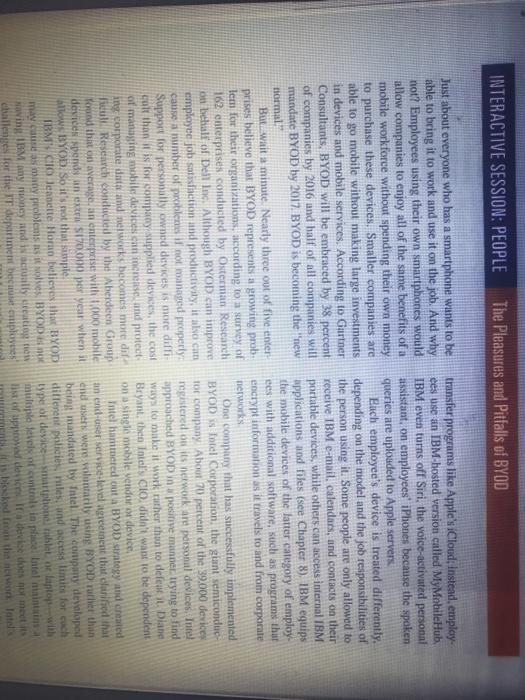
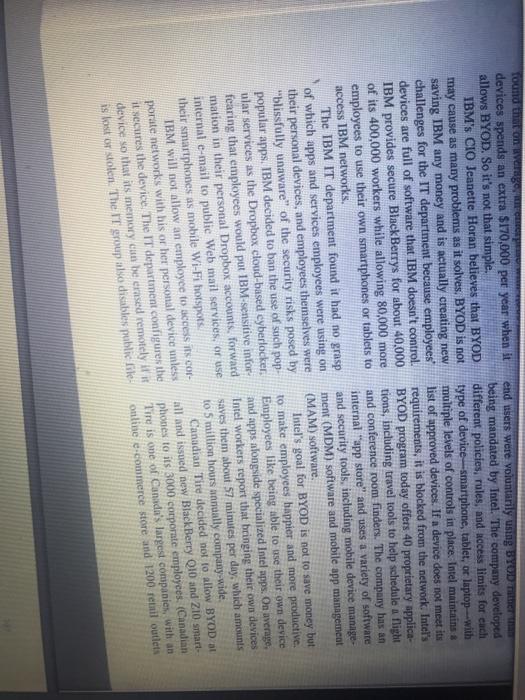
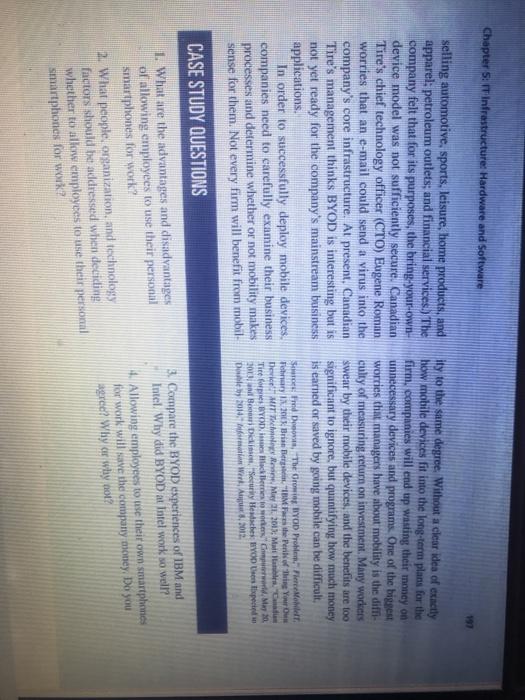
INTERACTIVE SESSION: PEOPLE The Pleasures and Pitfalls of BYOD Just about everyone who has a smartphone wants to be able to bring it to work and use it on the job. And why not? Employees using their own smartphones would allow companies to enjoy all of the same benefits of a mobile workforce without spending their own money to purchase these devices. Smaller companies are able to go mobile without making large investments in devices and mobile services. According to Gartner Consultants, BYOD will be embraced by 38 percent of companies by 2016 and half of all companies will mandate BYOD by 2017 BYOD is becoming the new normal But wait a minute. Nearly three out of five enter prises believe that BYOD represents a growing prob: lem for their organizations, according to a survey of 162 enterprises conducted by Osterman Research on behalf of Dell Inc. Although BYOD can improve employee job satisfaction and productivity, it also can cause a number of problems if not managed properly Support for personally owned devices is more diffi cult than it is for company supplied devices, the cost of managing mobile devices can incretise and protect in corporate it and he wacks becomes more dif Full Research conducted by the Aberdeen Group Yound that on average an enterprise with 1.000 mobile devices and in ES170.000 per year when it W BYOD. So it's not that imple IBM CII Jeanette Horn believes that BYOD may cause any problems is it solves BYOD.no Naving IDM any money and actually creation to challenges for the partment becut cuplytes transfer programs like Apple's iCloud: Instead, emplay- ees use an IBM-hosted version called MyMobileHub IBM even turns off Siri, the voice-activated personal assistant, on employees iPhones because the spoken queries are uploaded to Apple servers Euch employee's device is treated differently, depending on the model and the job responsibilities of the person using it. Some people are only allowed to receive IBM e-mail, calendars, and contacts on their portable devices, while others can access internal IBM applications and tiles (see Chapter 8). IBM equips the mobile devices of the latter category of employ ees with additional software, such as programs that encrypt information as it travels to and from corporate Networks One company that has successfully implemented BYOD otel Corporation, the giant semiconduc 10 company About 70 percent of the 39.000 devices registered on its network are personal devices, Intel approached BYOD V positive manner trying to find ways to make it work rather than to defeat it. Diane Bryant, the Intel's Clo, didn't want to be dependent on a single mobile vendor or device mtel hammered out a BYOD strategy and health an end-user service level gitement that loned that end users were wiluntarily using BYOD u thin being mandated by Intel The company developed dilleet palicis nie und is limits for coch type of device martphone ble or laptop with multiple levels outroli in parte maintains Morprowaddovice reduce does not meetit is blocked from the worlates found that on devices spends an extra $170,000 per year when it allows BYOD. So it's not that simple, IBM's CIO Jeanette Horan believes that BYOD may cause as many problems as it solves. BYOD is not saving IBM any money and is actually creating new challenges for the IT department because employees devices are full of software that IBM doesn't control. IBM provides secure BlackBerrys for about 40,000 of its 400,000 workers while allowing 80,000 more employees to use their own smartphones or tablets to access IBM networks, The IBM IT department found it had no grasp of which apps and services employees were using on their personal devices, and employees themselves were "blissfully unaware of the security risks posed by popular apps. IBM decided to ban the use of such pop ular services as the Dropbox cloud-based cyberlocker. fearing that employees would put IBM-sensitive infor: mation in their personal Dropbox accounts, forward internal e-mail to public Web mail services, or use their smartphones as mobile Wi-Fi hotspots IBM will not allow an employee to access its cor- porate networks with his or her personal device mless it secures the device. The IT department configures the device so that its memory can be erased remotely if it is lost or stolen. The IT group also disables public file end users were voluntarily using BYOD Tither being mandated by Intel. The company developed different policies, rules, and access limits for each type of device smartphone, tablet, or laptop --with multiple levels of controls in place. Intel maintains & list of approved devices. If a device does not meet its requirements, it is blocked from the network. Intel's BYOD program today offers 40 proprietary applica- tions, including travel tools to help schedule a flight and conference room finders. The company has an internal "app store" and uses a variety of software and security fools, including mobile device manage- ment (MDM) software and mobile app management (MAM) software Intel's goal for BYOD is not to save money but to make employees happier and more productive. Employees like being able to use their own device and apps alongside specialized Intel apps. On averago, Intel workers report that bringing their own devices saves them about 57 minutes per day, which amounts to 5 million hours annually company-wide. Canadian Tine decided not to allow BYOD at all and issued new BlackBerry Q10 and Zlo smart- phones to its 3000 corporate employees. (Canadian Tire is one of Canada's largest companies with an online e-commerce store and 1200 retail outlets Chapter S. IT Infrastructure: Hardware and software selling automotive, sports, leisure, home products, and apparel: petroleum outlets; and financial services. The company felt that for its purposes, the bring-your-own- device model was not sufficiently secure, Canadian Tire's chief technology officer (CTO) Eugene Roman worries that an e-mail could send a virus into the company's core infrastructure. At present, Canadian Tire's management thinks BYOD is interesting but is not yet ready for the company's mainstream business applications. In order to successfully deploy mobile devices companies need to carefully examine their business processes and determine whether or not mobility makes sense for them. Not every firm will benefit from mobil ity to the same degree. Without a clear idea of exactly how mobile devices fit into the long-term plans for the firm, companies will end up wasting their money on unnecessary devices and programs. One of the biggest worries that managers have about mobility is the diff- culty of measuring return on investment. Many workers swear by their mobile devices, and the benefits are too significant to ignore, but quantifying how much money is earned or saved by going mobile can be difficult SED, The Crow WYOD Prohls Fler Moler Tony Iris Bergsee the Perks of Thing Your Own Device MITT RM 1 2017: Mw. Tite fore BYOD ackers to world. May 20 2011. Bor Dice Serry Hensches VOD specie Dalby 2014 Werk 2012 CASE STUDY QUESTIONS 1. What are the advantages and disadvantages of allowing employees to use their personal smartphones for work 2. What people, organization, and technology factors should be addressed when deciding whether to allow employees to use their personal smartphones for work? 3. Compare the BYOD experiences of IBM and Intel Why did BYOD at Intel work so well? Allowing employees to use their own smartphones for work will save the company money. Do you gree? Why or why not









 Study Help