Question: Please answer this :) Fact Scenario Aisha has just been hired as Manager of Human Resources for a successful online grocery service. At the job
Please answer this :)
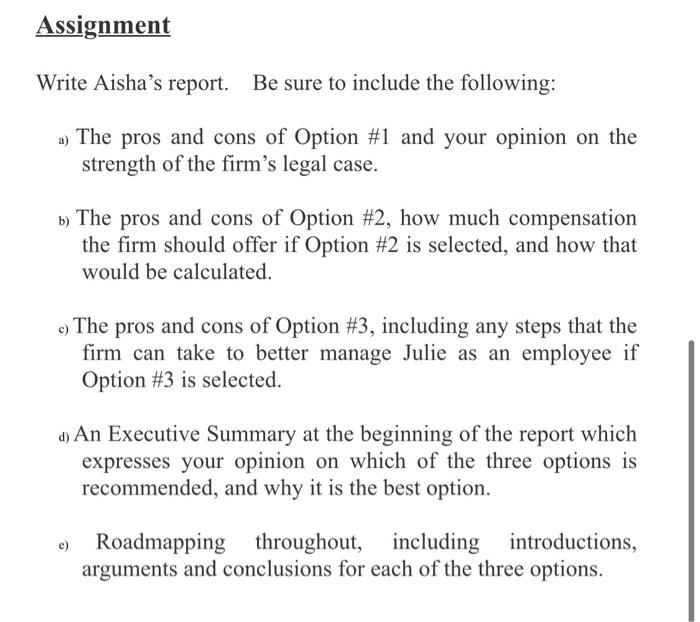
Fact Scenario Aisha has just been hired as Manager of Human Resources for a successful online grocery service. At the job interview, the firm's CEO explains to Aisha that updating the firm's administrative practices will be part of her job. This firm has experienced phenomenal growth since it was created 15 years ago but in many ways it still operates like a couple of individuals working out of a suitcase. The CEO also says that part of the workforce joined a union last year. He is perplexed why considering the firm is a fabulous place to work. He says the initial collective agreement that was negotiated is very brief because neither management nor employees knew what to put in it. However, he's heard the union is bringing in expertise to negotiate a more thorough collective agreement next year and he wants Aisha to lead negotiations on behalf of management. During her first week on the job, Aisha reviews the firm's policies and the collective agreement, which are on an internal webpage. It is a sad and neglected webpage. Some of the materials are not policies at all, they're copies of old invoices, advertisements and emails. Aisha realizes there is no policy on what employee conduct is considered unacceptable. There is a Google Translate" version of a policy on progressive discipline, originally published in Portuguese for a mining company in Brazil. The policy is reproduced word for word in the collective agreement. That Saturday evening, the firm holds its annual Christmas party for all staff. This used to be a small, intimate affair. With the firm's growth they now rent a hotel ballroom for the 200 staff. It is always a blast and the firm pays for all drinks at the bar. Aisha is seated at a table with one of the firm's partners who has flown in from B.C. with his wife. The partner, Jim, shows Aishas photos of his lovely estate on Salt Spring Island. Jim's wife, Clara, is a riot. She keeps the table laughing with amusing stories and anecdotes. Clara is the life of the party. After supper, the guests stand around chatting. Then it happens. A middle-aged woman emerges from the crowd looking visibly intoxicated. She wobbles up to Clara, points at her and says in a loud voice (slurring her words): "You're a fat cow!". The woman staggers off muttering in a loud voice: Moo! Moo! Moo!". Clara is very embarrassed. She has always been self-conscious about her body size. Shortly afterwards, Jim and Clara say their goodbyes and leave the party early. The next morning, Aisha receives a call from her CEO. He is outraged about what happened. He tells Aisha that the intoxicated woman from the night before is an employee named Julie who works in graphic design. The CEO asks Aisha to jump on this matter and report back by end of day on the firm's options. He makes it clear that dismissal of Julie for cause is his preferred outcome but that Aisha is welcome to suggest other options if she can defend them. Aisha pulls Julie's personnel file, which is skimpy. There are income tax forms from her hiring 15 years ago. There are "Annual Performance Review" forms in the file for four random years. Each form is three pages long with spaces for the supervisor to add their evaluation of the employee's performance. The 2013 Annual Performance Review contains the comment: "Beautiful centerpiece!". All the rest of the spaces on Julie's forms are completely blank. At the end of each form there is a statement: Employee in Good Standing" with check boxes to tick "Yes" or "No". "Yes" has been checked on all four forms. There is nothing else in the personnel file. Aisha interviews Julie's supervisor, Rita, Vice-President for Western Canada. Rita describes Julie as a talented graphic artist. She has done great work for the firm but also has problems. Julie is usually half an hour late arriving at work in the morning and sometimes shows up looking rough. She sometimes returns late after lunch and Rita thinks she has smelled alcohol on her breath on some of these occasions. Aisha asks for documentation of these incidents. Rita explains that she has always tried to bite her tongue and not criticize Julie, because Julie responds better to positive reinforcement, so there is no documentation as such. She explains that she and Julie used to be quite close at one time, but life has not gone well for Julie and Rita feels sorry for her. Rita thinks Julie may have an alcohol problem. Julie once emailed her: "You know my problem". When Aisha asks whether Julie has ever had treatment, Rita explains that she avoids discussing the drinking issue with Julie to avoid meddling. However, Rita agrees that Julie's behaviour at the Christmas party was the last straw and now she has to go. Aisha sits down to speak with Julie. Julie's union representative also attends the meeting. Julie says she is truly sorry for what happened. She says she has never met Clara before and this was a case of having "one too many at the party. After a while, Julie starts to open up and speak freely. She expresses frustration at her treatment by the firm. She has been stuck in the same position her whole career while others advance. She has not received a wage increase in over 10 years (her union representative pipes up at this point to say: "None of us. None of us.). She thinks she does not get adequate recognition for her artistic efforts that have really helped the company, and she claims to have designed the firm's logo which is a key marketing vehicle. Julie says early in her career she was up for partnership" but this was denied "because of some lawyer" (Aisha finds this statement to be rather far-fetched). Aisha comes to the conclusion that Julie is a deeply bitter employee and the firm is going to have ongoing challenges managing her. Aisha then quickly throws together a report for her CEO and walks it over to his office just prior to the close of the day. The report outlines three options for the firm to consider: 1. Dismiss Julie for Cause. 2. Negotiate a Buy-Out. 3. Continued Employment. Assignment Write Aisha's report. Be sure to include the following: a) The pros and cons of Option #1 and your opinion on the strength of the firm's legal case. b) The pros and cons of Option #2, how much compensation the firm should offer if Option #2 is selected, and how that would be calculated. c) The pros and cons of Option #3, including any steps that the firm can take to better manage Julie as an employee if Option #3 is selected. d) An Executive Summary at the beginning of the report which expresses your opinion on which of the three options is recommended, and why it is the best option. e) Roadmapping throughout, including introductions, arguments and conclusions for each of the three options









 Study Help