







Question: please answer this question in a short way so that i can memorize tgem quickly..Thank you very much. QUESTION 2 (a) What is the Android
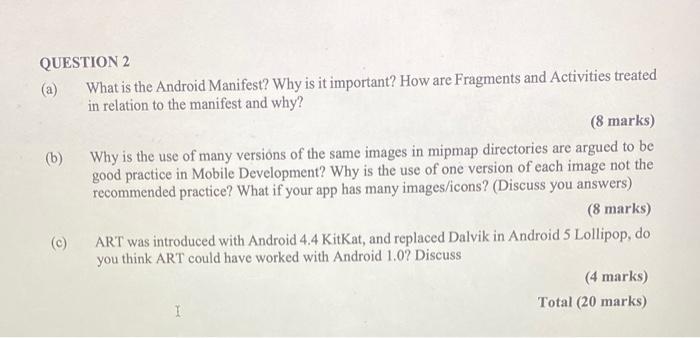
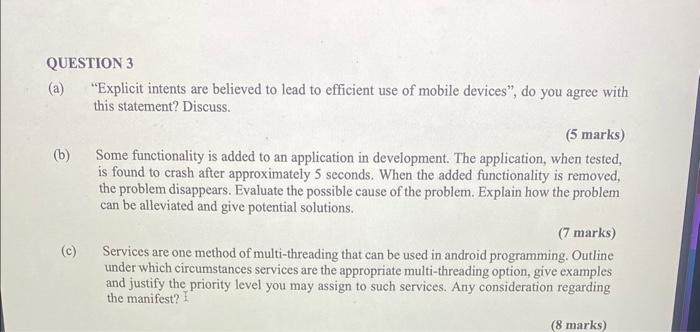
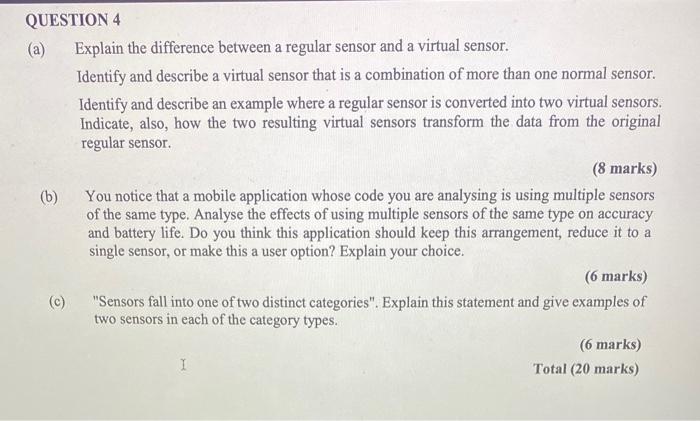
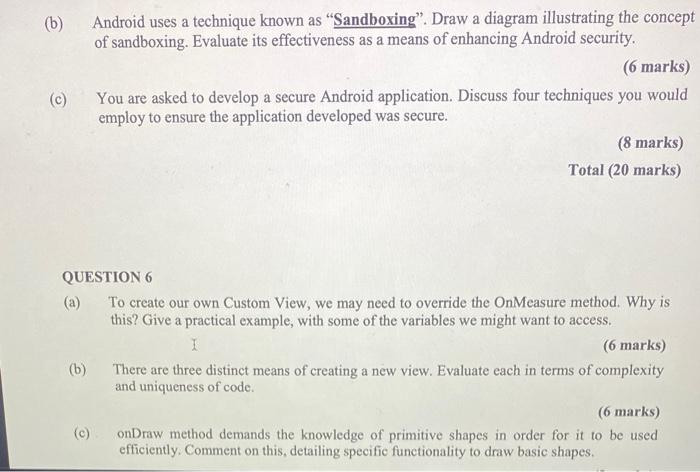

QUESTION 2 (a) What is the Android Manifest? Why is it important? How are Fragments and Activities treated in relation to the manifest and why? (8 marks) (b) Why is the use of many versions of the same images in mipmap directories are argued to be good practice in Mobile Development? Why is the use of one version of each image not the recommended practice? What if your app has many images/icons? (Discuss you answers) ( 8 marks) (c) ART was introduced with Android 4.4KitK at, and replaced Dalvik in Android 5 Lollipop, do you think ART could have worked with Android 1.0? Discuss (4marks)Total(20marks) QUESTION 3 (a) "Explicit intents are believed to lead to efficient use of mobile devices", do you agree with this statement? Discuss. (5 marks) (b) Some functionality is added to an application in development. The application, when tested, is found to crash after approximately 5 seconds. When the added functionality is removed, the problem disappears. Evaluate the possible cause of the problem. Explain how the problem can be alleviated and give potential solutions. (7 marks) (c) Services are one method of multi-threading that can be used in android programming. Outline under which circumstances services are the appropriate multi-threading option, give examples and justify the priority level you may assign to such services. Any consideration regarding the manifest? I QUESTION 4 (a) Explain the difference between a regular sensor and a virtual sensor. Identify and describe a virtual sensor that is a combination of more than one normal sensor. Identify and describe an example where a regular sensor is converted into two virtual sensors. Indicate, also, how the two resulting virtual sensors transform the data from the original regular sensor. (8 marks) (b) You notice that a mobile application whose code you are analysing is using multiple sensors of the same type. Analyse the effects of using multiple sensors of the same type on accuracy and battery life. Do you think this application should keep this arrangement, reduce it to a single sensor, or make this a user option? Explain your choice. (6 marks) (c) "Sensors fall into one of two distinct categories". Explain this statement and give examples of two sensors in each of the category types. (6 marks) Total (20 marks) (b) Android uses a technique known as "Sandboxing". Draw a diagram illustrating the concept of sandboxing. Evaluate its effectiveness as a means of enhancing Android security. (6 marks) (c) You are asked to develop a secure Android application. Discuss four techniques you would employ to ensure the application developed was secure. (8marks)Total(20marks) QUESTION 6 (a) To create our own Custom View, we may need to override the OnMeasure method. Why is this? Give a practical example, with some of the variables we might want to access. (6 marks) (b) There are three distinct means of creating a new view. Evaluate each in terms of complexity and uniqueness of code. (6 marks) (c) onDraw method demands the knowledge of primitive shapes in order for it to be used efficiently. Comment on this, detailing specific functionality to draw basic shapes. QUESTION 5 (a) State the two different storage areas on an Android Device. In your answer discuss how they relate to the security of the device
Step by Step Solution
There are 3 Steps involved in it

Get step-by-step solutions from verified subject matter experts
 Study Help