







Question: Please answer this question, thank you. 5. The utility function most commonly employed to represent people's time preferences is given by: U = u; +
Please answer this question, thank you.
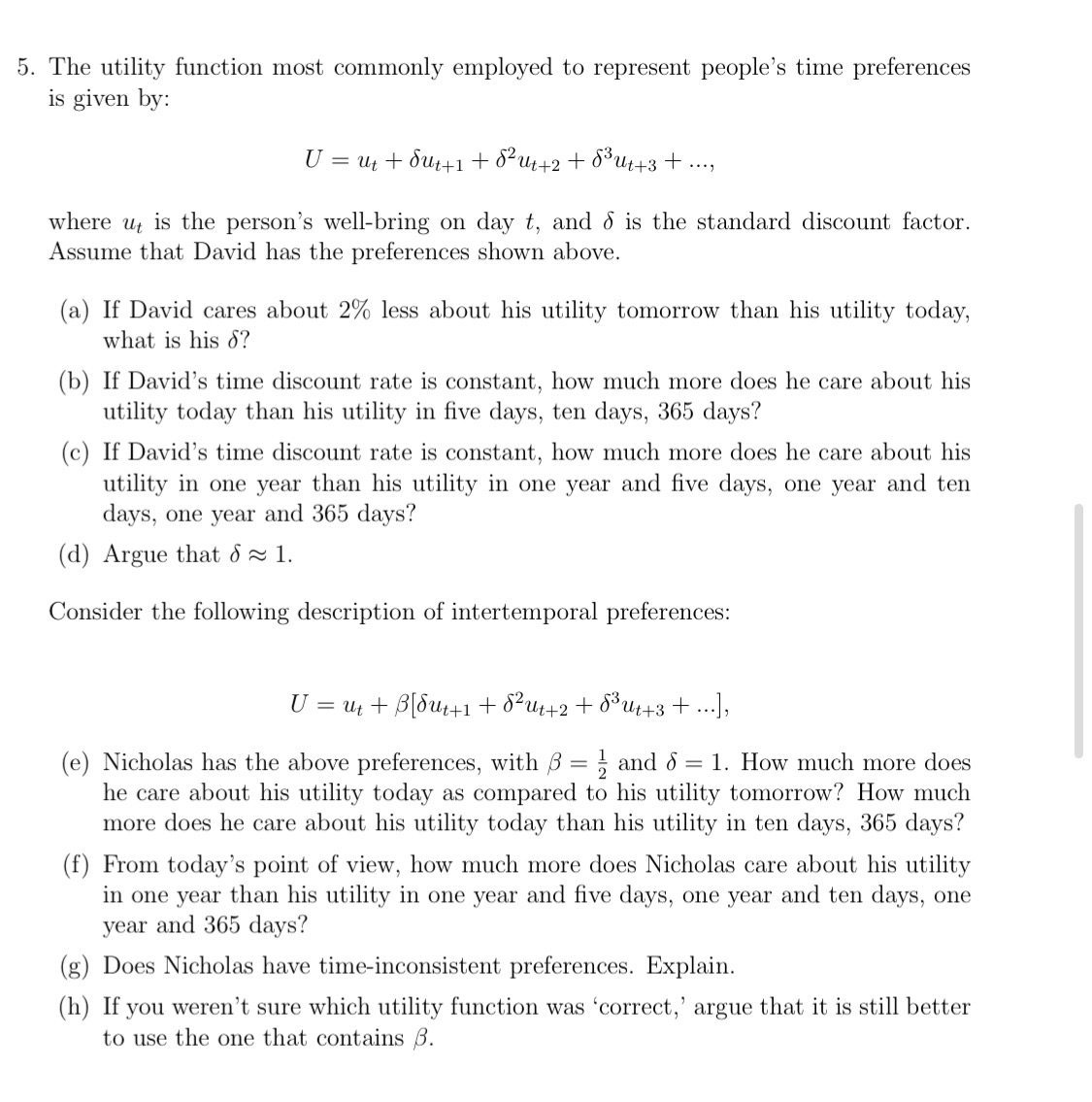
5. The utility function most commonly employed to represent people's time preferences is given by: U = u; + 6m+1+ 621.51% + 631.3,\" + ..., where a, is the person's well-bring on day t, and 5 is the standard discount factor. Assume that David has the preferences shown above. (a) If David cares about 2% less about his utility tomorrow than his utility today, what is his 6? (b) If David's time discount rate is constant, how much more does he care about his utility today than his utility in ve days, ten days, 365 days? (c) If David's time discount rate is constant, how much more does he care about his utility in one year than his utility in one year and ve days, one year and ten days, one year and 365 days? ((1) Argue that 6 s: 1. Consider the following description of intertemporal preferences: U = 1L; + [6ut+1 'i 62Ug+2 + 631L343 + m], (e) Nicholas has the above preferences, with 5 = % and 6 = 1. How much more does he care about his utility today as compared to his utility tomorrow? How much more does he care about his utility today than his utility in ten days, 365 days? (f) From today's point of view, how much more does Nicholas care about his utility in one year than his utility in one year and ve days, one year and ten days, one year and 365 days? (g) Does Nicholas have timeinconsistent preferences. Explain. (h) If you weren't sure which utility function was 'correct,' argue that it is still better to use the one that contains 5
Step by Step Solution
There are 3 Steps involved in it

Get step-by-step solutions from verified subject matter experts
 Study Help