







Question: please answer with solutions thank you so much. reference link: https://sg.docs.wps.com/l/sIDTNstgyz_OikAY please follow the solutions in the said module. please read the module. thank you.
please answer with solutions thank you so much.
reference link: https://sg.docs.wps.com/l/sIDTNstgyz_OikAY
please follow the solutions in the said module. please read the module. thank you. i will give a high rate
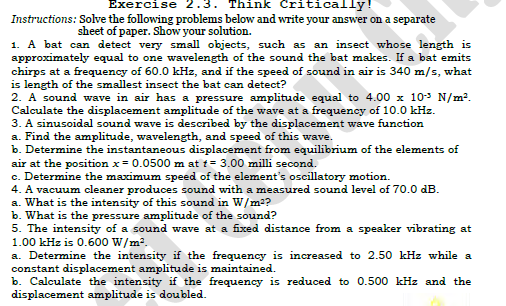
Exercise 2 .3. Think Critically! Instructions: Solve the following problems below and write your answer on a separate sheet of paper. Show your solution. 1. A bat can detect very small objects, such as an insect whose length is approximately equal to one wavelength of the sound the bat makes. If a bat emits chirps at a frequency of 60.0 kHz, and if the speed of sound in air is 340 m/s, what is length of the smallest insect the bat can detect? 2. A sound wave in air has a pressure amplitude equal to 4.00 x 10³ N/m. Calculate the displacement amplitude of the wave at a frequency of 10.0 kHz. 3. A sinusoidal sound wave is described by the displacement wave function a. Find the amplitude, wavelength, and speed of this wave. b. Determine the instantaneous displacement from equilibrium of the elements of air at the position x = 0.0500 m at t = 3.00 milli second. c. Determine the maximum speed of the element's oscillatory motion. 4. A vacuum cleaner produces sound with a measured sound level of 70.0 dB. a. What is the intensity of this sound in W/m=? b. What is the pressure amplitude of the sound? 5. The intensity of a sound wave at a fixed distance from a speaker vibrating at 1.00 kHz is 0.600 W/m= a. Determine the intensity if the frequency is increased to 2.50 kHz while a constant displacement amplitude is maintained. b. Calculate the intensity if the frequency is reduced to 0.500 kiz and the displacement amplitude is doubled
Step by Step Solution
There are 3 Steps involved in it

Get step-by-step solutions from verified subject matter experts
 Study Help