







Question: Please anwer the complete paper (1 and 2 question) Attached is also the reading for the question. (PLEASE COMPLETE THE PAPER AND NOT JUST ONE
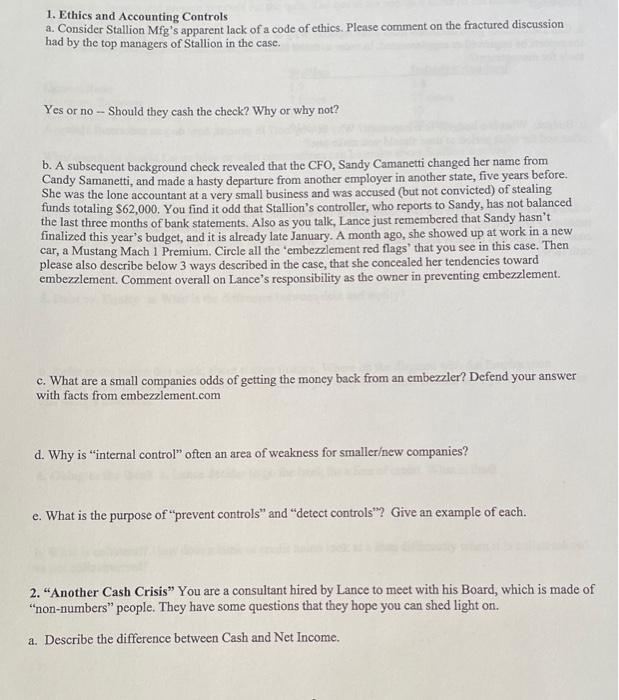
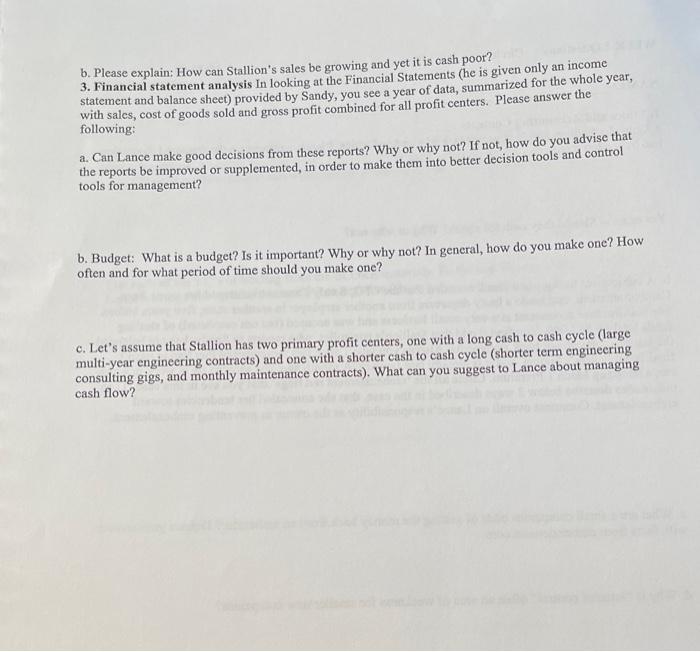
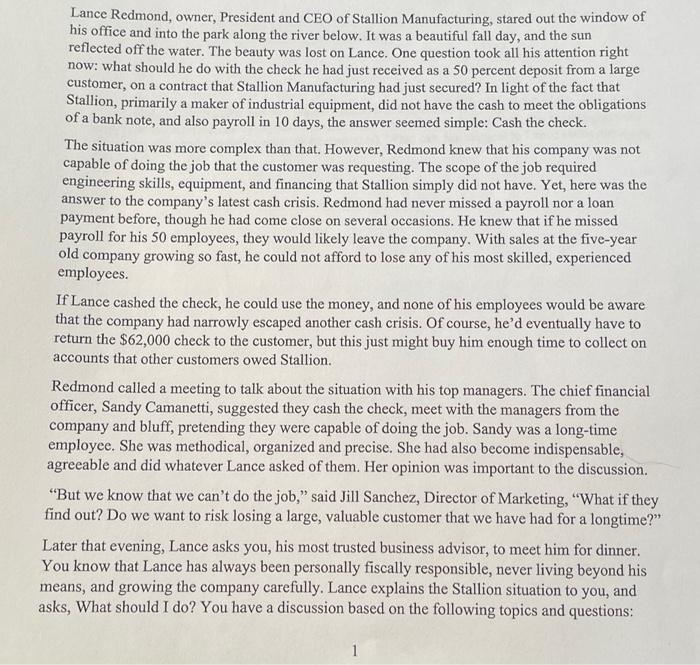
1. Ethics and Accounting Controls a. Consider Stallion Mfg's apparent lack of a code of ethics. Please comment on the fractured discussion had by the top managers of Stallion in the case. Yes or no - Should they cash the check? Why or why not? b. A subsequent background check revealed that the CFO, Sandy Camanetti changed her name from Candy Samanetti, and made a hasty departure from another employer in another state, five years before. She was the lone accountant at a very small business and was accused (but not convicted) of stealing funds totaling $62,000. You find it odd that Stallion's controller, who reports to Sandy, has not balanced the last three months of bank statements. Also as you talk, Lance just remembered that Sandy hasn't finalized this year's budget, and it is already late January. A month ago, she showed up at work in a new car, a Mustang Mach 1 Premium, Circle all the embezzlement red flags that you see in this case. Then please also describe below 3 ways described in the case, that she concealed her tendencies toward embezzlement. Comment overall on Lance's responsibility as the owner in preventing embezzlement. c. What are a small companies odds of getting the money back from an embezzler? Defend your answer with facts from embezzlement.com d. Why is "internal control often an area of weakness for smallerew companies? e. What is the purpose of "prevent controls" and "detect controls"? Give an example of each. 2. "Another Cash Crisis" You are a consultant hired by Lance to meet with his Board, which is made of "non-numbers" people. They have some questions that they hope you can shed light on, a. Describe the difference between Cash and Net Income. b. Please explain: How can Stallion's sales be growing and yet it is cash poor? 3. Financial statement analysis In looking at the Financial Statements (he is given only an income statement and balance sheet) provided by Sandy, you see a year of data, summarized for the whole year, with sales, cost of goods sold and gross profit combined for all profit centers. Please answer the following: a. Can Lance make good decisions from these reports? Why or why not? If not, how do you advise that the reports be improved or supplemented in order to make them into better decision tools and control tools for management? b. Budget: What is a budget? Is it important? Why or why not? In general, how do you make one? How often and for what period of time should you make one? c. Let's assume that Stallion has two primary profit centers, one with a long cash to cash cycle (large multi-year engineering contracts) and one with a shorter cash to cash cycle (shorter term engineering consulting gigs, and monthly maintenance contracts). What can you suggest to Lance about managing cash flow? Lance Redmond, owner, President and CEO of Stallion Manufacturing, stared out the window of his office and into the park along the river below. It was a beautiful fall day, and the sun reflected off the water. The beauty was lost on Lance. One question took all his attention right now: what should he do with the check he had just received as a 50 percent deposit from a large customer, on a contract that Stallion Manufacturing had just secured? In light of the fact that Stallion, primarily a maker of industrial equipment, did not have the cash to meet the obligations of a bank note, and also payroll in 10 days, the answer seemed simple: Cash the check. The situation was more complex than that. However, Redmond knew that his company was not capable of doing the job that the customer was requesting. The scope of the job required engineering skills, equipment, and financing that Stallion simply did not have. Yet, here was the answer to the company's latest cash crisis. Redmond had never missed a payroll nor a loan payment before, though he had come close on several occasions. He knew that if he missed payroll for his 50 employees, they would likely leave the company. With sales at the five-year old company growing so fast, he could not afford to lose any of his most skilled, experienced employees. If Lance cashed the check, he could use the money, and none of his employees would be aware that the company had narrowly escaped another cash crisis. Of course, he'd eventually have to return the $62,000 check to the customer, but this just might buy him enough time to collect on accounts that other customers owed Stallion. Redmond called a meeting to talk about the situation with his top managers. The chief financial officer, Sandy Camanetti, suggested they cash the check, meet with the managers from the company and bluff, pretending they were capable of doing the job. Sandy was a long-time employee. She was methodical, organized and precise. She had also become indispensable, agreeable and did whatever Lance asked of them. Her opinion was important to the discussion. "But we know that we can't do the job," said Jill Sanchez, Director of Marketing, "What if they find out? Do we want to risk losing a large, valuable customer that we have had for a longtime?" Later that evening, Lance asks you, his most trusted business advisor, to meet him for dinner. You know that Lance has always been personally fiscally responsible, never living beyond his means, and growing the company carefully. Lance explains the Stallion situation to you, and asks, What should I do? You have a discussion based on the following topics and questions: 1. Ethics and Accounting Controls a. Consider Stallion Mfg's apparent lack of a code of ethics. Please comment on the fractured discussion had by the top managers of Stallion in the case. Yes or no - Should they cash the check? Why or why not? b. A subsequent background check revealed that the CFO, Sandy Camanetti changed her name from Candy Samanetti, and made a hasty departure from another employer in another state, five years before. She was the lone accountant at a very small business and was accused (but not convicted) of stealing funds totaling $62,000. You find it odd that Stallion's controller, who reports to Sandy, has not balanced the last three months of bank statements. Also as you talk, Lance just remembered that Sandy hasn't finalized this year's budget, and it is already late January. A month ago, she showed up at work in a new car, a Mustang Mach 1 Premium, Circle all the embezzlement red flags that you see in this case. Then please also describe below 3 ways described in the case, that she concealed her tendencies toward embezzlement. Comment overall on Lance's responsibility as the owner in preventing embezzlement. c. What are a small companies odds of getting the money back from an embezzler? Defend your answer with facts from embezzlement.com d. Why is "internal control often an area of weakness for smallerew companies? e. What is the purpose of "prevent controls" and "detect controls"? Give an example of each. 2. "Another Cash Crisis" You are a consultant hired by Lance to meet with his Board, which is made of "non-numbers" people. They have some questions that they hope you can shed light on, a. Describe the difference between Cash and Net Income. b. Please explain: How can Stallion's sales be growing and yet it is cash poor? 3. Financial statement analysis In looking at the Financial Statements (he is given only an income statement and balance sheet) provided by Sandy, you see a year of data, summarized for the whole year, with sales, cost of goods sold and gross profit combined for all profit centers. Please answer the following: a. Can Lance make good decisions from these reports? Why or why not? If not, how do you advise that the reports be improved or supplemented in order to make them into better decision tools and control tools for management? b. Budget: What is a budget? Is it important? Why or why not? In general, how do you make one? How often and for what period of time should you make one? c. Let's assume that Stallion has two primary profit centers, one with a long cash to cash cycle (large multi-year engineering contracts) and one with a shorter cash to cash cycle (shorter term engineering consulting gigs, and monthly maintenance contracts). What can you suggest to Lance about managing cash flow? Lance Redmond, owner, President and CEO of Stallion Manufacturing, stared out the window of his office and into the park along the river below. It was a beautiful fall day, and the sun reflected off the water. The beauty was lost on Lance. One question took all his attention right now: what should he do with the check he had just received as a 50 percent deposit from a large customer, on a contract that Stallion Manufacturing had just secured? In light of the fact that Stallion, primarily a maker of industrial equipment, did not have the cash to meet the obligations of a bank note, and also payroll in 10 days, the answer seemed simple: Cash the check. The situation was more complex than that. However, Redmond knew that his company was not capable of doing the job that the customer was requesting. The scope of the job required engineering skills, equipment, and financing that Stallion simply did not have. Yet, here was the answer to the company's latest cash crisis. Redmond had never missed a payroll nor a loan payment before, though he had come close on several occasions. He knew that if he missed payroll for his 50 employees, they would likely leave the company. With sales at the five-year old company growing so fast, he could not afford to lose any of his most skilled, experienced employees. If Lance cashed the check, he could use the money, and none of his employees would be aware that the company had narrowly escaped another cash crisis. Of course, he'd eventually have to return the $62,000 check to the customer, but this just might buy him enough time to collect on accounts that other customers owed Stallion. Redmond called a meeting to talk about the situation with his top managers. The chief financial officer, Sandy Camanetti, suggested they cash the check, meet with the managers from the company and bluff, pretending they were capable of doing the job. Sandy was a long-time employee. She was methodical, organized and precise. She had also become indispensable, agreeable and did whatever Lance asked of them. Her opinion was important to the discussion. "But we know that we can't do the job," said Jill Sanchez, Director of Marketing, "What if they find out? Do we want to risk losing a large, valuable customer that we have had for a longtime?" Later that evening, Lance asks you, his most trusted business advisor, to meet him for dinner. You know that Lance has always been personally fiscally responsible, never living beyond his means, and growing the company carefully. Lance explains the Stallion situation to you, and asks, What should I do? You have a discussion based on the following topics and questions
Step by Step Solution
There are 3 Steps involved in it

Get step-by-step solutions from verified subject matter experts
 Study Help