







Question: Please ASAP and start from e Problem 5 Here, we will be deriving mof's of some of our brand name r.v.'s and using them to
Please ASAP and start from e
![to prove cool things about distribution theory. (a) [harder] Using the definition](https://s3.amazonaws.com/si.experts.images/answers/2024/07/668800550a6ac_01266880054dd039.jpg)
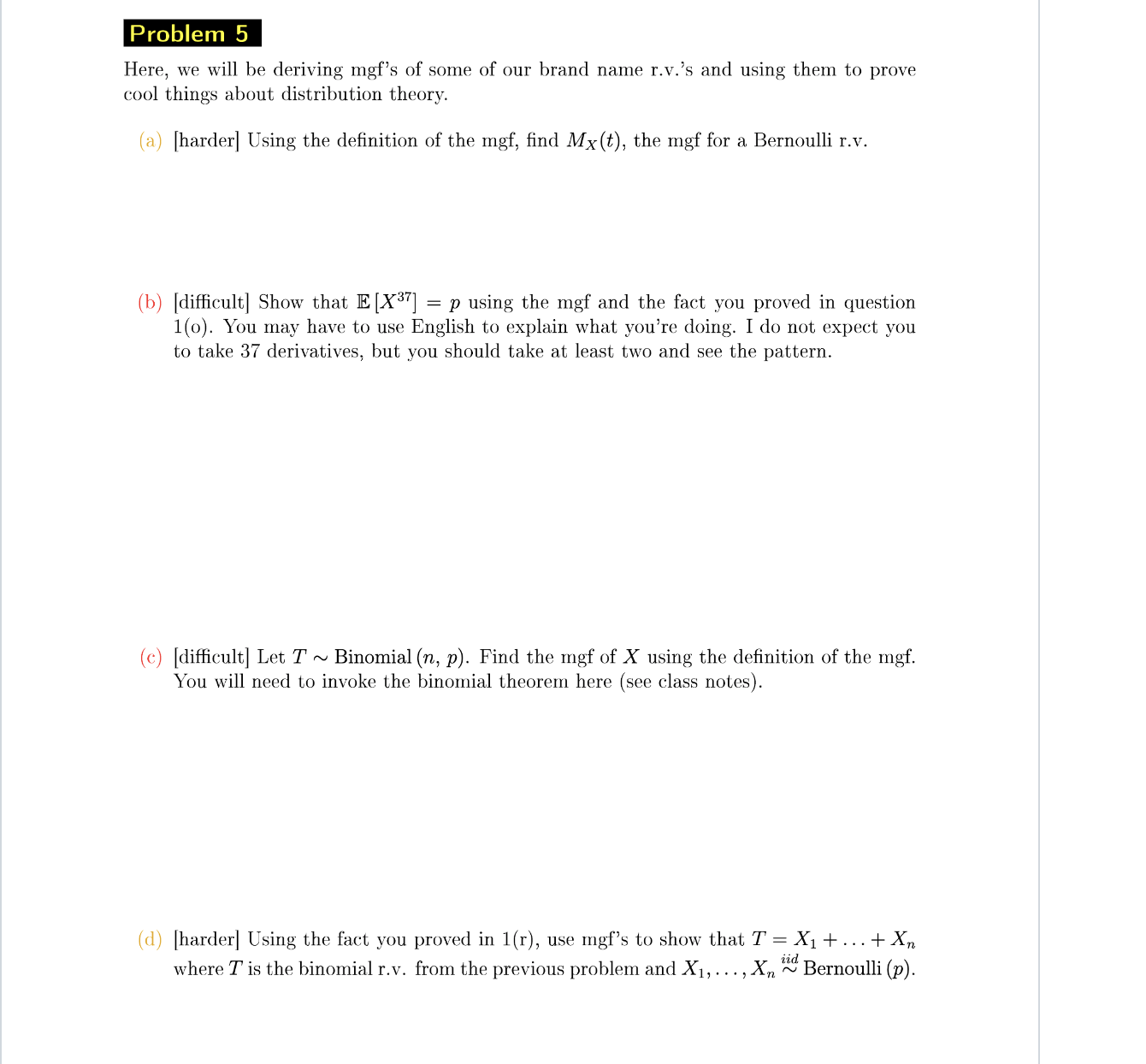
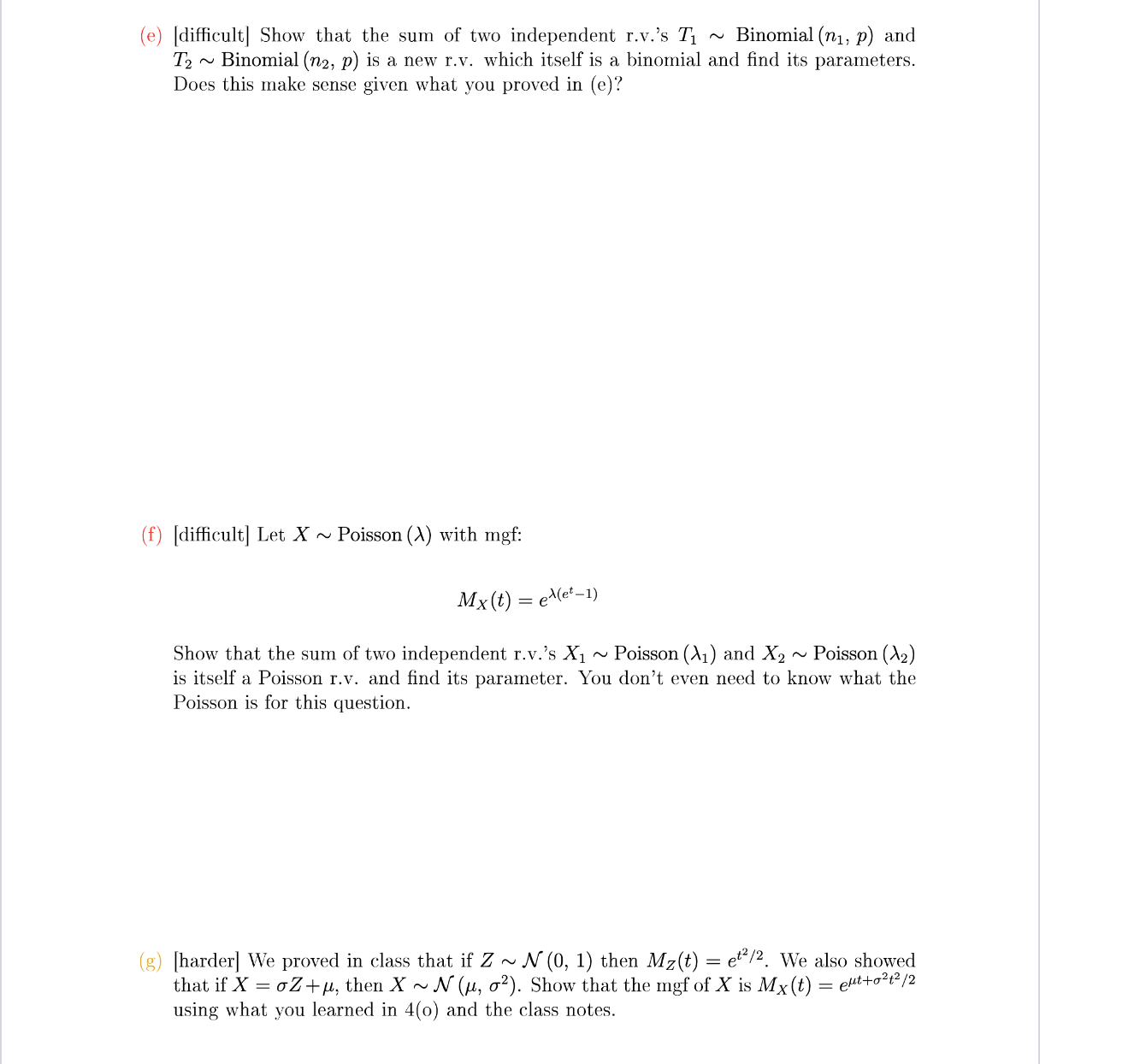
Problem 5 Here, we will be deriving mof's of some of our brand name r.v.'s and using them to prove cool things about distribution theory. (a) [harder] Using the definition of the mgf, find Mx(t), the mof for a Bernoulli r.v. (b) [difficult] Show that E [X37] = p using the mof and the fact you proved in question 1(o). You may have to use English to explain what you're doing. I do not expect you to take 37 derivatives, but you should take at least two and see the pattern. (c) [difficult] Let T ~ Binomial (n, p). Find the mof of X using the definition of the mgf. You will need to invoke the binomial theorem here (see class notes). (d) [harder] Using the fact you proved in 1(r), use mof's to show that T = Xi + ... + Xn where T is the binomial r.v. from the previous problem and X1, . . ., Xn ~Bernoulli (p).(e) [difficult] Show that the sum of two independent r.v.'s T1 ~ Binomial (n1, p) and T2 ~ Binomial (n2, p) is a new r.v. which itself is a binomial and find its parameters. Does this make sense given what you proved in (e)? (f) [difficult] Let X ~ Poisson (A) with mgf: Mx(t) = ex(et-1) Show that the sum of two independent r.v.'s X1 ~ Poisson (1) and X2 ~ Poisson (12) is itself a Poisson r.v. and find its parameter. You don't even need to know what the Poisson is for this question. (g) [harder] We proved in class that if Z ~ N (0, 1) then Mz(t) = et /2. We also showed that if X = oZ +u, then X ~ N (u, 62). Show that the mof of X is Mx(t) = eutto212/2 using what you learned in 4(o) and the class notes.(h) [difficult] Let X1, X2, ..., Xn be a sequence of independent normal random variables where X1 has mean u and variance of and X2 has mean /2 and variance o?, etc. Show that X1 + X2 + ... + Xn is normally distributed and find its parameters. (i) [E.C.] Let X ~ Exp (1) with mgf: Mx(t) = Demonstrate that the sum of X1, . .., Xn ~ Exp ()) is an Erlang r.v. with parameters n and A, the continuous analogue of the Negative Binomial r.v. (You will need to look up the mgf of the Erlang distribution). Do on a separate piece of paper. (j) [E.C.] The standard Cauchy distribution has center 0 and scale parameter 1 and its PDF is: f (20) = = TT (1 + 202 ) The Cauchy distribution is a classic example of a pathological r.v. You'll see why. The standard Cauchy r.v. is actually the ratio of two independent standard normal r.v.'s: if X ~ N (0, 1) and Y ~ N (0, 1) then X/Y has the PDF above. Prove that the mgf for a standard Cauchy r.v. does not exist. This is really not hard but it looks menacing. Do on a separate piece of paper
Step by Step Solution
There are 3 Steps involved in it

Get step-by-step solutions from verified subject matter experts
 Study Help